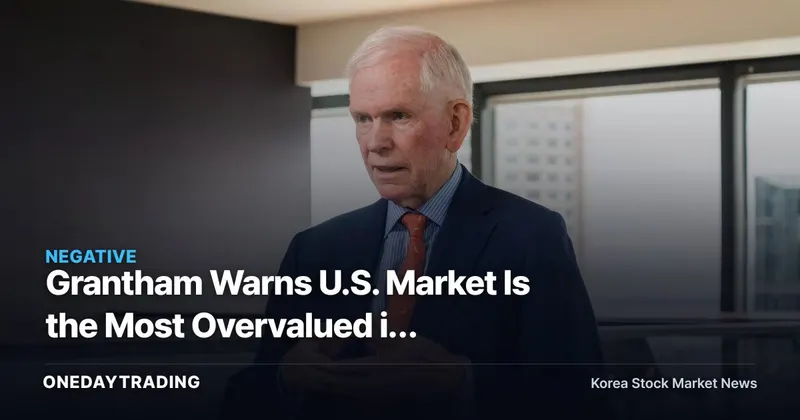

The core of this warning is not a negative catalyst for any single stock (ticker), but a diagnosis that the overall price tag of the U.S. equity market far exceeds its historical average. Jeremy Grantham — widely regarded as a titan of value investing — has assessed that AI-driven optimism has pushed valuations to the highest level in American history. For Korean investors, this should be read as a signal to review not only direct holdings in U.S. big tech, but also the volatility of large-cap KOSPI semiconductor stocks that move in lockstep with the Nasdaq and S&P 500. Elevated valuations alone do not guarantee a decline, but the practical implication of this statement is clear: when expectations are not validated by earnings, the magnitude of any correction grows significantly.
3-Line Briefing
- Grantham has characterized the U.S. market as the most expensive in American history, pointing to AI-driven valuation surge (sharp gain) as the primary cause.
- The key issue is not a single negative catalyst, but broad market overvaluation and a structure heavily concentrated in a handful of AI-related stocks (tickers).
- For Korean investors, this warrants a simultaneous review of direct U.S. big tech exposure and the co-movement risk of KOSPI semiconductor stocks.
What Changes
The significance of Grantham's argument lies not in the emergence of a new negative catalyst, but in his direct challenge to the pricing burden built into the AI growth narrative that has justified the rally thus far. If the force driving market valuations higher is concentrated not in broad earnings strength but in the share price surge (sharp gain) of a small number of AI-related stocks (tickers), then the concentration risk lurking behind the index's headline strength becomes considerably more acute.
This perspective matters because, in a phase of elevated valuations, stock prices already price in future profits in advance. When the same earnings slowdown or interest rate variable materializes, markets with higher valuations tend to see steeper declines than those with lower valuations. Ultimately, the critical question is the pace at which AI investment translates into actual revenue and profits — and if the gap between expectations and earnings fails to narrow, revaluation pressure will continue to build.
By the Numbers and Context
Grantham, who heads GMO and has warned of market bubbles in the past, has once again framed the U.S. market not in terms of absolute timing, but through the lens of historical comparison — describing it as the most expensive in American history. However, the original remarks lean more toward a qualitative diagnosis that AI expectations have inflated prices, rather than citing specific valuation multiples or target figures. Accordingly, it is more prudent for investors to verify the data themselves — checking where valuation metrics such as the price-to-earnings ratio stand relative to long-term averages, and whether AI capital expenditure is actually converting into earnings — rather than acting on the statement alone.
Stocks (Tickers) to Watch — Winners and Losers
- Nvidia: At the center of the AI valuation debate, this is the stock (ticker) most likely to exhibit the greatest volatility if overvaluation concerns intensify. Conversely, if data center demand continues to be validated through earnings, it becomes the key variable that could put the debate to rest.
- Microsoft, Alphabet, and other big tech names: Given their heavy AI investment exposure, the speed at which capital expenditure is recovered will be the watershed for share price revaluation.
- Samsung Electronics (005930) and SK Hynix: Tied to upstream AI memory demand — including high-bandwidth memory — their earnings are directly linked to the U.S. AI investment cycle, and they also carry the risk of co-movement declines in the event of a U.S. market correction.
- Korean semiconductor materials and equipment stocks (tickers): These names carry a dual-sided exposure — standing to benefit from the trickle-down effect of AI capital expenditure, while facing downside risk if AI investment slows.
Risk Check
- A valuation warning does not pinpoint the timing of a decline; the bull market could extend longer than expected.
- If the pace at which AI capital expenditure converts into revenue falls short of expectations, revaluation pressure will intensify.
- Shifts in the interest rate and liquidity environment could translate into greater volatility for high-valuation growth stocks (tickers).
- If the concentration in a small number of stocks (tickers) unwinds, individual names could fall more sharply than the broader index.
Bottom Line
It is clear that valuation pressure has accumulated to a significant degree, but that alone is insufficient to call it an outright sell signal. A balanced approach is warranted — one that monitors the conversion of AI capital expenditure into earnings and tracks interest rate trends through quarterly results and key indicators, while actively managing concentration risk.
This content was automatically summarized and analyzed based on the original news source. View Original Article (CNBC)