
Bank of Korea’s Won Valuation and Exchange Rate Outlook
The won’s nominal effective exchange rate of 94.83 does not mark the completion of its recovery, but the start of a debate over the lower bound for the USD/KRW exchange rate. A market assessment reported by Asia Economy Securities on 2026-10-26 pointed to both room for further declines and downside resistance following the sharp drop (plunge). Investors now need to distinguish between how much the won has recovered and how far that recovery can continue.
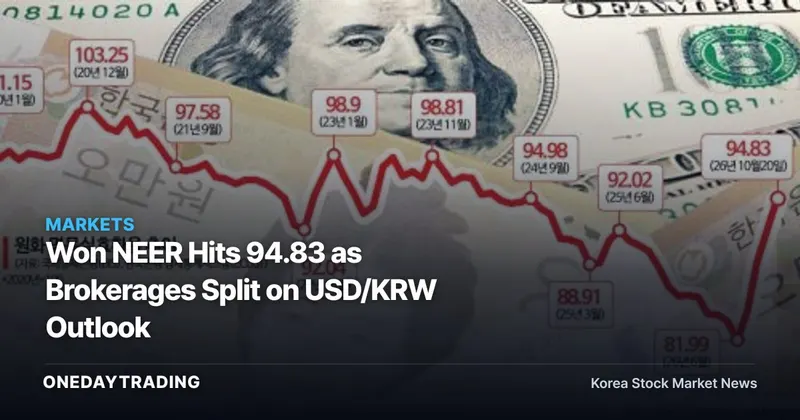
- According to statistics associated with the Bank for International Settlements (BIS) and the Bank of Korea, the won’s nominal effective exchange rate stood at 94.83 as of Oct. 20, its highest level since the 94.91 recorded on Oct. 9, 2024.
- Hyun Song Shin assessed that the won remains undervalued and is still historically weak.
- While acknowledging room for a further decline in the USD/KRW exchange rate, the market also cited downside resistance around 1,270–1,280 won and the possibility of a rebound toward 1,380–1,390 won.
94.83 Does Not Mark the End of the Won’s Recovery
In this article, the nominal effective exchange rate serves as a benchmark for gauging the won’s current value. The won’s nominal effective exchange rate climbed from 81.99 in June to 91.99 in September before reaching 94.83 on Oct. 20. On the surface, this represents a rapid recovery, but the interpretation changes when compared with the long-term average.
Hyun Song Shin noted that the won’s BIS effective exchange rate stood at about 89 as of the end of August, below its long-term average of 101, saying, “Whether viewed through the USD/KRW exchange rate or the effective exchange rate, it is true that the won remains weaker than in previous years.” His assessment is therefore that the won’s recent rebound alone does not establish that its undervaluation has been fully corrected.
Monthly Average USD/KRW Exchange Rate Signals a Reversal
The monthly average USD/KRW exchange rate declined from 1,528.0 won in June to 1,488.9 won in July, 1,404.4 won in August and 1,358.8 won in September. Over the same period, the won’s nominal effective exchange rate rose from 81.99 in June to 91.99 in September. Together, the two indicators show that the won has rebounded significantly from its low level in June.
The won’s real effective exchange rate, which reflects inflation differentials, also rose from 83.03 in June to 92.73 last month. The latest figure was the highest since the 93.43 recorded in November 2024. The fact that the recovery is evident in the real measure, rather than only the nominal indicator, forms the starting point of the current exchange rate debate.
Eugene Investment & Securities Sees Scope for 1,230–1,250 Won
One estimate suggests that the monthly average USD/KRW exchange rate would need to reach 1,230–1,250 won for the won’s nominal effective exchange rate to approach its long-term average. This is a market estimate based on current conditions, not a level that has actually been reached. Continued won strength would reinforce the case for a move toward this range, but whether the exchange rate will reach it remains uncertain.
Cha Young-hoo, a researcher at Eugene Investment & Securities, estimated that foreign-currency inflows from semiconductor shareholder returns and investments related to megaprojects would total $210 billion annually. This would exceed the annualized $130 billion in net outflows from portfolio and direct investment based on the trend over the past three years. Cha’s scenario is based on the expectation that the impact of domestic capital inflows will outweigh pressure from renewed foreign-currency outflows.
Korea Investment & Securities Flags Downside Resistance at 1,270–1,280 Won
The market is not uniformly positioned in one direction. Moon Da-woon, a researcher at Korea Investment & Securities, said, “We expect downside resistance to strengthen around 1,270–1,280 won.” Given the exchange rate’s recent rapid decline, her assessment is that any further fall could lose momentum within that range.
Upside risks also remain. Moon said caution surrounding the U.S. midterm elections, geopolitical risks and uncertainty over the U.S. Federal Reserve’s monetary policy could allow the USD/KRW exchange rate to rebound toward 1,380–1,390 won, levels reached after the U.S. Federal Open Market Committee (FOMC) meeting in September. This is the alternative path investors could easily overlook if they focus only on the lower bound.
Three Conditions Investors Should Assess Separately
- Won valuation: The nominal effective exchange rate of 94.83 on Oct. 20 confirms a recovery, but some assessments note that it remains below the long-term average of 101.
- Fund flow: The projected $210 billion in annual foreign-currency inflows and the annualized $130 billion in net outflows compare a forecast with a trend-based figure. The actual scale of future inflows and renewed outflows has yet to be confirmed.
- External variables: The direction of U.S. Federal Reserve monetary policy and geopolitical risks remains uncertain. If these conditions change, upside exchange rate risks could emerge before the lower bound comes into focus.
Next Focus: Whether the Exchange Rate and Effective Rate Move Together
The rebound in the won’s nominal effective exchange rate leaves room for further appreciation, but it does not guarantee that the USD/KRW exchange rate will reach 1,230–1,250 won. Investors should monitor whether the exchange rate maintains its decline around 1,270–1,280 won and whether growing uncertainty surrounding the U.S. Federal Reserve opens a path for a rebound toward 1,380–1,390 won. The market has already priced in the won’s recovery; what remains less fully reflected is where that recovery will end.
USD/KRW Exchange Rate IndicatorsAs of 2026-10-26
| Performance by period | 1 week -0.93% 1 month -3.38% |
|---|
Index, commodity and exchange rate figures are based on global markets and reflect values at the time of publication.
This article was automatically summarized and analyzed based on the original news report. View the original article (Asia Economy Securities)