
3-Line Briefing
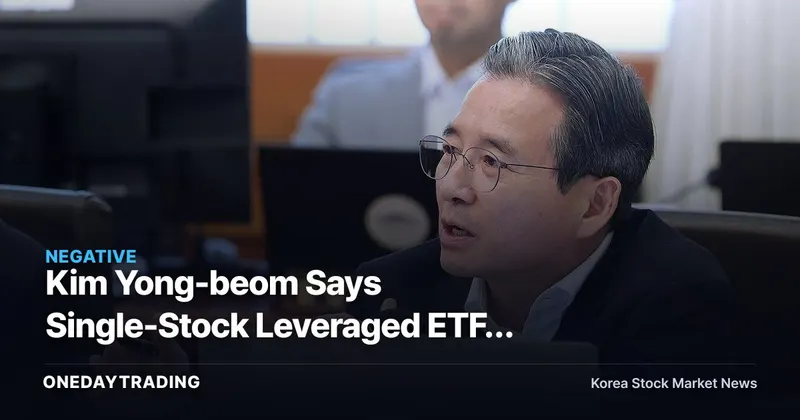
- Kim Yong-beom, chief policy officer at the presidential office, said on the 19th that delisting single-stock leveraged ETFs is effectively impractical
- This product has recently been cited as one of the main drivers behind sharp price swings in individual stocks (tickers)
- He raised concerns that pushing through a forced delisting could instead deliver a fresh shock to the market
What Changes
The fact that a policymaker has publicly stated that delisting is impractical shows just how far the regulatory discussion around this product had already progressed. At the same time, the remark overturns the simple assumption that "regulation makes the risk disappear." What Kim actually pointed to is the opposite. Leveraged ETFs are structured to rebalance their derivative positions daily in order to track a multiple of the underlying index's daily return, and forcing a liquidation would require dumping the entire holding onto the market in a short span of time. The goal of regulation is to dampen volatility, yet the method itself risks creating more volatility — a paradox.
What the market needs to price in, then, is not "delisting risk" but "non-delisting risk." The individual stocks (tickers) this product has tracked will remain exposed to inflows and outflows of leveraged capital for the time being, which stays a factor amplifying price swings regardless of earnings or fundamentals. The policy chief's remark isn't a signal of deregulation — it's closer to a signal that financial authorities have chosen "gradual management" over "immediate structural overhaul."
Numbers and Context
The key point is that this remark came at a time when single-stock leveraged ETFs are being singled out as the main cause of stock price swings. In effect, the policy authorities themselves acknowledged a lag between identifying the cause and rolling out a response. For market participants, what matters is when — and at what intensity — alternative measures such as restrictions on new listings or margin requirements will be introduced. With the extreme option of delisting off the table, the remaining choices are likely to narrow down to liquidity management and investor-protection safeguards.
Winners and Losers
- Asset managers and brokerages that issue and manage leveraged/inverse ETFs and ETNs - if regulation settles on tighter management rather than delisting, fee income from the products' continued existence is preserved, but stricter margin and liquidity rules would increase the operational burden
- High-volatility individual stocks (tickers) that have served as underlying targets for single-stock leveraged products - forced-liquidation risk from delisting has eased, but the volatility from day-to-day leveraged fund inflows and outflows continues
- KOSDAQ small-cap stocks with high retail investor participation broadly - if the supply-demand (order flow) skew driven by leveraged products isn't resolved, the frequency of short-term sharp swings could remain higher than in other industry sectors
Risk Check
- The timing and intensity of any concrete follow-up measures from the Financial Services Commission and Financial Supervisory Service, following the policy chief's remark, need to be confirmed
- With delisting off the table, the next variable is when alternative regulations — such as raising margin requirements or restricting new listings — will be announced
- At the individual stock (ticker) level, volatility could be amplified if leveraged fund outflows coincide with earnings releases or supply-demand (order flow) events
- The opposite scenario also can't be ruled out — if the regulation turns out weaker than expected, the market-unease factor could persist for longer
Bottom Line
With delisting removed as an option, anxiety over a regulatory vacuum has eased, but the underlying risk of volatility driven by single-stock leveraged ETFs still remains in the market.
This article is automatically summarized and analyzed content based on the original news report. View original article (Yonhap News Agency, Finance)