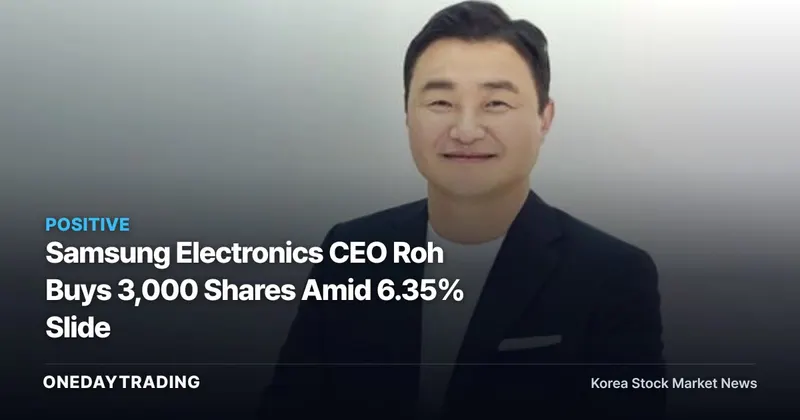

Roh Tae-moon’s Samsung Electronics Share Purchase: Key Facts
- According to Asia Business Daily Securities, citing the Financial Supervisory Service’s electronic disclosure system, Samsung Electronics CEO and Device eXperience Division Head Roh Tae-moon purchased 3,000 shares of Samsung Electronics common stock on the open market on the 6th.
- The shares were acquired at 210,000 won apiece for a total of 630 million won. His holdings increased from 124,280 shares to 127,280 shares.
- Samsung Electronics shares fell 6.35% that day, closing at 188,700 won. The session presented both a positive signal from an executive purchase and continued weakness in the market price.
For investors, the significance of Roh’s 3,000-share purchase lies less in its size than in its timing. The CEO increased his holdings on a day when Samsung Electronics shares fell by 12,800 won. However, an executive’s open-market purchase is only a signal of personal judgment; it does not guarantee stronger earnings or a rebound in the share price.
What the Samsung Electronics Executive Purchase Means
An executive’s open-market purchase is not a corporate share buyback, but a transaction that increases the executive’s personal holdings of common stock. The purchase does not directly alter Samsung Electronics’ business structure or profit and loss. Its market impact comes less from the inflow of funds than from the confidence and judgment it communicates.
The report interpreted the transaction as reflecting “a view that the shares are undervalued and a commitment to responsible management.” The confirmed facts extend only to Roh’s purchase on the 6th at 210,000 won per share. The materials do not include Roh’s own stated purpose, so the interpretation should not be treated as a direct statement from him.
The Gap Between the 210,000 Won Purchase Price and 188,700 Won Close
What merits the market’s attention is that the purchase price and the day’s closing price sent different signals. Roh acquired the shares at 210,000 won apiece, while Samsung Electronics ended the regular session at 188,700 won. Because the exact times of the order and execution have not been disclosed, there is no basis for linking the price difference to a specific intraday development.
The share-price move cannot be explained by the executive purchase alone. Samsung Electronics fell 6.35% that day, while the KOSPI also dropped 6.02% to close at 5,059.69. With the individual executive’s buying signal competing against a broad market plunge, a single day’s price action is insufficient to determine which force has prevailed.
Viewing the Purchase Alongside His Late-July Buying
Roh also purchased 3,045 Samsung Electronics shares at 230,000 won apiece in late July, spending approximately 700.35 million won. Including the latest transaction, he has bought 6,045 shares in the second half of this year for a total of 1.33035 billion won. The fact that he has repeatedly increased his holdings, rather than making a one-off symbolic purchase, adds weight to the latest disclosure.
Conversely, repeated purchases should not be overinterpreted as proof that the shares have bottomed. Samsung Electronics’ closing price fell about 22% in nine days, from 242,000 won on the 28th of last month to 188,700 won that day. The price was also below the April 7 closing price of 196,500 won. Executive judgment and the market’s price-discovery process do not move at the same pace.
Upside and Risks Samsung Electronics Investors Should Distinguish
- Samsung Electronics: The CEO’s decision to increase his holdings to 127,280 shares during a period of falling prices is positive for market sentiment. It supports the view that management’s interests are aligned with those of shareholders.
- Samsung Electronics shares: The 6.35% decline that day and roughly 22% drop since the 28th of last month show that the purchase disclosure alone has not reversed the weakness. Whether the positive signal translates into an actual price recovery remains a separate question requiring confirmation.
- KOSPI: With the index ending down 6.02% at 5,059.69, investors should distinguish Samsung Electronics-specific factors from broader market volatility. If market pressure persists, the psychological impact of the executive purchase may also be limited.
What to Monitor in Future Disclosures
- If Roh’s Samsung Electronics holdings remain unchanged in the next disclosure, the case for viewing this transaction as a sustained investment decision rather than a short-term response will strengthen.
- Investors should distinguish between any disclosed additional open-market purchases and the continued maintenance of his current 127,280-share holding.
- If Samsung Electronics shares recover to Roh’s purchase price of 210,000 won, the gap between the market price and the executive’s acquisition price will narrow. If they remain below that level, market weakness will be exerting more influence than the buying signal.
- The seller’s identity and the brokerage used have not been disclosed. Any interpretation of the transaction should avoid speculation beyond the holdings and acquisition price stated in the filing.
Bottom Line
Roh’s purchase of 3,000 shares is a positive signal of responsible management for Samsung Electronics, but the 188,700 won closing price and the KOSPI plunge that day also show that the signal alone cannot reverse the trend. The next assessment will depend less on the strength of any statements than on whether he maintains his holdings and whether the shares recover to 210,000 won.
Samsung Electronics Key MetricsAs of 2026-11-07
| Returns by Period | 1 Week -14.04% 1 Month -27.97% |
|---|---|
| Trading Value · Trading Volume | 132.9 billion won · 56,147,847 shares |
| Supply-Demand (Order Flow) | Foreign Investors Net selling of 166.2 billion won (4 consecutive days) Institutional Investors Net selling of 98.5 billion won |
| Recent News Tone | Positive Catalysts 3 · Negative Catalysts 4 |
Price and supply-demand (order flow) data are real-time figures from Korea Investment & Securities (KIS), while supply-demand (order flow) and news-tone tallies are calculated independently by OneDayTrading.
Supply-Demand (Order Flow) and Momentum Assessment🔴 Caution
Foreign investor, institutional investor, news, and momentum indicators are showing negative signals.
- ▼Order-Flow PersistenceForeign investors net sold for 4 consecutive days (166.2 billion won)
- ▼Joint SellingForeign investors sold a net 166.2 billion won · Institutional investors sold a net 98.5 billion won
- ▼Trend AlignmentShort- and medium-term downtrends aligned (Day -4.0% · 1 week -14.0% · 1 month -28.0%)
Upcoming Dates to Watch
- 11.12Index Options ExpirationLowKOSPI 200 options expiration
- 11.26Bank of Korea Monetary Policy BoardHighBenchmark interest rate decision meeting
- 12.09FOMC Policy Rate DecisionHighU.S. Federal Reserve monetary policy announcement — direction of interest rates and the dollar
- 12.10Futures and Options ExpirationMediumQuadruple witching — watch for volatility and supply-demand (order flow) disruptions
This article was automatically summarized and analyzed based on the original news report. View original article (Asia Business Daily Securities)