
What Investors Should Watch After the First Sweet Persimmon Export
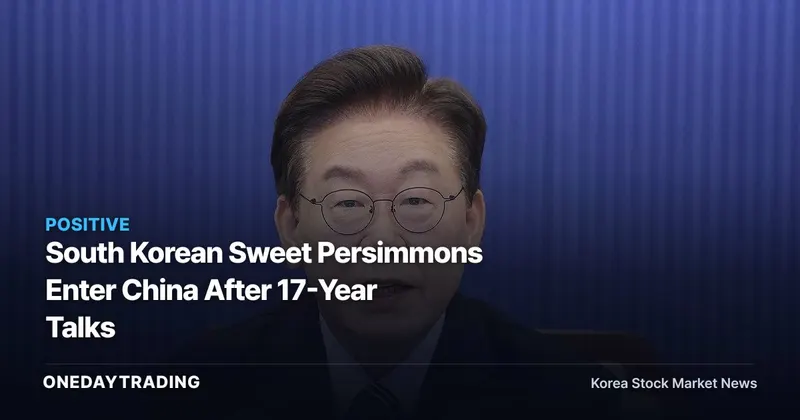
South Korea’s first sweet persimmon export to China is less a basis for immediately calculating the profits of a specific listed company than a sign that a new sales channel has actually opened. According to a Yonhap News Agency Industry report published at 16:53 on 2026/11/07, President Lee Jae-myung wrote on X that South Korean sweet persimmons had been exported to China for the first time following 17 years of quarantine negotiations. For investors, the analysis begins by separating the fact of market entry from the commercial results that have yet to be disclosed.
South Korea’s first sweet persimmon export to China marks the opening of a new sales channel beyond its existing export markets following quarantine negotiations. President Lee explained that expanding the export market from Southeast Asia to China has created new opportunities for farmers. He also said the government would actively support the development of new export markets to increase agricultural sales and farm income.
The 17-Year Negotiation Signals Market Entry, Not Earnings
The 17 years cited by President Lee refers to the duration of quarantine negotiations required to export South Korean sweet persimmons to China. The figure does not represent revenue growth or profitability; it shows how long the negotiation process took before market entry. The completion of the first export alone should not be treated as confirmation of either the export scale or its contribution to profits.
When assessing consumer products, announcements must be distinguished from data. The announcement confirms only the first export of South Korean sweet persimmons to China and the government’s intention to support market development. It provides no information on export volume, export value, retail prices in China or specific support measures. Accordingly, the current FACT_SHEET offers no basis for identifying related listed companies or calculating the revenue impact.
The economic significance of this news will depend on actual transaction data. If exports continue, investors will gain evidence to assess whether market entry is translating into recurring sales. If transactions do not continue, a gap will remain between the symbolic significance of the first export and sustainable sales performance. The direction is positive, but it is too early to quantify the magnitude.
Busan’s 1 Trillion Won in Spending Is Separate From Sweet Persimmon Exports
According to the Yonhap News Agency Industry report, President Lee also shared a post by Busan Mayor Jeon Jae-soo stating that foreigners’ card spending in Busan had surpassed 1 trillion won. President Lee expressed support for Mayor Jeon and Busan residents, saying the city should regain its status as South Korea’s second capital. Although both topics appeared in the same posting activity, the FACT_SHEET identifies no relationship between South Korean sweet persimmon exports and spending by foreigners in Busan.
The subject and unit of Busan’s 1 trillion won figure are confirmed as card spending by foreigners. Because the measurement period was not disclosed, changes from the previous period and spending trends cannot be calculated. Using Busan’s spending indicator to reinforce the investment implications of sweet persimmon exports—or using agricultural export performance to explain Busan’s consumption trends—would go beyond the available evidence.
Next Indicators for South Korean Sweet Persimmon Exports to China
- Disclosure of export volume would help distinguish the size of the initial shipment from the continuity of subsequent transactions. The current volume is unknown.
- Disclosure of export value would provide a basis for assessing whether entry into the Chinese market has translated into actual sales. No value data are currently available.
- Retail prices in China must be confirmed to assess volume and value together. Without pricing data, it is difficult to evaluate the quality of the sales performance.
- Specific government export-support measures must be announced before investors can assess how the commitment will be implemented. President Lee’s remarks went only as far as pledging support for developing new markets.
Under an optimistic scenario, transactions would continue after the first export, with volume and value subsequently disclosed. The opposing scenario is that no follow-up export data emerge, making it impossible to determine whether market entry has led to recurring sales. What is confirmed for now is that the door to the Chinese market has opened. The next information capable of changing an investment assessment will not be the symbolic first step, but actual export volume, value and retail prices.
This article was automatically summarized and analyzed based on the original news report. View the original article (Yonhap News Agency Industry)