
Overview
The index and theory created by Charles Dow, a 19th-century financial journalist, are far more than a historical footnote — they are the intellectual roots of passive investing and index-tracking fund flow that directly influence Korean investors' portfolios today. His idea of compressing the entire market's direction into a single number, at a time when individual stock (ticker) information was scarce, ultimately gave rise to the vast capital channels we now know as index ETFs and index funds.
Background
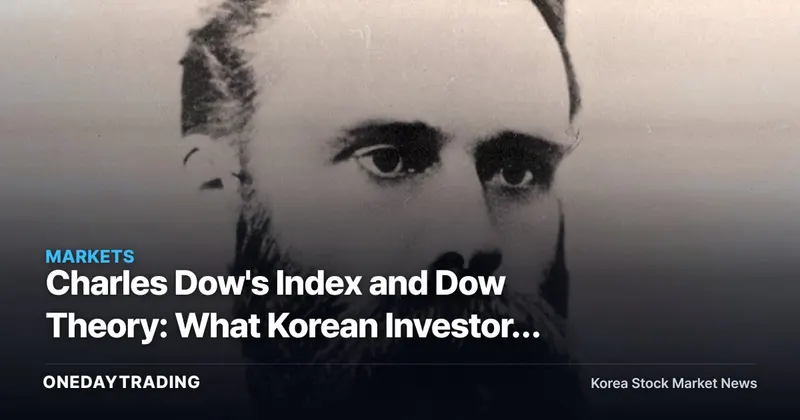
Charles Dow co-founded a financial information company with a colleague and published a daily market bulletin — the publication that would eventually become The Wall Street Journal. He gathered the fragmented stock price data of his era and pioneered the concept of averaging the share prices of representative companies into a single index.
In 1896, he began calculating what would become the Dow Jones Industrial Average, initially a simple average of a handful of companies. Over more than a century, it evolved into a thermometer for the broader market. The market analysis framework he outlined in his editorials was later codified by others as Dow Theory.
At the heart of Dow Theory is the view that markets move in trends, and that a trend is confirmed when both the industrial index and the transportation index move in the same direction. The attempt to read the overall flow of the market — rather than the positive catalyst of any single company — was genuinely revolutionary for its time.
Structural Context
The significance of Dow's insight lies in the fact that the question he posed ultimately evolved into the modern investment philosophy of diversification and capturing market-average returns. Buying the entire market rather than picking individual stocks (tickers) offers lower costs and more stable long-term performance — and this idea became the intellectual foundation for the massive fund flow now channeled into index ETFs.
Industry Sector Implications
- Financial data and index providers: The index itself has become a source of licensing revenue. The more ETFs track a given index, the larger the fee-based income for the index provider.
- Media and financial newspapers: The financial journalism tradition Dow established lives on in the subscription and data business models of economic media outlets.
- Asset managers and ETF operators: As index-tracking products became the primary conduit for passive fund flow, management-fee-based businesses have grown substantially.
- Korean index and ETF market: The inflow of retail investor capital into ETFs tracking domestic benchmarks such as the KOSPI 200 follows exactly the same principle.
Bull vs. Bear Scenarios
On the optimistic side, index investing is well-suited for reducing individual stock (ticker) risk and compounding returns over the long term. For retail investors facing high transaction costs and information asymmetry, a strategy of buying the market average can be a practical alternative.
On the other hand, a price-averaged index that started with only a handful of stocks can be skewed by a small number of large-market-capitalization names, and may be slow to reflect structural shifts across industry sectors. A clear weakness is that concentration of passive fund flow can inflate the valuation burden on certain large-caps and amplify volatility when the market moves in a single direction.
Action Points for Investors
- Check the composition of any ETF you hold — confirm which index it tracks and whether the weighting of its top holdings is excessively concentrated in one area.
- When selecting an index-tracking product, compare total expense ratios and tracking error to assess the long-term cost burden.
- Monitor whether industrial indicators and transportation or economically sensitive indicators are moving in the same direction — use this as a reference framework for gauging trend consistency in the market.
- Keep track of scheduled index rebalancing (additions and deletions) and weighting adjustment announcements to anticipate fund flow variables in advance.
This content was automatically summarized and analyzed based on the original news article. View original article (Yahoo Finance)