
Three-Line Briefing
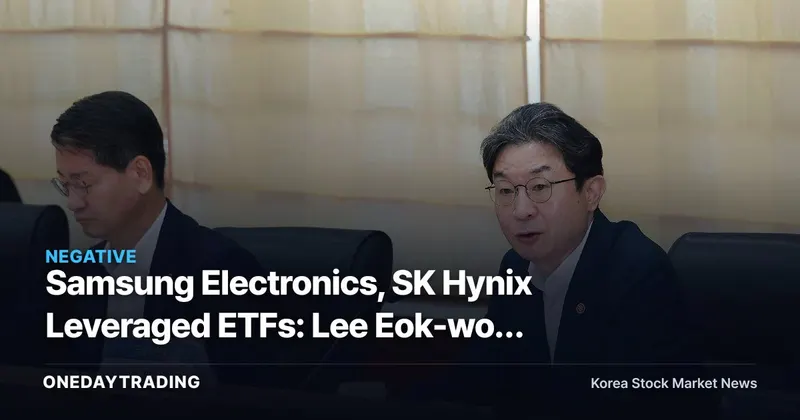
- Financial Services Commission Chairman Lee Eok-won said on the 28th that if demand for single-stock leveraged ETFs doesn't sufficiently cool down, the regulator will preemptively review additional measures, including setting individual investment caps
- Specifically, a cap in the 20% range was mentioned — a scheme that would prevent investors from putting more than a certain percentage of their account assets into a specific leveraged product
- The remarks come against the backdrop of rising volatility as retail investors' money has poured into leveraged ETFs based on Samsung Electronics (005930) and SK Hynix (000660) as underlying assets
What's Changing
What stands out about this statement is that the specific figure of "20%" was mentioned publicly for the first time. Until now, financial regulators had only voiced general concerns about single-stock leveraged ETFs, but this time they directly referenced a cap figure similar in structure to margin lending regulations. This signals that the warning is moving beyond rhetoric into an actionable policy option.
Leveraged ETFs are designed to track a multiple of the underlying asset's daily return, so the more retail money flows in, the more asset managers must expand their hedge positions through swaps, futures, and similar instruments. In the process, program trading is repeatedly layered onto underlying stocks like Samsung Electronics (005930) and SK Hynix (000660), generating "leverage-driven volatility" that has nothing to do with earnings. This is precisely what regulators are taking issue with — a phenomenon in which derivatives structures, rather than individual companies' fundamentals, amplify stock price movements.
However, this is currently only at the "review" stage, and implementation is not yet confirmed. It remains unclear how much the market has already priced in this statement as an actual regulatory risk. If a cap is actually introduced, leveraged ETF trading value would likely contract, and rotational volatility would likely ease as well — but if the remarks amount to nothing more than talk, the current supply-demand (order flow) structure will remain unchanged.
Numbers in Context
The 20% figure is similar in nature to margin lending cap regulations for retail investors. By directly limiting exposure to a specific product relative to an account's total assets, this approach is milder than eliminating the product outright, but it structurally suppresses retail investors' demand for "all-in leverage" bets. The concern is that this cap wouldn't be limited to mega-cap stocks (tickers) like Samsung Electronics (005930) and SK Hynix (000660) — it leaves room for expansion to other single-stock leveraged products down the road.
Stocks (Tickers) to Watch
- Samsung Electronics (005930) — As the underlying asset for leveraged ETFs that have drawn heavy retail inflows, program trading volatility could ease if a cap is introduced, reducing short-term supply-demand (order flow) noise — but the leverage-driven buying that had been pushing up the stock's upside would also weaken
- SK Hynix (000660) — Having been affected by leveraged ETF supply-demand (order flow) in the same structure as Samsung Electronics, it could see reduced volatility unrelated to earnings if the regulation takes effect
- Mirae Asset Securities — With an asset management affiliate that generates fee income from managing and trading leveraged/inverse ETFs, a confirmed individual investment cap could weigh on profitability as related trading value contracts
- Samsung Securities — Similarly exposed to the ETF brokerage and asset management business, a contraction in leveraged product trading could become a factor reducing fee revenue
Risk Check
- For now, this is only a general warning-level statement, and whether and when an actual cap would take effect remains unconfirmed
- Even if a cap is introduced, its regulatory effect could be limited if retail investors shift demand to overseas-listed leveraged ETFs or after-hours over-the-counter (OTC) derivative products
- Changes in leveraged ETF supply-demand (order flow) are a separate variable from the earnings and industry fundamentals of Samsung Electronics (005930) and SK Hynix (000660), and do not determine the semiconductor industry's fundamentals themselves
- Conversely, a scenario in which leveraged ETF demand naturally cools over time — making additional regulation unnecessary altogether — cannot be ruled out
Bottom Line
These remarks are not yet regulation but an advance warning of a regulatory possibility — whether this issue becomes a real factor in Samsung Electronics (005930) and SK Hynix (000660) supply-demand (order flow) can only be judged by tracking both the announcement of any actual cap's implementation and timing, and the trend in leveraged ETF trading value.
Samsung Electronics (005930): Real-Time Data Snapshot
Samsung Electronics (005930)'s most recent closing price was 227,500 won (-10.43% from the previous day), and the signal light combining foreign investors/institutional investors supply-demand (order flow) with news and momentum reads 🟡 Neutral / Wait-and-see. Positive and negative signals are mixed, making this a zone to watch.
- ▼ Trend Alignment — Short- and medium-term downtrend alignment (today -10.4% · 1 week -12.2% · 1 month -33.0%)
- ▲ News Flow — 10 positive catalysts vs. 0 negative catalysts — positive catalysts dominate
Recent related news skews favorable, with 10 positive catalysts versus 0 negative catalysts.
※ Price and foreign investors/institutional investors supply-demand (order flow) data are provided by Korea Investment & Securities (KIS) and reflect figures as of publication time.
This content was automatically summarized and analyzed based on the original news article. View original (Maeil Business Newspaper, Securities)