
Key Takeaways
U.S. President Donald Trump has threatened to impose a 100% tariff on French wine unless France scraps its so-called digital tax levied on American Big Tech companies. The remarks came ahead of the Group of Seven (G7) summit being held in Évian-les-Bains, France. With trade friction over digital taxation between the United States and Europe resurfacing, volatility is expected to rise across the luxury goods and spirits sectors as well as U.S. platform companies.
What Happened
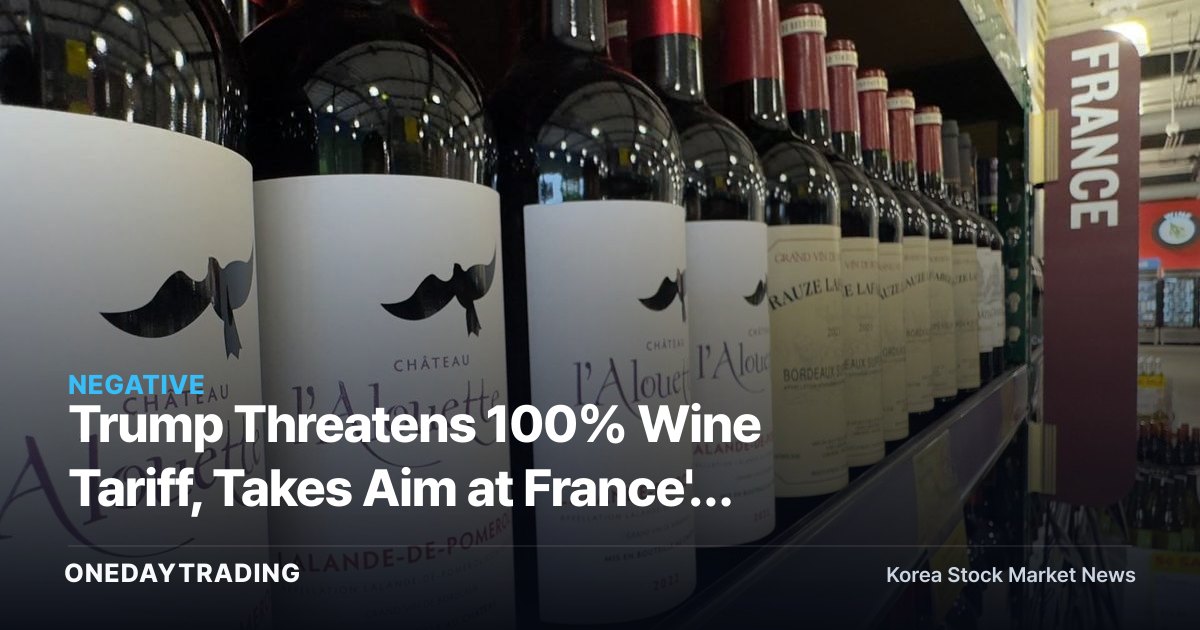
President Trump effectively characterized France's digital services tax — a revenue-based levy targeting American technology giants such as Google, Apple, Meta, and Amazon — as discriminatory taxation, and stated that unless it is withdrawn, he would impose retaliatory tariffs on wine and champagne, two of France's signature exports.
Because the digital tax is assessed on revenue generated within the country rather than on a company's net profit, the U.S. views it as a trade barrier that singles out American firms. France and other European nations, by contrast, have countered with the logic of tax fairness, arguing that large platforms reap enormous profits locally while failing to pay their fair share of taxes.
This threat goes beyond a simple tax dispute and is taking shape as a bargaining chip for the G7 summit. As wine is a symbolic French export, a 100% tariff would double its price in the U.S. market — a high-intensity pressure tactic that would effectively block exports.
Background and Context
This is not the first clash between the U.S. and France over the digital tax. In the past, the U.S. considered imposing retaliatory tariffs on wine, handbags, and cosmetics in response to France's digital tax, and on each occasion the luxury goods and spirits industries were gripped by fears of a direct hit. With a global agreement on taxing the digital economy stalling, structural friction has persisted in which individual countries impose their own taxes and the U.S. responds with tariff retaliation.
Impact on the Market and Stocks
- French spirits maker Pernod Ricard has a high share of exports to the U.S. in cognac, champagne, and other products, so it would face the most direct earnings hit if the tariffs materialize.
- LVMH, with its wine and champagne division, is exposed to the possibility of retaliatory tariffs spreading across the luxury sector as a whole, which could dampen investor sentiment.
- U.S. Big Tech names such as Alphabet, Meta, Apple, and Amazon could gain a potential positive catalyst in the form of reduced tax burdens if the pressure to scrap the digital tax succeeds, but an escalation of the trade dispute acts as a source of uncertainty.
- An expansion of tariff and trade friction could stoke global risk-off sentiment and heighten volatility in export-driven stock markets, including South Korea's.
- Domestically, indirect price effects could emerge in the import and distribution of luxury goods and spirits, as well as in duty-free channels.
Investor Checkpoints
- Investors should watch whether the G7 summit leads to actual tariff imposition or whether it remains merely a negotiating threat.
- The retaliatory responses of France and the European Union, and whether the U.S. expands its list of targeted products, will determine the intensity of the trade friction.
- For luxury and spirits stocks, it is necessary to distinguish short-term noise from long-term fundamentals and guard against overreaction.
- Progress toward a global agreement on the digital tax will determine the medium- to long-term direction of Big Tech's tax burden.
Outlook
The optimistic scenario is one in which this threat works as negotiating leverage, a compromise on the digital tax is reached, the tariffs are never actually imposed, and luxury and spirits stocks quickly regain stability. Conversely, if the retaliation materializes and Europe responds in kind, the trade dispute could spread across the board, adding pressure on global consumer goods and platforms alike. Given their limited direct exposure, Korean investors would do well to take a level-headed approach — calmly examining how trade tensions ripple across risk assets in general, rather than succumbing to excessive fear.
This article is content automatically summarized and analyzed based on the original news report. View Original (CNBC)