
At a Glance
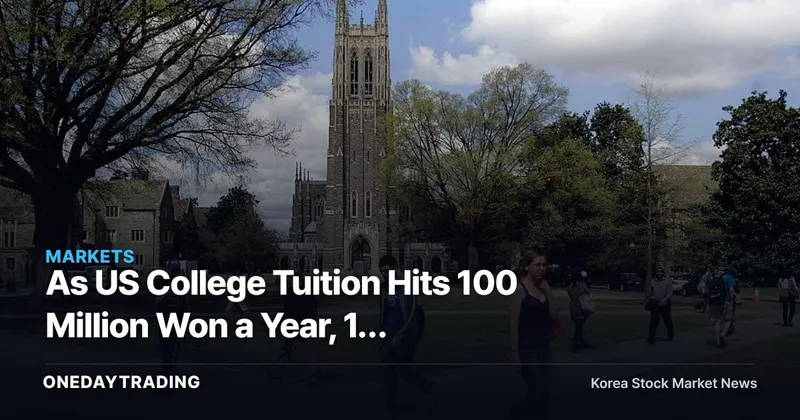
According to Princeton Review data, 16 US universities now carry an annual cost of attendance (sticker price) exceeding $100,000. This is the listed price before scholarships and financial aid are deducted, however, and most students in practice pay far less.
Why It Matters Now
$100,000 a year comes to roughly 140 million won, and over four years that tops 500 million won. The growing number of universities crossing the six-figure mark for the first time shows that US higher-education cost inflation has, over the long run, run well ahead of overall inflation.
The key issue is the gap between the sticker price and the net price. At elite private universities in particular, generous financial aid funded by large endowments often cuts the actual cost for middle-income and lower-income households to less than half of the sticker price. Conversely, upper-middle-income households who fall into the aid gap tend to feel the heaviest burden.
For Korean investors, this is not simply someone else's problem. Financial planning for households considering study in the US, tuition costs that swing with the exchange rate, and the structural theme of education-cost inflation all tie directly into investment in the education and financial sectors.
FAQ
- If the sticker price is $100,000, does everyone pay that amount? No. The net price — after scholarships and financial aid are deducted — is what actually gets paid, and many students pay far less than the sticker price.
- Why does the sticker price keep rising? It reflects a combination of factors: rising labor and facility costs, total-cost accounting that bundles in room and board, and pricing strategies built on ample endowment funds.
- What's the impact on Korean households? The weaker the exchange rate, the heavier the won-denominated burden of dollar-priced tuition becomes, making FX hedging and staggered remittance strategies important.
- What are the investable themes here? Areas positioned to benefit from education-cost inflation, including student loans, edtech, and private tutoring/admissions-prep services.
Related Stocks (Tickers) and Sector Impact
- US student loan companies: Their earnings hinge on loan balances and the interest-rate environment, and rising education costs tend to boost loan demand.
- Domestic education and admissions-prep companies: Megastudy Edu and similar names are candidates to directly benefit from intensifying cost pressure and admissions-competition themes.
- Edtech/online education: As an alternative to costly in-person instruction, demand for lower-cost online degrees and courses is structurally expanding.
- Banking and finance: Rising demand for education-related loans and savings products is a tailwind for the financial sector.
- Exchange-rate-sensitive consumption: A stronger dollar raises the burden of overseas study costs, affecting demand for related remittance and currency-exchange services.
Investment Considerations
- A rising sticker price doesn't automatically translate into improved earnings for education companies, so net price and enrollment trends need to be watched together.
- Student-loan-related stocks (tickers) are highly sensitive to interest rates, delinquency rates, and government policy, making them volatile.
- Domestic education stocks (tickers) face the structural headwind of a shrinking school-age population, so approaching them purely on a cost-inflation theme carries risk.
- Overseas education themes are heavily influenced by exchange-rate and policy variables, so diversification is needed.
Overall Outlook
In the optimistic scenario, education-cost inflation could expand the revenue base for related industries — student loans, edtech, and admissions-prep services — establishing itself as a long-term growth theme. On the risk side, however, debate over a "tuition bubble" and the burden of student debt could invite regulatory intervention and cooling demand, while a shrinking school-age population remains a structural constraint on the domestic education market. In the end, what's needed is a level-headed approach that separates the attention-grabbing sticker-price figures from the actual amounts paid and industry-by-industry fundamentals.
This article is automatically summarized and analyzed content based on the original news report. Read original (CNBC)