
Key Summary
By excluding ETFs and ETNs from the aftermarket opening on the 14th, the Korea Exchange (KRX) is signaling that volatility control comes before after-work trading convenience. This is more than a simple product exclusion: it signals an additional filter against price shocks spreading through highly market-sensitive underlying assets such as Samsung Electronics and SK hynix.
The key point for investors lies elsewhere. Expanding the aftermarket does not automatically mean higher trading value, and which products are opened or kept out first will determine supply-demand (order flow) for brokerage stocks and the ETF ecosystem.
What Happened
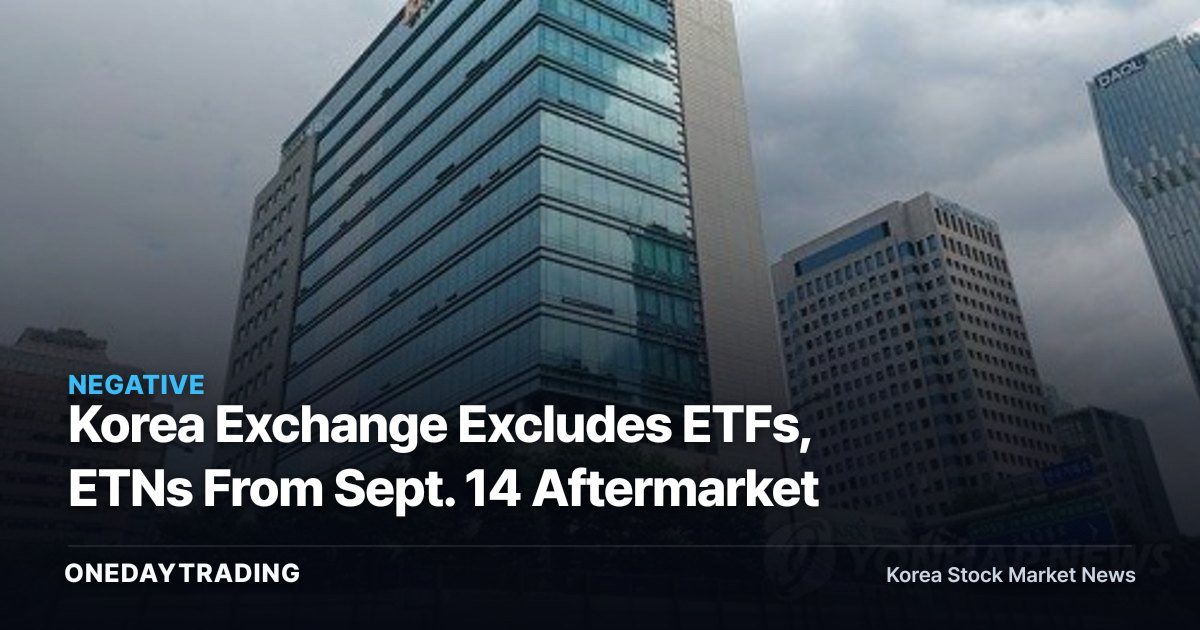
The Korea Exchange (KRX) decided to exclude ETFs and ETNs from the after-hours continuous trading available in its aftermarket, which will operate from 4 p.m. to 8 p.m. on the 14th of this month. The exchange is widening the window for buying and selling stocks (tickers) after the regular session, while keeping exchange-traded products outside the gate for now.
With this measure, the stocks (tickers) excluded from aftermarket trading now include ETFs and ETNs, in addition to stocks not traded during that day's regular session, investment-warning and investment-risk stocks, stocks with abnormal sharp gains (surges), managed stocks, and ultra-low-liquidity stocks. The exchange had initially planned to include exchange-traded products, but changed course as controversy grew that single-stock leveraged and inverse ETFs had amplified volatility during the recent semiconductor correction.
After-hours continuous trading collects orders and matches them at once. The judgment was that leaving leveraged products open during a period when quotes do not accumulate as densely as in the regular session could spread price distortion before genuine price discovery.
Background and Context
The core issue is not the products themselves but the time gap in liquidity. ETFs must track the prices of their underlying assets, while ETNs also move in tandem with their issuance structures and underlying indicators. After the market close, however, spot liquidity thins, and single-stock leveraged and inverse products can make intraday news and supply-demand (order flow) in the underlying shares appear amplified.
So this decision is not a policy to broaden the market, but a choice about how to manage the market once it is broadened. If volatility concerns continue, the exchange could narrow the permitted scope further; conversely, if first-week trading settles smoothly, the policy could be reconsidered later.
Impact on the Market and Stocks
- It is a short-term burden for brokerage stocks. If ETF and ETN trading is removed from the aftermarket, expectations for higher trading value will be delayed, weakening the supply-demand (order flow) leverage of Mirae Asset Securities, NH Investment & Securities, Samsung Securities, and Kiwoom Securities, which had expected after-hours fees and incoming orders.
- ETF management and distribution channels will see slower expansion. If the route for absorbing retail investors' demand to trade after work is blocked, regulatory compliance will be assessed before product adoption speed.
- For Samsung Electronics and SK hynix, this could instead help ease volatility. Blocking overnight trading in single-stock leveraged and inverse ETFs would remove one layer of overheated supply-demand (order flow) spreading around the underlying shares.
- For the Korea Exchange (KRX) and the market as a whole, the move is positive for institutional credibility. Holding back the most shock-sensitive products rather than rushing to broaden the new system should help reduce initial confusion.
Investor Checkpoints
- Watch how much trading value accumulates in the aftermarket during the first week after the 14th launch. If market participation holds even after ETFs and ETNs are removed, the system is more likely to take hold.
- Check the order-eligibility guidance on securities firms' HTS and MTS platforms. The practical difference depends greatly on which stocks (tickers) are excluded from after-hours continuous trading.
- Monitor the intraday tracking gaps and trading value of leveraged and inverse ETFs linked to Samsung Electronics and SK hynix. If overnight trading is blocked, concentration during the day could accelerate.
- Investors should watch whether the exchange revisits including ETFs and ETNs later. If volatility subsides, easing will gain momentum; if it expands, the case for tighter regulation will strengthen.
Outlook
In the optimistic scenario, excluding ETFs and ETNs ends as an initial stabilizing measure. If the aftermarket becomes a supplementary window to the regular session, large-cap stocks and ordinary spot stocks could receive the benefits of longer trading hours first.
The risk is the opposite. If controversy over single-stock leveraged ETFs continues, the exchange may narrow the product scope further and slow the expansion of the overnight market. In that case, the market will price control ahead of convenience.
Frequently Asked Questions
Why were ETFs and ETNs excluded from the aftermarket?
The key issue is volatility management. Liquidity thins after the market close, making prices easier to move, while single-stock leveraged and inverse ETFs can make those swings look even larger. The exchange chose market stability over longer trading hours.
Will ETFs be completely unavailable after the 14th?
No. The exclusion applies only to after-hours continuous trading in the aftermarket from 4 p.m. to 8 p.m. ETFs and ETNs will remain tradable as usual during the regular session.
Which stocks and industry sectors are most sensitive?
Directly, brokerage stocks and ETF distribution channels are most sensitive. Indirectly, large semiconductor stocks such as Samsung Electronics and SK hynix, which underlie single-stock leveraged and inverse products, could experience smaller or larger swings.
Ultimately, this change shows that expanding the aftermarket does not automatically mean expanding free trading. Trading value in the first week after the 14th launch, the scope of ETF and ETN exclusions, and intraday volatility in large semiconductor stocks are the next points to watch.
KOSPI Index IndicatorsAs of 2026-09-01
| Period trend | 1 week +2.07% 1 month +22.21% |
|---|
Index, commodity, and exchange rate data are based on global market benchmarks and reflect values at publication.
Mirae Asset Securities Key IndicatorsAs of 2026-09-01
| Period returns | 1 week -2.51% 1 month +1.01% |
|---|---|
| Trading value · trading volume | 30.7 billion won · 891,922 shares |
| Supply-demand (order flow) | Foreign investors +8.7 billion won net buying Institutional investors −7.7 billion won net selling |
| Recent news tone | Positive catalyst 2 · Negative catalyst 2 |
Price and supply-demand (order flow) data are real-time figures from Korea Investment & Securities (KIS); supply-demand (order flow) and news-tone aggregates are calculated by Oneday Trading.
Upcoming Dates to Watch
- 09.10Futures and options simultaneous expirationMediumQuadruple witching — watch for volatility and supply-demand (order flow) disruptions
- 09.16FOMC policy rate decisionHighU.S. Federal Reserve monetary policy announcement — direction of rates and the dollar
- 10.08Index options expirationLowKOSPI200 options expiration
- 10.22Bank of Korea Monetary Policy BoardHighBenchmark interest rate decision meeting
This article is automatically summarized and analyzed from the original news report. View original (Yonhap Securities)