
At a Glance
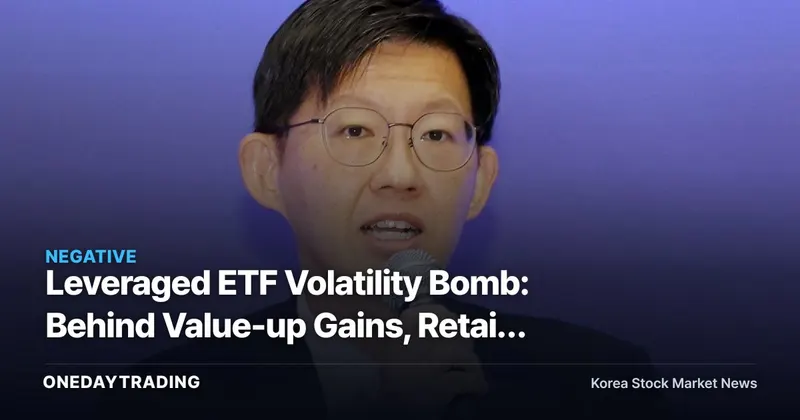
Concerns have emerged that trading in leveraged exchange-traded funds (ETFs) is amplifying KOSPI volatility, with a significant portion of the resulting hedging costs ultimately passed on to retail investors. Lee Hyo-sup, Head of the Financial Industry Research Division at the Korea Capital Market Institute, acknowledged the achievements of the government's Value-up policy, but noted that institutional improvements are urgently needed to fundamentally resolve the KOSPI's chronic undervaluation.
Why It Matters
Leveraged and inverse ETFs are designed to track two times (or -2 times) the daily return of their underlying index. To maintain this ratio, the asset management companies that issue these products and the securities firms acting as liquidity providers (LPs) must perform daily rebalancing trades, adjusting futures and spot positions just before market close. The more sharply the index swings, the larger the rebalancing volume becomes, creating a feedback loop in which this trading itself further amplifies volatility.
The issue lies in how the resulting costs are distributed. As volatility increases, leveraged products structurally suffer from what is known as volatility decay — a daily compounding effect that erodes returns relative to the underlying index. Retail investors who hold these products long-term as directional bets, rather than for short-term trading, are the most likely to bear this loss in full. This explains the recurring phenomenon in which the index itself is flat while leveraged ETF returns turn negative.
It is true that the Value-up program has contributed to a valuation re-rating by encouraging expanded dividends and share buyback cancellations. However, the key point being raised is that policy alone is insufficient to resolve the KOSPI's structural undervaluation, known as the "Korea discount." For the Value-up effect to be sustainable, reforms must go beyond improving governance and expanding dividends to include an overhaul of the risk management framework for the derivatives market.
Frequently Asked Questions
- Why are leveraged ETF hedging costs passed on to retail investors? Rebalancing trade costs and volatility decay are inherent in the product structure itself, and are directly reflected in the returns of retail accounts that hold the product long-term.
- Has the Value-up policy had no effect? There have been some achievements, such as expanded dividends and share buyback cancellations, but the assessment is that the policy alone has limits in resolving chronic undervaluation.
- Why is KOSPI volatility particularly high right now? Because the share of leveraged and inverse product trading has grown, rebalancing volume repeatedly flows in whenever the index swings sharply up or down.
- What specifically does the need for urgent institutionalization mean? It refers to strengthening derivatives market discipline, including enhanced risk disclosures when selling leveraged products, managing the market impact of hedging trades, and protective measures for long-term holders.
Related Stocks and Sector Impact
- Mirae Asset Securities Its leveraged and inverse ETF lineup and liquidity-provision volume are the largest in Korea, giving it the greatest exposure to the scale of related hedging trades and any regulatory changes.
- Samsung Securities With a high share of ETF liquidity-provider operations and retail derivatives brokerage, it is a direct party to discussions of hedging costs and regulatory risk.
- NH Investment & Securities With a large lineup of ETF issuance and management, it is affected by changes in leveraged product rebalancing trade practices.
- Kiwoom Securities With a high share of retail brokerage, it is sensitive to changes in related trading value and fee income if regulations such as stronger risk disclosures for leveraged products materialize.
Investment Considerations
- It should not be overlooked that leveraged and inverse ETFs are products designed to track daily returns. Holding them for more than a few days can lead to a widening gap from the underlying index's cumulative return.
- Investors should account for the fact that in periods of high volatility, losses from the compounding effect grow nonlinearly.
- Value-up-related policy announcements can move independently of improvements in individual companies' fundamentals, so it is risky to time entries and exits based solely on policy momentum.
- Discussions among financial authorities on strengthening derivatives market discipline are still at an early stage, making it difficult to draw firm conclusions about the impact on related stocks until concrete legislative or administrative guidance timelines are confirmed.
Overall Outlook
If an overhaul of the derivatives risk management framework is discussed as the next step in the Value-up policy, tighter sales regulations or stronger risk disclosures for leveraged products could materialize. In that case, trading value in related products could contract, potentially reducing some of securities firms' ETF and derivatives-related fee income. Conversely, if regulation is limited to reorganizing sales channels without restricting trading itself, the leveraged product market could continue its current growth trend. The next things to watch are the timing of the Financial Services Commission and Financial Supervisory Service's announcement of a derivatives risk management plan, and the trend in retail investors' net buying whenever the KOSPI re-enters a period of high volatility.
Mirae Asset Securities: Real-Time Data Snapshot
Mirae Asset Securities's most recent closing price is 42,200 won (+4.84% vs. the previous day), and the signal combining foreign/institutional investor order flow with news and momentum reads 🟡 Neutral / Wait-and-see. Positive and negative signals are mixed, making this a period to watch.
- ▲ Order-Flow Continuity — Foreign investors have been net buyers for 4 consecutive days (+23.1 billion won)
Recent related news skews negative, with 0 positive catalysts and 1 negative catalyst.
※ Price and foreign/institutional order-flow data are provided by Korea Investment & Securities (KIS) and are as of the time of publication.
This article is automatically summarized and analyzed content based on the original news source. View Original (Maeil Business Newspaper - Securities)