
Summary
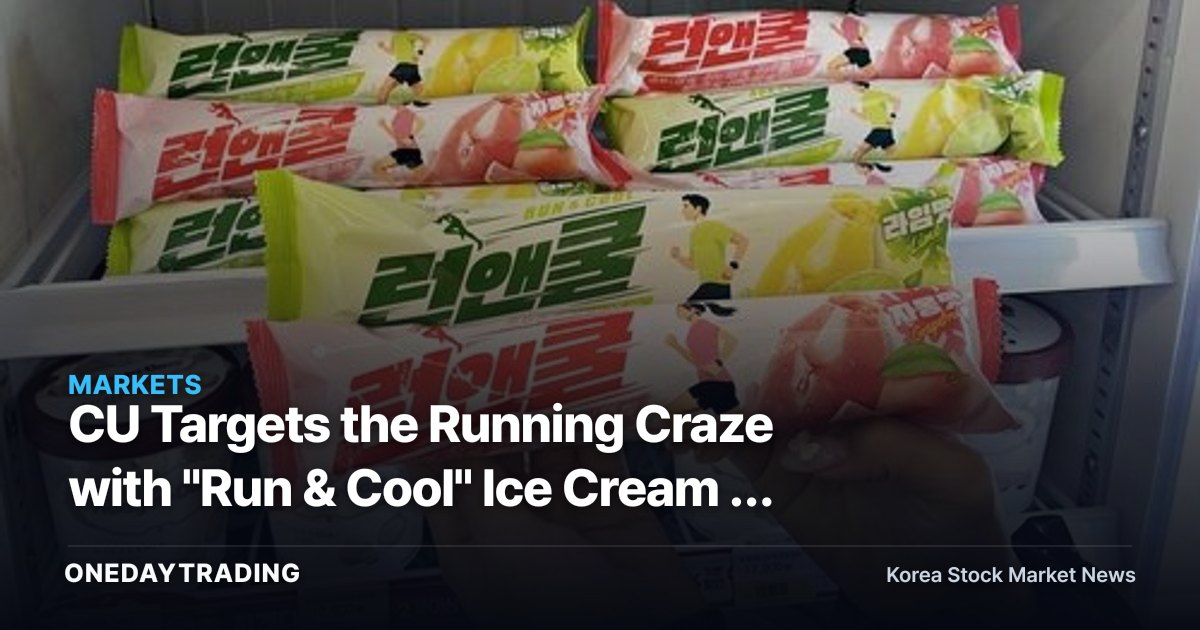
BGF Retail, which operates the CU convenience-store chain, has launched its "Run & Cool" ice cream and specialized stores to capitalize on the spread of running culture. While it may look like a one-off new product, it is a case that illustrates a structural trend in the convenience-store industry: combining private brands (PB) with lifestyle themes to lift average spend per customer and visit frequency. For investors, what matters is reading BGF Retail's PB revenue share and per-store sales trend together, rather than the success or failure of any single new product.
What Happened
In response to the running trend spreading rapidly among younger consumers, CU recently launched its new "Run & Cool" ice cream and moved to tailor its product lineup and stores to running demand. By bundling food aimed at post-workout hydration and sugar replenishment with running-related categories, CU is attempting to position convenience stores not as mere outlets but as everyday lifestyle hubs.
This is an extension of the marketing playbook BGF Retail has long used to generate social-media buzz through attention-grabbing PB and collaboration products. The approach is to quickly turn trends into products that create buzz, thereby driving store visits and repeat visits among consumers in their 20s and 30s.
Structural Background
Korea's convenience-store market has entered a phase of slowing top-line growth as store counts approach saturation. As a result, qualitative growth — boosting per-store sales and margins rather than opening new outlets — has emerged as the key challenge. PB products carry higher margins than ordinary manufacturer goods, and buzzworthy items can draw foot traffic without large marketing spend, making them important tools for defending profitability. Combining lifestyle themes such as running and fitness is seen as a strategy to differentiate while avoiding price competition.
Impact on Stocks and Sector
- BGF Retail: The company at the center of this story. If PB and theme marketing translate into higher average spend per customer and a rising PB share, it could help improve per-store profitability — though the contribution of any single new product is limited.
- GS Retail: A competitor operating GS25. If CU's buzz-driven PB marketing pays off, competition over the same themes could intensify and raise marketing-cost burdens.
- Binggrae: An ice cream and dairy-beverage maker with high reliance on the convenience-store channel; the expansion of in-house ice cream PB by convenience stores is a variable for its bargaining power on supply terms.
- Lotte Wellfood: A major player in the frozen-dessert market, facing both potential gains from PB contract manufacturing and concerns about cannibalization of its own brands.
Bull vs. Bear Scenarios
On the bull side, the ability to productize trends could draw consumers in their 20s and 30s and expand the PB share, creating a virtuous cycle that lifts both per-store sales and margins simultaneously. Repeated success with buzzworthy PB becomes an intangible asset that strengthens brand loyalty and the turnover rate of new products.
On the bear side, the running theme itself is highly seasonal and trend-driven, so sales may lack staying power, and a single new product has only a marginal effect on company-wide earnings. The bigger variables are structural headwinds — store saturation, slowing consumption, and labor and rent cost burdens — and there is also a risk that overheated buzz-marketing competition merely raises costs.
Investor Action Points
- In the next quarterly earnings release, check the trends in per-store sales, same-store growth, and the PB revenue share.
- Compare the intensity of similar theme and PB responses from competitors such as GS Retail, along with changes in promotional spending, to gauge whether margins are under pressure.
- Use summer-peak frozen-dessert sales and changes in average spend per customer to assess the actual foot-traffic impact of the lifestyle theme.
- Track common convenience-store cost variables such as the consumer economy and labor costs, together with changes in store-opening policy.
BGF Retail Through Real-Time Data
BGF Retail's latest closing price is 114,700 won (-2.38% from the previous day), and the traffic-light signal — combining foreign and institutional investor order flow with news and momentum — is 🟡 Neutral / Wait-and-See. With positive and negative signals mixed, this is a zone to watch.
- ▼ Trend Alignment — Short- and mid-term downward alignment (today -2.4% · 1 week -11.3% · 1 month -14.3%)
- ▼ News Flow — 2 positive catalysts vs. 3 negative catalysts — negative-leaning
Recent related news is negative, with 2 positive catalysts and 3 negative catalysts.
※ Price and foreign/institutional investor order-flow data are provided by Korea Investment & Securities (KIS), as of the time of publication.
This article is auto-summarized and analyzed content based on the original news. View original (Yonhap News, Industry)