
Key Takeaways
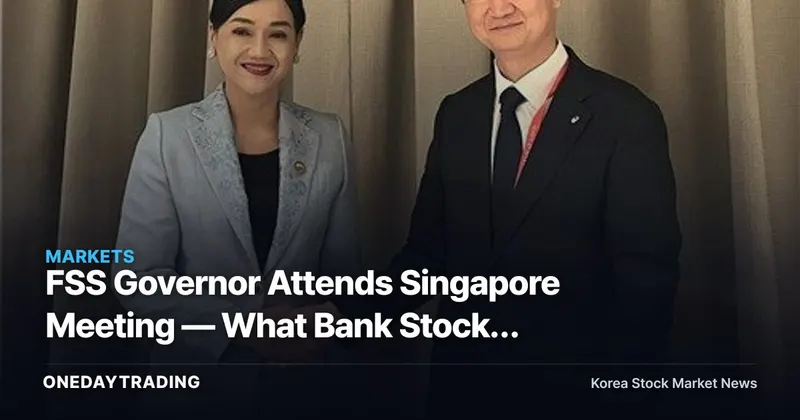
Financial Supervisory Service (FSS) Governor Lee Chan-jin attended the 15th East Asia-Pacific meeting of financial supervisory heads and central bank governors, held in Singapore from July 23 to 24. What this news really signals isn't short-term supply-demand (order flow) for bank stocks, but rather how regulators are recasting interest rate, exchange rate, and liquidity risk into new regulatory language.
Markets typically don't price in this kind of diplomatic activity to any significant degree. But for financial stocks, there are stretches where supervisory intensity weighs on valuation multiples more than the loan-deposit spread does. Right now, the sector is standing right at that threshold.
What Happened
According to the FSS, Governor Lee Chan-jin attended the two-day 15th East Asia-Pacific meeting of financial supervisory heads and central bank governors in Singapore. The format is a standard international consultation. But the mix of attendees matters. When financial supervisory heads and central bank governors meet together, the discussion shifts away from individual bank complaints and toward systemic risk, capital soundness, liquidity, and supervisory coordination.
For Korean investors, this isn't a catalyst that immediately boosts dividend expectations for bank stocks. Nor can it be dismissed outright as an immediate regulatory risk. The key question is whether the risk-management standards regulators will eventually demand of domestic financial firms end up aligned with the broader East Asia-Pacific consensus. For banks and financial holding companies that must simultaneously manage real estate project financing, household debt, and overseas exposure amid elevated interest rates, that alignment could translate into the language of added cost.
Background and Context
Financial stocks tend to see earnings improve first when interest rates rise. As long as net interest margins hold up, earnings stay well-defended. But after that, valuation starts to react to supervisory variables. If regulators signal that banks should build more conservative capital ratios, capacity for shareholder returns shrinks. If pressure to set aside provisions increases, the quality of earnings deteriorates. What the market has already priced in is dividend and buyback expectations; what it hasn't fully priced in yet is the pace of internationally coordinated supervisory tightening.
This meeting doesn't mean any specific rule has changed immediately, which is why the impact on share prices is limited for now. Still, the new supervisory chief's first international trip offers a clue to future direction. If Korean regulators align more closely with global supervisory discussions, banks' growth strategies may narrow away from loan-book expansion and toward managing risk-weighted assets and improving capital efficiency.
Impact on the Market and Individual Stocks
- KB Financial Group: The larger the financial holding company, the sooner it's exposed to shifts in supervisory tone. Since capital ratios and shareholder-return policy are the core investment thesis, if international supervisory discussions push toward more conservative capital management, that could cap the upside on valuation multiples.
- Shinhan Financial Group: With a broad portfolio spanning banking, cards, and insurance, it's exposed across the board to systemic-risk discussions. If regulatory coordination tightens consumer protection and soundness standards at the same time, cost-management ability becomes the key differentiator for the stock.
- Hana Financial Group: Given relatively high sensitivity to exchange rates and its overseas network, it sits within the indirect blast radius of East Asia-Pacific financial consultations. When won volatility and overseas asset quality both come into focus, investors should look at risk-adjusted profitability rather than headline earnings.
- Woori Financial Group: In a phase where shareholder-return expectations underpin valuation, regulators' capital demands matter a great deal. If discussion of additional capital buffers or provisioning intensifies, the market's math on dividend capacity could shift.
- Securities and insurance sector: Since the meeting brought together financial supervisory heads and central bank governors, this isn't a banking-only issue. Liquidity, market volatility, and consumer-protection standards can also spill over into cost and internal-control burdens for non-bank financial firms.
Investor Checkpoints
- FSS follow-up remarks: Watch which word Governor Lee repeats most after this meeting — soundness, consumer protection, or internal controls. Whichever term recurs is the regulatory priority.
- Financial holding companies' shareholder-return guidance from Q2 onward: Watch whether payout ratios and share-buyback-and-cancellation plans hold steady. If the supervisory tone turns more conservative, the first trace of it will show up in capital policy before it shows up in words.
- Real estate PF and delinquency indicators: The channel through which supervisory coordination burdens Korea's financial sector isn't total loan volume — it's the revaluation of risk assets. PF provisions and delinquency rates are the key metrics.
- The Monetary Policy Board and the exchange-rate level: If expectations for rate cuts accelerate, bank earnings estimates could be revised down. If the won-dollar exchange rate grows unstable again, foreign-currency liquidity management becomes a bigger supervisory issue.
Outlook
The optimistic scenario is straightforward. If this international meeting stays at the level of information-sharing and supervisory cooperation, and domestic financial holding companies' capital ratios and provisions are confirmed to remain stable, bank stocks could be re-rated on their dividend appeal. As long as rate cuts are gradual and delinquency rates stay under control, shareholder-return expectations won't easily break down.
The trigger for the opposite scenario is a shift in supervisory language. If regulators use East Asia-Pacific coordination as grounds to apply soundness standards more conservatively, or bundle non-bank risk into the capital burden of financial holding companies as a whole, the market will discount regulatory costs before earnings. The next signals to watch are the FSS's follow-up messaging, provisioning disclosed in financial holding companies' earnings releases, and the won's trajectory after the Monetary Policy Board meeting.
KB Financial Group in Real-Time Data
KB Financial Group's most recent closing price was 171,500 won (-2.72% from the previous day), and the composite signal combining foreign/institutional order flow with news and momentum reads 🔴 Caution. Foreign investors, institutional investors, and momentum are all negative, so caution is warranted right now.
- ▼ Twin-side selling — foreign investors −6.2 billion won · institutional investors −10.5 billion won, sold in tandem
- ▲ News flow — 4 positive catalysts vs. 0 negative catalysts — positive catalysts dominate
Recent related news skews favorable, with 4 positive catalysts versus 0 negative catalysts.
※ Price and foreign/institutional order-flow data are provided by Korea Investment & Securities (KIS) and are as of the time of publication.
This article is auto-summarized and analyzed content based on the original news report. View original (Yonhap News Agency, Markets)