
At a Glance
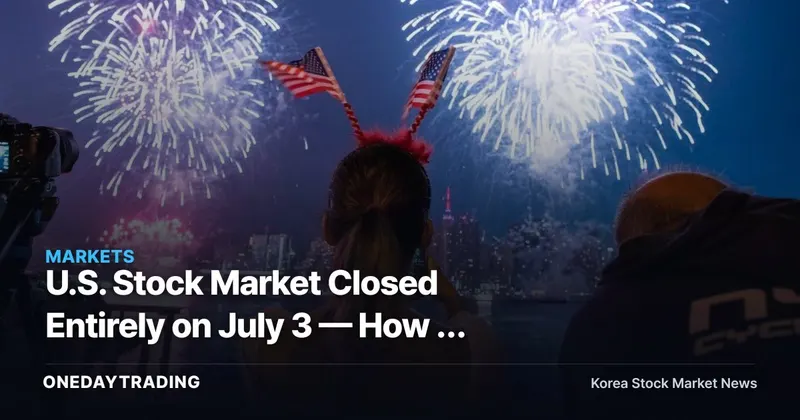
The New York Stock Exchange (NYSE) and the Nasdaq will be closed for the entire session on Friday, July 3, as July 4th Independence Day falls on a Saturday this year. Under the U.S. convention of observing holidays that fall on weekends on the nearest weekday, the market holiday is shifted forward to Friday. The bond market responds by closing even earlier, wrapping up on Thursday afternoon. For domestic investors, what matters most is that these three days (Friday through Sunday) represent a complete blackout period for pricing signals out of New York.
Why It Matters Now
The market microstructure surrounding the closure matters more than the closure itself. The session immediately before a holiday typically sees thinner trading value, as institutional investors trim positions and bid-ask spreads widen. In years when the June jobs report also falls within the same week, the data release is often moved up by a day, concentrating volatility into the final trading session before the closure. What actually moves the market isn't the holiday itself, but this combination of a key data release landing in a low-liquidity window.
For the domestic market, the key risk is that even though the KOSPI and KOSDAQ will open as usual on Friday, there will be no New York closing price to reference. Until markets reopen Monday, domestic investors will have to hold three days' worth of positions based solely on Thursday's New York closing levels and futures indicators. The KRW/USD exchange rate also warrants attention, since offshore market liquidity thins out during this window, meaning volatility could run higher than usual even for news of similar magnitude.
Frequently Asked Questions
- When exactly is the U.S. market closed: The full trading day on Friday, July 3 is closed, and combined with the weekend, there is effectively no trading from Friday through Sunday.
- Why is the closure moved up by a day: Since July 4th Independence Day falls on a Saturday, under the U.S. holiday-observance convention the closure is shifted to the preceding weekday, Friday.
- Does the bond market close on the same schedule: Following SIFMA guidance, the bond market closes early Thursday afternoon and remains closed Friday, meaning bond market functionality winds down a full day earlier than the stock market.
- Is there no impact on the domestic market: The KOSPI and KOSDAQ will trade as usual, but the absence of a New York closing price creates a stretch with fewer directional reference points.
Related Stocks and Sector Impact
- Securities sector: The drop in trading value around the closure puts short-term pressure on brokerage fee income.
- Exporters (electronics, automotive): Increased KRW/USD volatility during the New York data blackout could widen share price swings for exporters with lower FX hedge ratios.
- Airlines and travel: Travel-demand indicators are often released the same week, coinciding with the U.S. holiday travel season.
- Domestic large-cap index-tracking ETFs: With the New York closing-price reference unavailable, it's worth monitoring for a wider potential tracking-error gap.
Investment Considerations
- During the low-liquidity session right before the closure, limit orders are preferable to market orders.
- Be sure to check the economic calendar for whether major indicators, such as the June jobs report, are being released a day earlier than usual.
- When markets reopen Monday, check New York futures and Asian market reactions first before adjusting positions.
- Given the potential for increased KRW/USD volatility during the closure window, consider trimming short-term leveraged positions.
Overall Outlook
The closure itself is a recurring annual calendar event and not a directional catalyst on its own. However, in years when a low-liquidity window coincides with a major data release, volatility in the final session before the closure can run higher than usual, so short-term traders should adjust position sizing accordingly. For long-term investors, conversely, the three-day information gap can serve as a useful window to tune out noise while waiting for the next major catalysts — the July jobs report and the FOMC minutes.
This article was automatically summarized and analyzed based on the original news source. Read the original article (MarketWatch)