
At a Glance
The repeated shutdowns at Saeul Unit 3 are unlikely to disrupt Korea Electric Power Corporation's earnings immediately. Instead, they are a negative catalyst that adds a discount factor to the new reactor's commercial-operation schedule and confidence in South Korea's nuclear operations. The impact should remain limited if the issue is confined to the drain piping and testing resumes quickly, but the longer the investigation and repairs take, the more schedule uncertainty—not lost generation—will come into focus.
A manual shutdown is a controlled measure in which operators halt a reactor after detecting an abnormal condition so they can stabilize the equipment and perform repairs. According to Yonhap News Agency's Sept. 6 report, the Saeul Nuclear Power Site said there was no radiation impact and the plant remained stable.
Why It Matters Now
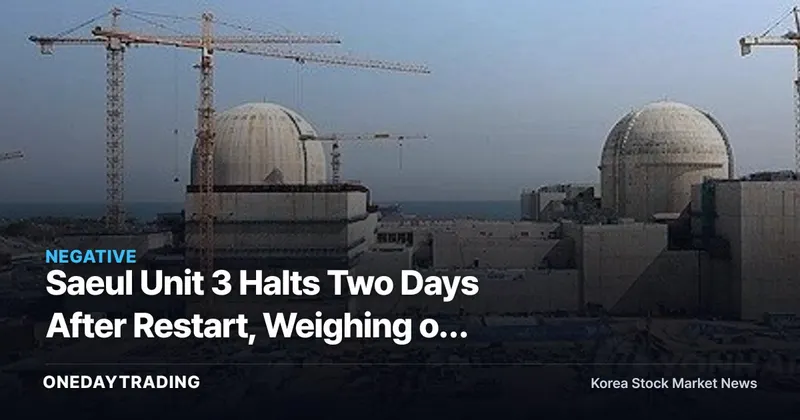
Saeul Unit 3 is a 1.4 GW nuclear reactor. After receiving an operating license from the Nuclear Safety and Security Commission last December, it had been undergoing tests that gradually increased its output ahead of commercial operation. With the completed facility just short of becoming a revenue-generating asset, the key variable is no longer construction progress but when testing will be completed.
The immediate cause of the manual shutdown at 3:01 p.m. on Sept. 6 was a leak detected in piping used to drain condensate from steam supplied to the turbine. The incident has not been identified as a radiation accident involving a core reactor system, but the timing is concerning because the unit stopped again just two days after receiving approval to restart. A nuclear plant does not translate into generation and cash flow merely upon completion of construction; it must first clear regulatory reviews, ramp up output and transition to commercial operation.
The previous shutdown was different in nature. On Aug. 11, while restoring output after completing a test that disconnected power transmission at 80% reactor output, Saeul Unit 3 automatically shut down because an operator entered an incorrect setting for the turbine control-valve position limiter. The Nuclear Safety and Security Commission completed its investigation and approved the resumption of testing on Sept. 4, but a new equipment issue—the piping leak—has now emerged. The consecutive occurrence of human error and equipment failure invites greater scrutiny of the overall commissioning-management system, beyond the individual causes.
Key Issues
- Safety and scheduling should be assessed separately. The announcement that there was no radiation impact eases safety concerns. However, the effect on the commercial-operation schedule cannot be ruled out until the cause is analyzed and repairs are completed.
- The two shutdowns had different causes. The August shutdown resulted from an incorrect control-valve setting, while the September shutdown involved a leak in steam-condensate drain piping. Rather than treating them as a recurring single defect, personnel, procedures and equipment should be examined separately.
- 1.4 GW is potential generating capacity, not current earnings. Commissioning must be completed before the asset's utilization rises and its capacity becomes available to the Korea Electric Power Corporation grid.
- The scope of the cause is the key dividing line. If the leak is limited to a localized section of piping, the repair burden should remain contained. If further inspections uncover problems in related equipment, the testing schedule and approval process could be prolonged.
Impact on Related Stocks and Sectors
- Korea Electric Power Corporation is the listed parent company exposed to Saeul Unit 3's operating schedule through Korea Hydro & Nuclear Power. A prolonged series of shutdowns would delay the addition of new generating capacity, but it is too early to estimate the earnings impact because neither the repair period nor any change to the commercial-operation schedule has been disclosed.
- Doosan Enerbility and other nuclear power equipment companies are not facing a direct signal of order cancellations. However, the quality of commissioning at a new domestic nuclear plant may serve as a qualitative factor when overseas customers assess the delivery performance and operating reliability of Korean reactor technology.
- KEPCO Engineering & Construction and the nuclear engineering industry sector need to watch whether the defect review expands to include the design. Current reporting provides no basis for linking the incident to a design flaw.
- The nuclear maintenance and instrumentation industry sector could see greater demand for work if the scope of inspections expands. However, interpreting short-term maintenance demand as an industry-wide increase in new orders would overstate the scale of the incident.
Points for Investors to Watch
- Investors should first confirm the cause of the piping leak and the scope of replacement or repairs to be announced by the Saeul Nuclear Power Site. Expectations of a restart without a disclosed cause amount to schedule speculation.
- Watch whether the Nuclear Safety and Security Commission conducts additional inspections and when it approves the resumption of testing. A delayed approval or broader inspection scope would reduce visibility into the transition to commercial operation.
- When assessing the impact on Korea Electric Power Corporation's share price, distinguish the shutdown itself from any change to the scheduled commercial-operation date. A two-day sequence of events provides no basis for calculating annual lost generation or reduced profit.
- Nuclear-related stocks should not be treated as a single group. The pathways through which this incident could affect earnings differ among operators, engineering firms, equipment manufacturers and maintenance providers.
Overall Outlook
The base-case scenario is that the remaining commissioning tests resume after the source of the leak is identified and localized repairs are completed. In that case, establishing a record of faithfully following safety procedures would matter more than the financial impact on Korea Electric Power Corporation and the nuclear supply chain. Conversely, if inspections of related piping expand into other systems, uncertainty over the commercial-operation schedule would increase, potentially undermining confidence in the project-schedule management and operating reliability emphasized in overseas nuclear bids.
Even if the share price reacts first, the operational sequence does not change. A new reactor must resume testing, ramp up output and transition to commercial operation before its utilization and earnings contribution materialize. The next investment judgment should rest on three factors: the Saeul Nuclear Power Site's findings on the cause, the Nuclear Safety and Security Commission's restart decision and whether the commercial-operation schedule changes.
Frequently Asked Questions
Why did Saeul Unit 3 shut down again?
The Saeul Nuclear Power Site manually shut down the reactor on Sept. 6 to stabilize the equipment and perform repairs after detecting a leak in steam-condensate drain piping. This is separate from the operator setting error that caused the automatic shutdown in August, and the cause of the latest leak remains under investigation.
Did the Saeul Unit 3 shutdown create a radiation risk?
According to Yonhap News Agency, the Saeul Nuclear Power Site said the shutdown had no radiation impact and the plant remained stable. Nothing disclosed so far supports treating the piping leak as a radiation accident.
How will the Saeul Unit 3 shutdown affect Korea Electric Power Corporation's share price?
It is a negative catalyst in the short term, but the actual earnings impact will depend on the repair period and whether the commercial-operation schedule changes. If commissioning recovers quickly, the impact should be limited. Continued delays would increase concern that the earnings contribution from 1.4 GW of generating capacity will be pushed back.
Lee Do-yoon, One Day Trading Editorial Board Member
Korea Electric Power Corporation Key MetricsAs of 2026-09-06
| Period Return | 1 Week -1.23% 1 Month -9.94% |
|---|---|
| Trading Value · Trading Volume | 27.8 billion won · 860,534 shares |
| Supply-Demand (Order Flow) | Foreign Investors Net Selling of 5.8 billion won Institutional Investors Net Buying of 1 billion won |
Price and supply-demand (order flow) data are real-time figures from Korea Investment & Securities (KIS); supply-demand (order flow) and news-tone assessments are calculated independently by One Day Trading.
Supply-Demand (Order Flow) and Momentum Assessment🔴 Caution
Foreign investor flows and momentum are negative, warranting caution for now.
- ▼Trend AlignmentShort- and medium-term bearish alignment (Day -0.9% · 1 Week -1.2% · 1 Month -9.9%)
- ▼52-Week PositionNear the 52-week low at 4%
Upcoming Dates to Watch
- 09.10Futures and Options ExpirationMediumQuadruple witching—watch for volatility and supply-demand (order flow) disruptions
- 09.16FOMC Policy Rate DecisionHighU.S. Federal Reserve monetary-policy announcement—direction of interest rates and the dollar
- 10.08Index Options ExpirationLowKOSPI 200 options expiration
- 10.22Bank of Korea Monetary Policy BoardHighBenchmark interest rate decision meeting
This article was automatically summarized and analyzed from the original news report. View Original Article (Yonhap News Agency—Industry)