
Key Takeaways
LG Electronics is expanding its recovery and recycling of waste refrigerant from home appliances to about 81 tons per year — roughly sevenfold the 2024 level. The company said this would cut greenhouse gas emissions equivalent to those produced by approximately 30,000 passenger cars. The initiative carries more significance from a long-term perspective — ESG ratings, environmental regulatory compliance, and the foundation for a circular-economy business — than from an impact on near-term earnings.
What Happened
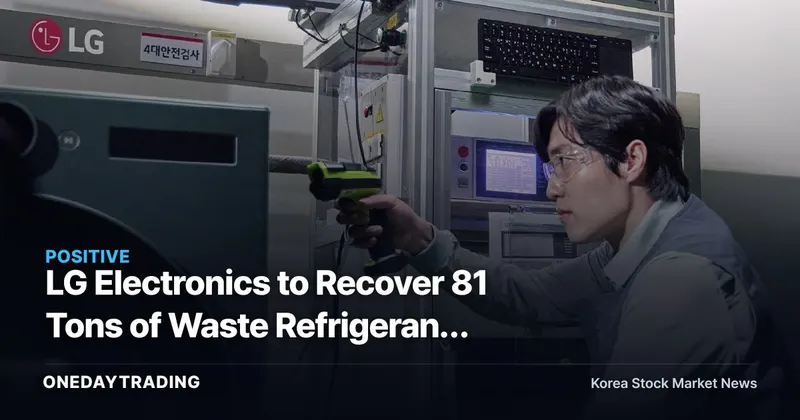
At the core of this announcement is LG's plan to build out a genuine resource-circulation ecosystem — recovering and recycling refrigerant used in refrigerators, air conditioners, and similar appliances at the disposal stage, rather than releasing it directly into the atmosphere. By setting a recovery target of 81 tons per year, a sevenfold increase from 2024, the company signals its intent to move beyond a one-off campaign and establish a permanent system backed by recovery infrastructure and a partner network.
Depending on the type, refrigerants can have a warming potential hundreds to thousands of times greater than the same amount of carbon dioxide. That is precisely why the company was able to translate the recovery of 81 tons of waste refrigerant into an emissions-reduction figure equivalent to roughly 30,000 passenger cars — a relatively small physical quantity can produce an outsized carbon-reduction effect in this area.
Background and Context
Resource circulation in home appliances has moved well beyond simple eco-friendly PR and is increasingly taking on the character of regulatory compliance. Regulations at home and abroad are progressively tightening restrictions on the use and emission of high-global-warming-potential refrigerants (F-gases), and for manufacturers selling appliances in global markets, establishing recovery and reduction systems in advance is directly tied to export competitiveness.
At the same time, capital markets have settled into a structure where ESG rating metrics influence institutional investors' decision-making and a company's cost of funding. Presenting quantifiable carbon-reduction performance and circular-economy data can favorably affect ESG ratings as well as trading terms with global customers and distribution partners.
Impact on the Market and Stocks (Tickers)
- LG Electronics: With home appliances as its core business, proactively building out a recovery system amid tightening refrigerant regulations is a positive factor for mitigating export risk and improving its ESG rating. That said, recovery and recycling costs could add to expenses in the near term, so the benefit is closer to long-term brand and regulatory value than to an immediate boost to profit.
- Samsung Electronics (005930): As a fellow global appliance maker facing the same refrigerant regulations and resource-circulation requirements, it faces pressure from a rival's move that could raise the industry-wide bar.
- Waste and recycling processors: Rising demand for appliance collection, dismantling, and refrigerant treatment could benefit these firms in terms of upstream volume, though their earnings remain sensitive to changes in recovery pricing and processing regulations.
- Refrigerant and materials chemical companies: As demand shifts toward low-global-warming-potential alternative refrigerants, suppliers in the next-generation refrigerant supply chain stand to gain a structural tailwind.
Investor Checkpoints
- Check the actual waste refrigerant recovery volume, target achievement rate, and related capital spending disclosed in upcoming quarterly/annual earnings reports and sustainability reports.
- Monitor how changes in the timeline and scope of domestic and international F-gas regulations feed through into appliance export pricing and certification costs.
- Track business disclosures to see whether resource circulation remains merely a cost item or evolves into a revenue-generating structure, such as sales of recycled materials.
- Monitor changes in major ESG ratings such as MSCI's, along with the institutional-investor supply-demand (order flow) linked to them.
Outlook
Given the clear trajectory toward tighter regulation, companies that establish recovery and reduction systems early stand a good chance of gaining an edge in export certification and global trade. If resource circulation expands from a cost center into a business model in its own right, valuations could rise accordingly. On the other hand, the added cost of recovery and processing may weigh on near-term margins, and in a period of softening appliance demand, it could take time before the benefits of eco-friendly investment are reflected in the share price — both factors worth keeping in mind.
LG Electronics in Real-Time Data
LG Electronics's most recent closing price was 221,000 won (-3.28% from the previous day), and the composite signal combining foreign/institutional investor supply-demand (order flow) with news and momentum reads 🟡 Neutral — Wait and See. With positive and negative signals mixed, this is a stock (ticker) to keep watching.
- ▲ News Flow — 2 positive catalysts vs. 1 negative catalyst — Positive catalysts lead
Recent related news skews favorable, with 2 positive catalysts versus 1 negative catalyst.
※ Price and foreign/institutional investor supply-demand (order flow) data are provided by Korea Investment & Securities (KIS) and reflect figures as of the time of publication.
This article is automatically summarized and analyzed content based on the original news report. View original (Maeil Business Newspaper - Corporate)