
At a Glance
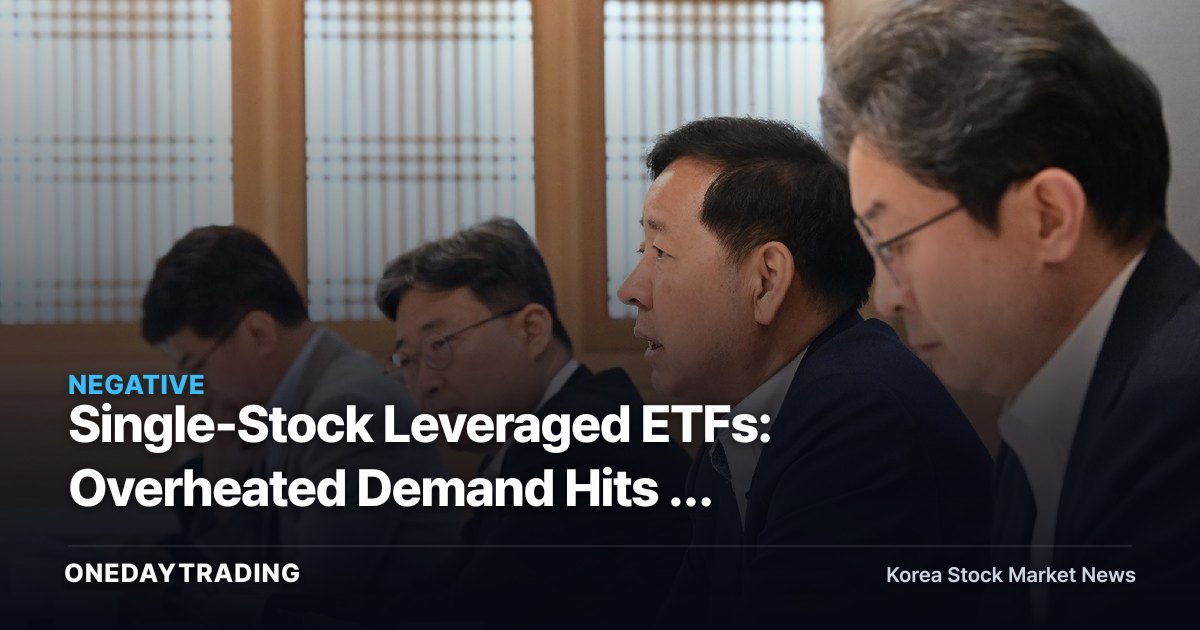
Financial authorities have signaled they are reviewing an individual investment limit for single-stock leveraged ETFs. The figure cited as an example is within 20% of an investor's total financial investment product holdings.
What this really signals isn't a problem confined to a single leveraged product. It's the start of a regulatory cycle that touches everything at once: closing-price supply-demand (order flow) in large-cap stocks like Samsung Electronics (005930) and SK Hynix (000660), brokerage trading value, and even how ETF managers rebalance.
Why It Matters Now
The market has been using single-stock leveraged ETFs as a quick way to ride the semiconductor rally. The issue is that leveraged products don't simply track their underlying stock. When the price moves, the manager must adjust exposure to the underlying asset to maintain the target multiple. When this rebalancing clusters right before the market close, it amplifies closing-price volatility — and predictive trading aimed at that volatility further inflates trading activity.
Authorities first raised the entry barrier. The basic deposit required to buy domestic and overseas single-stock leveraged products is being tightened from 10 million won (which could previously include substitute securities) to 30 million won in cash. The effective date was also moved up from sometime in August to July 31. The cash requirement narrows the workaround of using substitute securities — a measure that suppresses leveraged demand through funding conditions rather than price.
The core of this latest statement is that authorities are leaving the door open for further steps if this isn't enough. The message was that if demand doesn't cool, they would also consider an individual investment cap, periodic re-education requirements, mock trading, and prior investment-experience requirements. In particular, the 20% cap would restrict the weight of single-stock leveraged holdings within an investor's own portfolio. What the market has already priced in is the tightened deposit requirement. What it hasn't fully priced in yet is how much trading value would fall if the aggregate cap is actually institutionalized.
FAQ
- Why does the 20% cap matter? The deposit requirement is a threshold; the investment cap is a ceiling. Even an investor who meets the 30 million won cash requirement would have less room for additional purchases if the share of single-stock leveraged holdings within their total financial investment products is capped.
- Is this a negative catalyst for Samsung Electronics and SK Hynix shares? It isn't a negative catalyst that directly lowers earnings estimates. However, if short-term buy/sell pressure through leveraged ETFs eases, intraday and closing-price volatility could decline.
- What's the impact on brokerages? If leveraged ETF trading contracts, brokerage commissions and liquidity-provider-related trading opportunities could shrink. Brokerages with a large share of retail investor trading are especially sensitive to a slowdown in trading value.
- Why do managers need to spread out rebalancing? When orders cluster right before the market close, the closing price swings more from supply-demand (order flow) than from underlying fundamentals. Spreading rebalancing throughout the trading session improves tracking stability but raises operational complexity.
Related Stocks (Tickers) and Sector Impact
- Samsung Electronics (005930). A flagship underlying asset for single-stock leveraged ETFs. The regulation affects supply-demand (order flow) volatility more than the semiconductor business outlook itself.
- SK Hynix (000660). A stock (ticker) where HBM and AI-chip expectations have combined with leveraged demand. If aggregate limits are introduced, short-term overheated supply-demand (order flow) could cool.
- Kiwoom Securities. A brokerage highly sensitive to retail investor trading value. A contraction in leveraged ETF trading would weigh on brokerage revenue.
- NH Investment & Securities / Korea Investment Holdings. Both their liquidity-provider role in single-stock leverage and market-making burden are affected simultaneously. Being asked to keep liquidity provision at an appropriate level requires balancing profit opportunity against risk management.
- Mirae Asset Securities. A major brokerage exposed to both the ETF ecosystem and retail trading. As regulatory intensity rises, risk management takes priority over product expansion.
Investment Considerations
- Trading value after July 31. Watch how much the average daily trading value of single-stock leveraged ETFs falls once the 30 million won cash deposit requirement takes effect.
- Closing-price volatility. If spreading out rebalancing actually works as intended, sharp quote swings in Samsung Electronics and SK Hynix right before the market close could ease.
- Further regulatory language. The moment authorities move the 20% cap from an example to a formal institutional proposal, brokerage stocks and ETF-related supply-demand (order flow) will face an additional discount factor.
- The counter-scenario. If investment demand holds up even after the tightened deposit requirement, regulatory risk grows further. A rally where supply-demand (order flow) doesn't cool may look like a short-term positive catalyst, but it becomes the trigger for a policy response.
Overall Outlook
Regulation of single-stock leveraged ETFs is not news that undermines the earnings outlook for large-cap semiconductor stocks. As such, the medium-term direction of Samsung Electronics and SK Hynix will still be determined by memory prices, HBM demand, and customer orders. But the story changes if share prices had been accelerating on leveraged supply-demand (order flow) rather than fundamentals. Authorities are now trying to slow that pace.
The optimistic scenario is clear: if the tightened deposit requirement and spread-out rebalancing alone are enough to cool the overheating, the market can shed its volatility premium and return to being driven by underlying earnings. Conversely, if this escalates into a 20% aggregate cap and mandatory mock trading, the turnover speed of retail capital will slow. The next checkpoints to watch are trading value and closing-price volatility after the July 31 implementation, and any further remarks from the July 29 National Assembly Political Affairs Committee briefing. The numbers to watch now, ahead of the won or interest rates, are leveraged ETF balances and order density right before the market close.
This article was automatically summarized and analyzed based on the original news report. View original (Maeil Business Newspaper, Securities)