
TSMC’s Decline Highlights Pressure on Taiwan’s Stock Market
TSMC fell 4.69% on the 6th, while Taiwan’s TAIEX finished below the 40,000 mark. For Korean investors assessing the move reported by Maeil Business Newspaper’s securities desk, the key takeaway is not that all semiconductor companies moved in the same direction, but that Taiwan’s flagship company and Chinese chip stocks showed differing price reactions. The available evidence is insufficient to extrapolate a sharp drop (plunge) in one market directly into the business outlook for every semiconductor company.
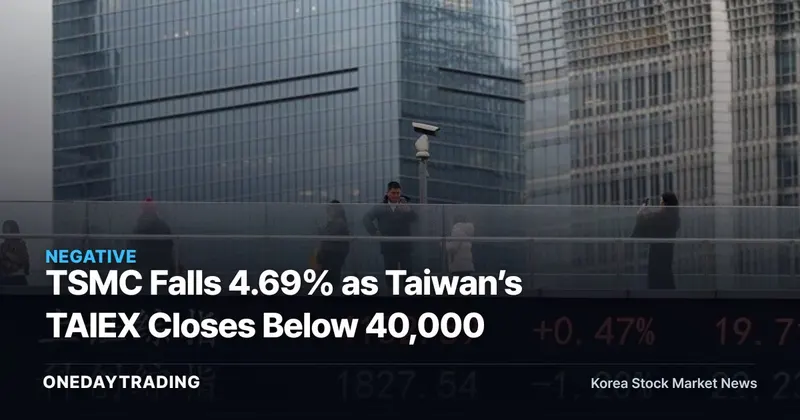
Taiwan’s TAIEX tracks price movements in the Taiwanese stock market. On the 6th, it closed at 39,701.64, down 1,873.08 points, or 4.51%, from the previous session, after falling as much as 8.99% in early trading. Although the closing price reflected a smaller decline than the intraday low, the index failed to regain the 40,000 level.
Seven-Session Decline Compounded by Foreign Net Selling
The decline was not limited to a single day. By the 6th, Taiwan’s TAIEX had fallen for seven consecutive sessions and was down 12.18% for the week. It had declined 20.3% from its high of 49,822.55 on the 6th of last month. The weekly loss was the largest recorded since 2001.
Supply-demand (order flow) moved in the same direction as prices. Since the start of the fourth quarter, foreign investors have recorded foreign net selling of more than $45 billion, equivalent to approximately 61 trillion won, in Taiwanese stocks. Because the precise total was not provided, the verifiable figure is limited to “more than $45 billion.” If this selling eases while the index remains under pressure, it could provide evidence that the pressure is subsiding. If it continues, however, a price rebound alone would not be enough to confirm a trend reversal.
TSMC, the largest company by market capitalization in Taiwan’s stock market, had declined for seven consecutive sessions through the 6th. Its intraday loss widened to as much as 9.82% on the day. What can currently be confirmed is that the flagship stock (ticker) and the index weakened together; the data do not include changes in TSMC’s shipment volume, yields, customer orders, or capital expenditure. The share-price shock therefore should not be treated as equivalent to a change in semiconductor business indicators.
CXMT Weakness and Hua Hong Strength Reveal a Market Divide
Mainland Chinese and Hong Kong markets also declined. On the 6th, the Shanghai Composite fell 1.10%, the CSI 300 dropped 1.44%, and Hong Kong’s Hang Seng Index lost 1.27%. The technology-heavy STAR 50 Index fell 2.60%. The breadth of the decline makes it difficult to view the move solely as a correction in Taiwan.
Individual semiconductor stocks moved in different directions. CXMT fell 4.98% on the 6th, while Hua Hong Semiconductor gained 6.86%. This indicates that stocks within the same semiconductor category did not show a uniform price response that day. Because the data provide no changes in the two companies’ earnings, orders, utilization rates, or yields, the business reasons behind the divergent moves cannot be determined.
- TSMC: Fell 4.69% based on the closing price on the 6th and declined as much as 9.82% intraday. Investors should first assess the price volatility concentrated in Taiwan’s flagship semiconductor stock.
- CXMT: Fell 4.98% on the 6th, moving in the same direction as the weaker STAR 50 Index.
- Hua Hong Semiconductor: Rose 6.86% on the 6th, demonstrating why semiconductor stocks across Greater China cannot be treated as a single weak group.
Price and Supply-Demand Conditions to Check Before Policy
Tension was also evident in safe-haven asset prices. The yield on China’s 10-year government bonds fell to a record intraday low of 1.58% on the 6th. While the decline in equity indexes and the low in government bond yields occurred on the same day, the available data are insufficient to establish a causal relationship between the two moves.
Lai Ching-te said he would monitor financial-market conditions and prepare stabilization measures. The People’s Bank of China has also recently introduced measures to stabilize capital markets. However, the specific details of the measures on either side and their subsequent market impact have not been confirmed. The existence of a plan should not be interpreted as proof that price stability has been achieved.
- If Taiwan’s TAIEX recovers above 40,000, assess whether closing-price pressure has eased.
- If foreign net selling of Taiwanese stocks decreases, check whether supply-demand (order flow) is reversing.
- Distinguish between whether TSMC’s decline continues and whether CXMT and Hua Hong Semiconductor maintain their divergent directions.
- Assess stabilization measures from Lai Ching-te and the People’s Bank of China alongside the market’s price reaction after their specific details are confirmed.
Key TSMC MetricsAs of 2026-11-06
| Period Returns | 1 Week -12.90% 1 Month -20.35% |
|---|---|
| Trading Value · Trading Volume | 160,462 Shares |
| Recent News Tone | Positive Catalyst 0 · Negative Catalyst 1 |
Price and supply-demand (order flow) data are real-time figures from Korea Investment & Securities (KIS), while supply-demand (order flow) and news-tone tallies are calculated independently by One Day Trading.
Supply-Demand and Momentum Assessment🟡 Neutral · Wait-and-See
Positive and negative signals are mixed, warranting a wait-and-see approach.
This article was automatically summarized and analyzed based on the original news report. View Original Article (Maeil Business Newspaper Securities)