
Summary
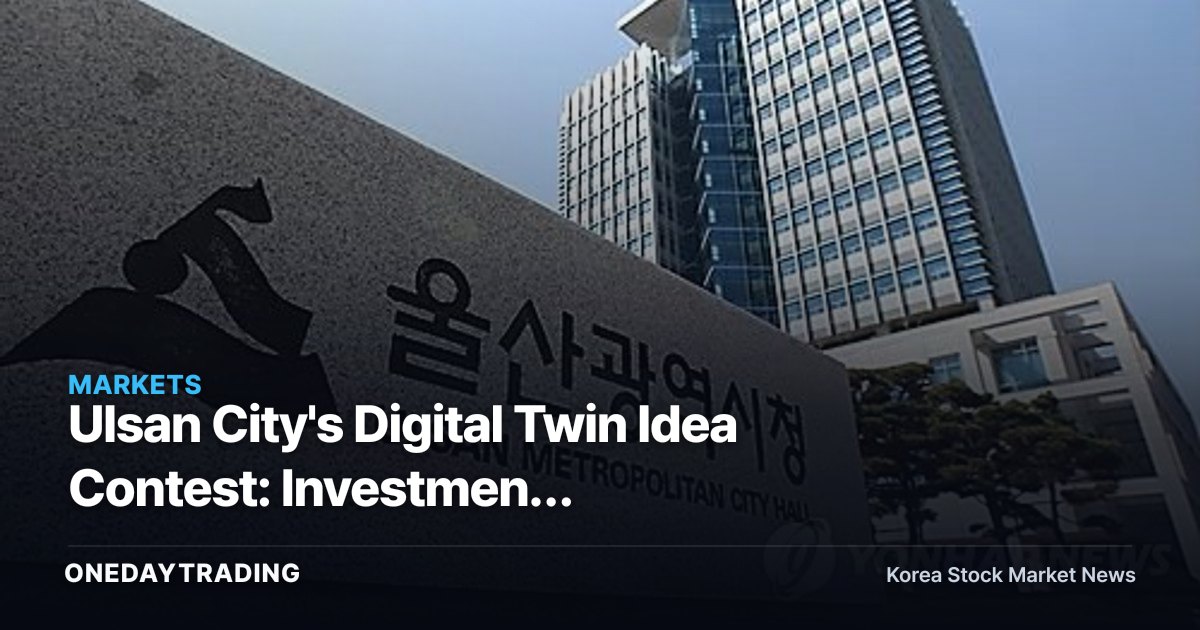
Ulsan City is launching an idea contest with the aim of tackling urban challenges through digital twins. The single event itself is not a share-price catalyst, but the trend of local governments bringing virtual modeling technology into public administration warrants attention from the standpoint of a gradually expanding public procurement market.
For investors, the key is not the outcome of the event itself, but whether such contests will translate into actual service contracts and system-building budgets down the line. Public digital twins only show up in the earnings of related companies once they move from one-off campaigns to ongoing infrastructure investment.
What Happened
From June 29 to July 31, a span of roughly one month, Ulsan City will run its 2026 Ulsan Virtual Modeling Application Idea Contest. The aim is to uncover solutions to local issues using digital twin technology—that is, replicating real-world cities, facilities, and environments as data-driven virtual models for simulation.
The contest is largely an early-stage effort to gather ideas from citizens and experts and gauge their applicability to public administration. It appears geared toward pre-validating, in virtual space, the urban problems Ulsan faces, such as industrial-complex safety, transportation, the environment, and disaster response.
That said, no specific budget size or follow-up procurement schedule has been presented at this stage. As a result, it is difficult to draw a direct link between this announcement alone and any specific company's revenue growth; it is more reasonable to read it as a sign that the foundation of the public digital twin market is broadening.
Structural Background
Digital twins began in manufacturing and plant operations and have steadily broadened their scope into urban and infrastructure administration. Regions like Ulsan—densely packed with large industrial complexes and petrochemical and shipbuilding facilities—carry greater safety and environmental risks, giving them relatively strong potential demand for virtual models that simulate accidents in advance.
Domestically, central-government policy foundations are already in place, such as the Ministry of Land, Infrastructure and Transport's Digital Twin Land initiative, and cases of local governments applying these to regional issues continue to accumulate. Once the public sector establishes standards and procurement practices, surveying, spatial information, simulation software, and cloud infrastructure become chained together in a linked structure.
Stock and Industry Sector Impact
- Spatial information and surveying solution providers: Urban digital twins are built on precise 3D spatial data. As public procurement increases, this opens a path for expanding upstream demand for data-building and data-updating service revenue.
- Engineering and plant IT: Given Ulsan's characteristics, demand for industrial-complex safety simulation is central, and firms handling plant design and operational data are direct beneficiary candidates.
- Cloud and infrastructure operators: Running virtual models requires computing and storage resources, allowing indirect benefits in tandem with the shift toward public-sector cloud adoption.
- Simulation and visualization software: Game and graphics engine technology is being repurposed for urban visualization, broadening the application scope for related solution companies.
Bull vs. Bear Scenarios
On the bull side, if this contest serves as a primer and digital twin budgets at Ulsan and other local governments become a regular fixture, the share of public-sector revenue at spatial information and engineering IT firms could rise structurally. Policy continuity and stricter industrial-complex safety regulations are factors underpinning this demand.
On the bear and risk side, it is clear that the contest itself is an early-stage event with no confirmed budget. Public projects are always subject to procurement delays, pricing pressure, and the possibility that commercialization falls through, and digital-twin-related stocks tend to have valuations priced in on expectations alone—making volatility large during any earnings gaps. Investors should be wary of over-interpreting a one-off event as earnings momentum.
Investor Action Points
- After the contest ends, check for follow-up main-project procurement notices and budget sizes from Ulsan City and the Ministry of Land, Infrastructure and Transport—this is the dividing line for whether it translates into actual revenue.
- Examine the trend in the share of digital twin and spatial information revenue in related companies' public-contract disclosures and quarterly earnings.
- Monitor the policy budget schedules of central-government initiatives such as Digital Twin Land, along with the number of local-government adoption cases, to gauge the pace at which the market base is expanding.
- For stocks that have posted a sharp gain (surge) on thematic expectations alone, assess actual order substance separately from valuation and watch out for volatility lacking an earnings basis.
This article is content automatically summarized and analyzed based on the original news report. View original (Yonhap News Industry)