
Summary
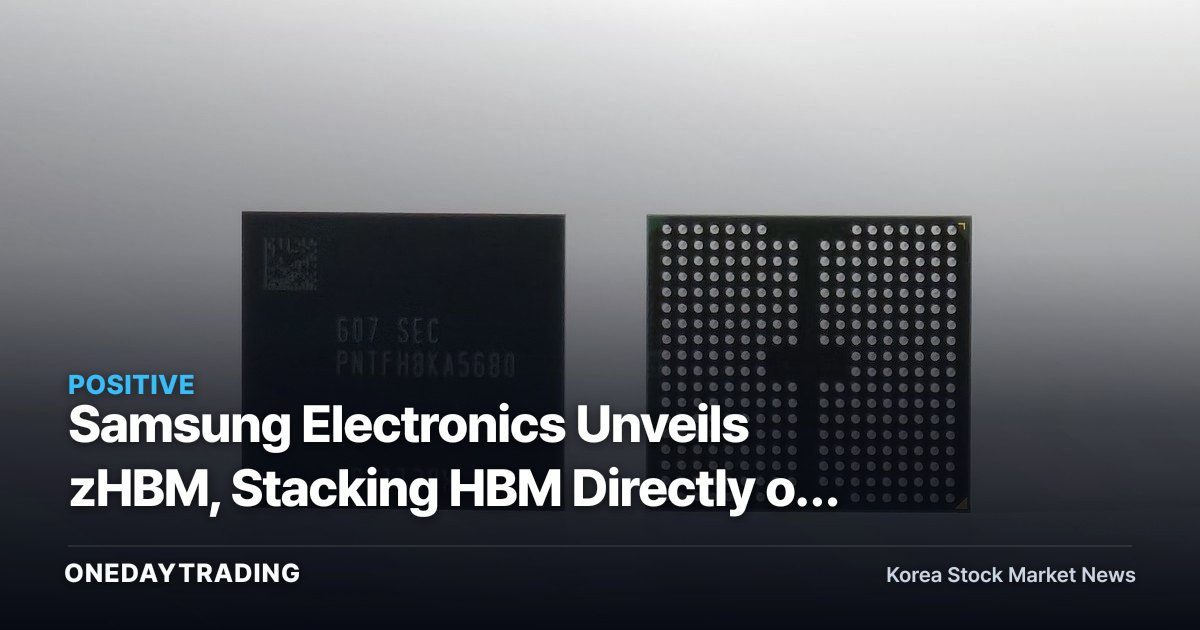
Samsung Electronics has unveiled zHBM, a next-generation memory technology that stacks HBM directly on top of the graphics processing unit (GPU) — a world first. By shortening the physical distance data must travel, the technology is said to ease the memory bottleneck in the advanced HBM5 generation by roughly a factor of eight. At the same event, Samsung also introduced 400-layer NAND for the first time, in what looks like an attempt to reclaim technology leadership across its entire memory lineup.
What Happened
Until now, memory has sat side by side with the GPU on an interposer. 2.5D packaging — connecting the logic die and the HBM die through a silicon interposer — became the industry standard for a simple reason: stacking heterogeneous dies vertically made it difficult to manage heat and signal interference. Samsung's newly unveiled zHBM tackles that constraint head-on. It places HBM directly on top of the GPU die, shortening the physical distance data must travel — and a shorter path means lower signal latency and reduced power consumption at the same time.
Samsung itself describes the technology as easing the memory bottleneck in the advanced HBM5 generation by about a factor of eight. An eightfold improvement in the bottleneck means compute units spend that much less time waiting for data — a variable that directly determines the real-world compute utilization of a GPU cluster. The announcement carries extra weight because it comes at a moment when the AI chip race has shifted from "how fast can you make the GPU" to "how well can you keep feeding that GPU with data without starving it."
At the same event, 400-layer NAND was also unveiled for the first time. If HBM is a technology aimed at resolving the bottleneck next to compute, 400-layer NAND signals Samsung's intent to retake the lead in the storage-density race. Claiming a world first on both the DRAM and NAND fronts simultaneously reads as an attempt to restore Samsung's technology narrative — shaken by weakness in its foundry business — starting with memory.
Structural Backdrop
In the HBM market, SK hynix has held the upper hand by securing early supply deals with Nvidia, while Samsung Electronics has been seen as lagging due to delays in HBM3E quality certification. If a GPU-stacked memory approach like zHBM actually makes it onto product roadmaps, the axis of competition would shift — from who can mass-produce 12-layer or 16-layer stacks first, to who can achieve viable yields on 3D heterogeneous stacking first. That said, this remains a concept-stage disclosure, and the announcement provides no confirmation of mass-production yields or a commercialization timeline.
Stock (Ticker) and Sector Impact
- Samsung Electronics — Both zHBM and 400-layer NAND are in-house developments, reaffirming the memory division's technology leadership. The move looks aimed at offsetting weak foundry order intake with a stronger memory narrative.
- SK hynix — A competitive pressure variable to its lead in HBM. If Samsung pulls ahead with a heterogeneous stacking approach, it could influence customer discussions around vendor diversification.
- Hanmi Semiconductor — A supplier of back-end equipment such as TC bonders for HBM. If 3D heterogeneous stacking requires new equipment specifications, it opens a path to benefit from equipment replacement demand.
- EO Technics — An equipment maker for HBM-related laser annealing and bonding, positioned further down the value chain where changes in stacking structure translate into demand for process equipment.
Bull vs. Bear Scenarios
Bull scenario — If zHBM translates into an actual roadmap and gets adopted in GPU customers' next-generation architectures, Samsung Electronics gains a concrete basis for reclaiming HBM market share from SK hynix. Add 400-layer NAND to the mix, and the story of a full memory-wide technology premium recovery becomes complete.
Bear scenario — This disclosure leans heavily toward a concept and prototype. With actual mass-production yields, customer certification timelines, and cost structure still undisclosed, the lag between a technology demonstration and an actual revenue contribution remains large. Samsung has a track record of unveiling new technology first only to fall behind SK hynix in mass-production certification, so it's premature to treat this announcement alone as grounds for a valuation re-rating.
Investor Action Points
- Check whether Samsung Electronics' next earnings release mentions a mass-production timeline or customer certification progress for zHBM and 400-layer NAND.
- Compare the timing of SK hynix's next-generation HBM roadmap announcement to reassess the direction of the technology gap.
- Watch for order disclosures from HBM back-end equipment makers such as Hanmi Semiconductor to confirm actual demand shifts in equipment specifications.
- Keep an eye on GPU customers' next-generation architecture announcements for signs of adoption of heterogeneous-stacked memory.
Samsung Electronics: Real-Time Data Snapshot
Samsung Electronics's most recent closing price is 246,000 won (0.00% vs. the previous day), and the signal combining foreign investor/institutional investor supply-demand (order flow) with news and momentum reads 🟡 Neutral / Wait-and-see. With bullish and bearish signals mixed, this is a stock to watch.
- ▼ News flow — 2 positive catalysts vs. 3 negative catalysts — negative catalysts lead
Recent related news skews negative, with 2 positive catalysts versus 3 negative catalysts.
※ Price and foreign/institutional investor supply-demand (order flow) data are provided by Korea Investment & Securities (KIS) and reflect figures as of publication.
This article is automatically summarized and analyzed content based on the original news report. View original (Maeil Business Newspaper - Corporate)