
Key Takeaways
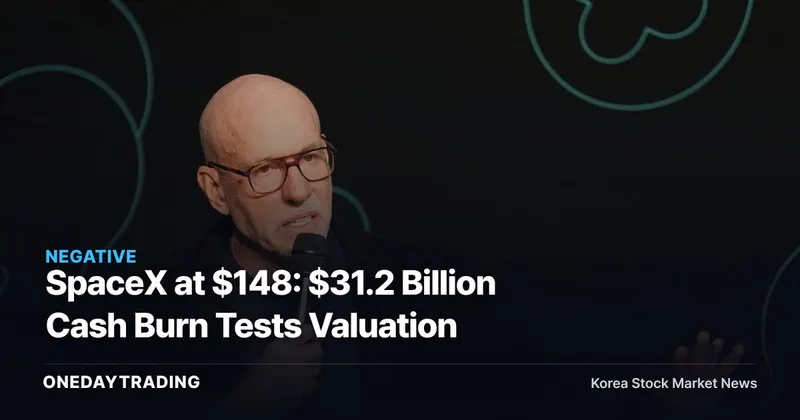
When assessing SpaceX at $148 per share, the first figure to consider is not its $100 billion in cash, but the $31.2 billion in free cash outflow over the last 12 months. Revenue has grown, but there is still insufficient evidence that massive AI compute investment has translated into profits and cash generation.
The current share price reflects not only the business outlook but also a limited public float and index-inclusion demand. Korean investors should therefore focus less on Scott Galloway’s $10-$30 valuation itself and more on whether capital efficiency can support the stock after the supply-demand (order flow) premium fades.
What Happened
According to Yahoo Finance, SpaceX raised more than $75 billion through its June 2026 Nasdaq initial public offering. The offering price was $135 per share, valuing the company at approximately $1.8 trillion. At the time of the report, the stock was quoted at $148, with a market capitalization of $1.91 trillion.
After listing, the stock climbed to $225 before falling by more than 50% to $105, then returned to trading above its offering price over the past two weeks. Scott Galloway, a marketing professor at New York University, valued the shares at $10-$30 on a podcast. This is an individual’s extremely bearish scenario, not the company’s outlook or the market consensus.
AI compute refers to the servers, accelerators, and data-center resources required for artificial intelligence processing. Citing the large bond issuance and AI capital spending immediately after the listing, Galloway characterized SpaceX as an AI infrastructure investment wrapped in the appearance of a space company.
Revenue Growth Has Not Translated Into Cash
According to Yahoo Finance, citing Fiscal.ai data, SpaceX’s revenue increased from $10.4 billion in 2023 to $23 billion over the last 12 months. However, its net loss was $4.6 billion in 2023 and $4.9 billion in 2025, widening to $8.2 billion over the last 12 months. Its operating margin during the same period was negative 16.2%.
The main driver of cash outflow was capital expenditure, which reached $41.1 billion over the last 12 months. After accounting for this spending, free cash flow was negative $31.2 billion. As long as revenue growth cannot cover equipment replacement and operating costs, the company’s valuation will remain more sensitive to financing terms than to future growth rates.
One-Year Payback Claim Faces Recurring Investment Risk
Chief Financial Officer Bret Johnson said during the second-quarter earnings call that AI compute spending had a payback period of less than one year. At the same time, he noted that maintaining growth requires continual replenishment of these assets, making the spending more akin to cost of revenue than traditional long-lived infrastructure.
Under this model, margins depend on more than how quickly the initial investment is recovered. The key issue is how much of the recovered cash must be reinvested in the next round of equipment purchases. Even if AI investment increases revenue, improvement in free cash flow will be delayed if replacement and expansion spending rises at the same pace.
Impact on the Market and Stock
- SpaceX: Only about 4%-5% of total shares were available for public trading immediately after the listing. Limited selling supply can magnify price moves from the same volume of buy orders, widening the gap between fundamentals and the share price.
- Index-tracking funds: Inclusion in the Nasdaq 100 triggered price-insensitive, mechanical buying by index funds. This supply-demand (order flow) stems from index weightings and assets tracking the index, not from improved profitability.
- Existing shareholders: SpaceX priced $25 billion of bonds less than two weeks after its listing. Additional borrowing affects shareholder value through interest expense, while new share issuance does so through dilution.
Investor Checklist
- Quarterly cash flow: Watch whether the $31.2 billion free cash outflow over the last 12 months narrows as revenue increases.
- AI investment payback: A key test will be whether the company’s stated payback period of less than one year is reflected in both operating margin and cash flow in upcoming earnings.
- Financing terms: Investors should monitor the size and interest rates of new bond offerings, as well as any additional equity issuance. The equation changes if capital expenditure rises beyond $41.1 billion.
- Tradable share supply: If lockup expirations or sales by existing shareholders increase the tradable float, the premium created by the scarcity of the 4%-5% float will be the first to weaken.
Outlook
Consensus estimates compiled by Tikr.com project that SpaceX’s revenue will rise from $44.63 billion in 2026 to $388 billion in 2030. Of 34 analysts, 25 rated the stock a buy, six a hold, and three a sell, with an average price target of $228.
On the other side is a forecast of approximately $280 billion in cumulative free cash outflow through 2030. If operating margins recover and cash outflow declines as revenue expands, the growth premium would gain fundamental support. Conversely, if recurring investment and new projects merely increase funding needs, dilution risk obscured by the limited public float may be priced in first.
Frequently Asked Questions
Is Scott Galloway’s $10-$30 SpaceX price target an official forecast?
No. The $10-$30 range is Galloway’s personal valuation presented on a podcast. Given the substantial gap from the average $228 price target among 34 analysts, it should be viewed as a bearish scenario rather than consensus.
Why does SpaceX need additional financing if it has $100 billion in cash?
Cash on hand and internally generated cash flow are separate metrics. Free cash outflow totaled $31.2 billion over the last 12 months, and cumulative outflow through 2030 is projected at approximately $280 billion. If the current pace of investment continues, the need for debt or additional equity issuance will rise again.
Which earnings metrics matter most when assessing SpaceX shares?
Investors should evaluate revenue growth alongside operating margin, capital expenditure, and free cash flow. In particular, whether the negative 16.2% operating margin improves and the $41.1 billion in capital expenditure generates cash returns will determine the economics of the company’s AI infrastructure investment.
Key SpaceX MetricsAs of 2026-09-08
| Period Returns | 1 Week +4.56% 1 Month +28.74% |
|---|---|
| Trading Value · Trading Volume | 49,122,393 Shares |
| Recent News Tone | Positive Catalyst 1 · Negative Catalyst 0 |
Price and supply-demand (order flow) data are real-time figures from Korea Investment & Securities (KIS), while supply-demand (order flow) and news-tone metrics are calculated independently by One Day Trading.
Supply-Demand (Order Flow) and Momentum Assessment🟡 Neutral · Wait and See
Positive and negative signals are mixed, suggesting a period of watchful waiting.
This article was automatically summarized and analyzed based on the original news report. View Original Article (Yahoo Finance)