
At a Glance
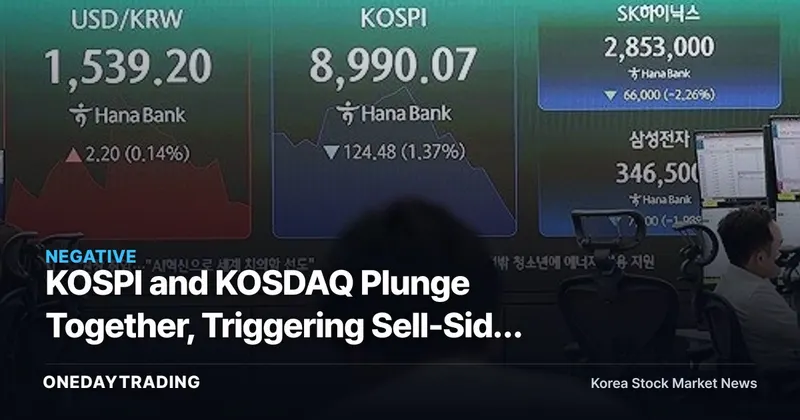
As Korean equities plunged intraday on the 23rd, a series of program sell-order suspensions — so-called sell-side sidecars — were triggered on both the KOSPI and KOSDAQ markets. A sidecar is a safety mechanism that halts program trading for five minutes when futures prices swing beyond a set threshold, cooling volatility; the very fact that it is triggered signals weakening market sentiment and a short-term skew in supply-demand (order flow).
Why It Matters Now
A sidecar is triggered when KOSPI 200 futures fall by more than a certain percentage and the move persists for one minute, temporarily suspending the validity of program-trading orders. A rise in the frequency of triggers means that a structure is at work in which index-futures-led mechanical selling is dragging down the cash market. When arbitrage and non-arbitrage program sell orders from foreign investors and institutional investors hit the market simultaneously, large-cap stocks at the top of the market capitalization rankings amplify the index decline.
For investors, the key is to distinguish whether this plunge stems from a deterioration in fundamentals, or whether it is a short-term supply-demand (order flow) shock driven by derivatives, exchange rates, and overseas variables. Because a sidecar is not the cause that creates a trend but rather a consequence and symptom of volatility, you need to look beyond the number of triggers to the underlying factors — foreign investors' futures positions, the won-dollar exchange rate, and the trends in U.S. interest rates and semiconductor stocks. Judging solely by whether the market rebounds after a sidecar is lifted risks mistaking the early stage of a trending decline for a bargain-buying opportunity.
Frequently Asked Questions
- Is a sidecar different from a circuit breaker? A sidecar is a relatively mild measure that halts only program trading for five minutes when futures swing sharply, whereas a circuit breaker is a stronger step that halts trading across the entire market when the index itself falls by a large margin.
- Does a trigger always mean further declines? Not necessarily. There are cases where the pause cools overheating and the market rebounds during the lull in selling, so the direction is hard to call definitively.
- Why is the KOSDAQ more sensitive? With a larger weighting of small- and mid-cap and growth stocks, it is more volatile, and its thinner order flow makes it prone to larger declines from the same shock.
- What should retail investors watch? It is useful to check the scale of foreign investors' net futures selling, the exchange rate, and the net program selling amount together.
Impact on Related Stocks and Sectors
- Samsung Electronics and SK hynix With high index weightings, they are structurally positioned to directly widen the index's decline when program sell orders hit the market. In the short term, they move in tandem with supply-demand (order flow) variables rather than the semiconductor industry conditions themselves.
- Brokerage stocks (Mirae Asset Securities, Kiwoom Securities, etc.) Shrinking trading value and rising volatility can weigh on brokerage revenue and proprietary trading profits.
- KOSDAQ growth stocks High-valuation names such as secondary batteries and biotech are prone to wider declines as capital exits quickly during risk-off phases.
- High-dividend, low-volatility value stocks Their relative defensiveness can come to the fore during plunges, so capital tends to rotate into them temporarily.
Points to Note When Investing
- Do not simply interpret a sidecar trigger itself as a buy or sell signal; review the underlying factors as well.
- Stocks with a large share of leverage and margin loans can see declines amplified by forced liquidation during plunges.
- Futures and exchange-rate moves often lead the cash market, so check foreign investors' futures positions first.
- Even during rebounds, watch whether trading value accompanies the move to distinguish a genuine trend reversal from a temporary bounce.
Overall Outlook
In an optimistic scenario, this plunge proves to be no more than a short-term supply-demand (order flow) shock driven by derivatives and external variables, and volatility may settle around large-cap stocks once the selling is absorbed. Conversely, if won weakness and foreign investors' net futures selling persist and global risk-off lingers, sidecar triggers may recur and further corrections could emerge. Ultimately, since the index's direction is governed by foreign investors' order flow, the exchange rate, and overseas market trends, a conservative approach that tracks program-trading trends alongside exchange-rate levels is reasonable for the time being.
This article is content automatically summarized and analyzed based on the original news. View original (Yonhap News Securities)