
Key Takeaways
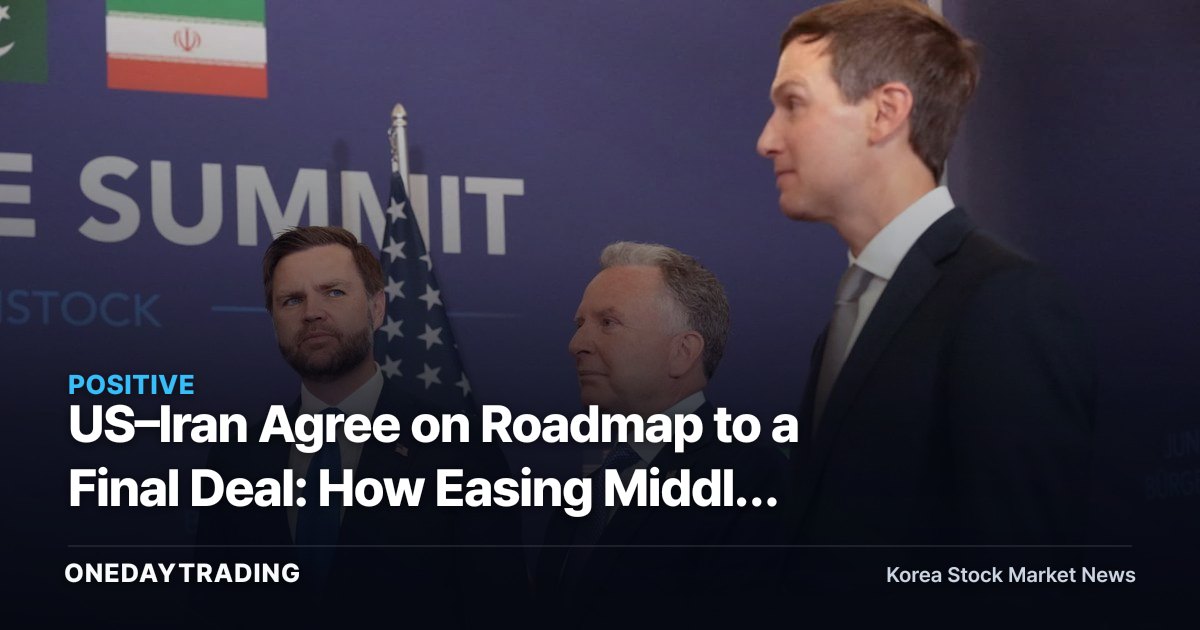
With the United States and Iran agreeing on a roadmap toward a final deal and announcing plans to end military operations in Lebanon, expectations of easing tensions in the Middle East have grown. This works to lower the geopolitical risk premium embedded in global oil prices, which reads as a cost-side positive catalyst for Korea's economy and stock market given the country's heavy dependence on crude oil imports. That said, sectors such as defense, which had benefited during periods of heightened tension, may face pressure in the opposite direction.
What Happened
This round of talks marked the first official negotiating session under the memorandum of understanding (MOU) signed last week, and it included an additional 60-day extension of the precariously held ceasefire. The two sides converged on a step-by-step roadmap toward a final deal and also discussed a plan to wind down the military operations underway in Lebanon.
The crux is not a one-off truce but the fact that a negotiating framework has been established. The 60-day window is short, but as long as the negotiating table is kept in place, the likelihood that military conflict will spill over immediately into oil prices diminishes. Markets react sensitively to this kind of time-limited stability.
Background and Context
The Middle East is a central pillar of global crude oil supply, and tensions surrounding the Strait of Hormuz in particular have long added a risk premium to oil prices. Because Korea depends on imports for nearly all of its crude oil, swings in oil prices feed directly into the trade balance, inflation, and corporate costs. When tensions ease, the risk compensation the market demands shrinks even at the same per-barrel price, which can translate into downward pressure on oil prices.
Impact on the Market and Stocks
- Airline stocks: For carriers such as Korean Air, fuel costs account for a large share of operating expenses, so stable oil prices feed directly into margin improvement. Easing geopolitical risk also reduces uncertainty around route operations.
- Refining stocks: For S-Oil and SK Innovation, the picture is double-edged. A lower crude procurement cost is favorable on the cost side, but a sharp drop (plunge) in oil prices becomes a source of inventory valuation losses and swings in refining margins. The magnitude and speed matter more than the direction.
- Shipping and transport: Names such as HMM stand to benefit from reduced fuel (bunker) costs and improved operational stability on Middle East routes.
- Defense stocks: For sectors like Hanwha Aerospace and LIG Nex1, where geopolitical tension had been an order-book momentum driver, this could be a near-term factor that weakens expectations. That said, the global trend of rising defense budgets is a separate variable.
Investor Checkpoints
- Check whether Brent and WTI prices actually give back the risk premium after the agreement was announced, and watch the trend in per-barrel levels.
- Track whether follow-up negotiations make progress within the 60-day window, along with the schedule of official announcements regarding implementation of the agreement.
- Watch how fuel costs and refining margins are reflected in the next-quarter earnings of airlines and refiners.
- The KRW/USD exchange rate trend — the impact of lower oil prices on the trade balance and inflation expectations also shows up in the exchange rate.
Outlook
If the negotiating framework holds and the oil risk premium actually narrows, a favorable environment could take shape, centered on cost-sensitive sectors. The opposite scenario is just as clear. The 60-day window is a provisional agreement that could break at any time, and Middle East ceasefires have frequently been reversed in the past. If the agreement collapses or armed conflict resumes, oil prices could quickly reapply the risk premium, risking a disruption to the cost assumptions of airline and transport stocks. Ultimately, it is more reasonable to approach this agreement not as a trend reversal but as a conditional catalyst whose direction will hinge on whether it is implemented.
Korean Air in Real-Time Data
The most recent closing price of Korean Air was 27,000 won (-3.40% versus the prior day), and the signal light combining foreign investors' and institutional investors' supply-demand (order flow) with news and momentum is 🟡 Neutral · Wait-and-See. With positive and negative signals mixed, it is a zone to watch.
- ▲ News flow — 12 positive catalysts vs 3 negative catalysts — positive bias
Recent related news is favorable, with 12 positive catalysts and 3 negative catalysts.
※ Price and foreign/institutional supply-demand (order flow) data are provided by Korea Investment & Securities (KIS) and are as of the time of publication.
This article is content automatically summarized and analyzed based on the original news. View original (CNBC)