
Summary
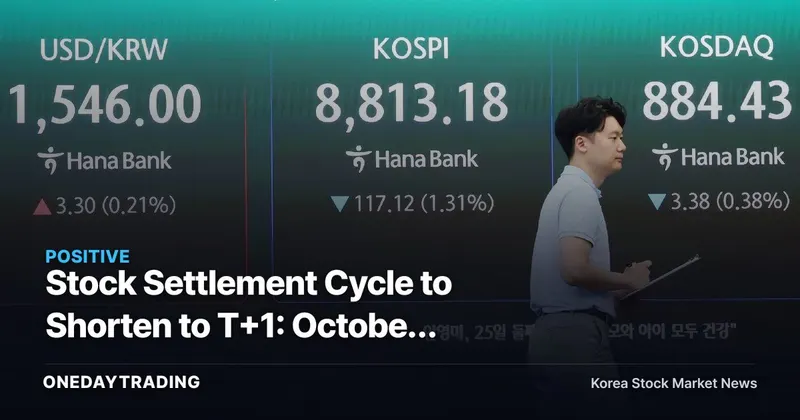
A roadmap to shorten the settlement cycle — moving stock sale proceeds that currently arrive two business days later (T+2) to the next day (T+1) — will be unveiled in October. This is not merely an administrative process improvement but a structural change that touches retail investors' capital turnover, brokerage operating structures, and even foreign investors' currency hedging costs. For the brokerage sector, it carries both an upside factor in the form of greater trading activity and a short-term burden in the form of system replacement costs.
What Happened
Financial authorities plan to release a roadmap in October outlining a plan to shorten the period from trade execution to settlement of proceeds from two days to one. This is an extension of the direction signaled when President Lee Jae-myung mentioned improving settlement efficiency at a March roundtable on capital market stabilization and normalization.
Once the change takes effect, investors will be able to withdraw or reinvest the proceeds from stocks sold today not the day after tomorrow but tomorrow. Because previously tied-up funds are freed up a day earlier, the tangible benefit will be greatest for retail investors who trade frequently over the short term.
The direction itself is largely about aligning with global standards. The United States moved its settlement cycle forward from T+2 to T+1 in May 2024, and with major markets following suit, the intent is to upgrade the Korean market's settlement infrastructure.
Structural Background
The core of shortening the settlement cycle lies in reducing counterparty risk and collateral burdens that accumulate in the market during the unsettled period. The shorter the time to settlement, the smaller the unsettled balance that clearinghouses and brokerages carry, easing the inefficiency of capital being tied up.
However, during the transition, the IT systems and back-office processes of brokerages and the central securities depository infrastructure must be redesigned to fit the one-day shortening. Automation investments to prevent settlement failures and adjustments to foreign investors' currency exchange and hedging schedules are required simultaneously, creating an early phase where costs and operational risks become concentrated.
Stock and Sector Ripple Effects
- Kiwoom Securities: With a structure heavily weighted toward retail trading value, faster capital turnover could most directly boost demand for turnover trading and revenue based on trading commissions.
- Mirae Asset Securities and Samsung Securities: As large firms with substantial retail assets and system scale, they face a two-sided structure of benefiting from improved settlement efficiency while also bearing infrastructure transition costs.
- NH Investment & Securities and Korea Investment Holdings: With large shares of brokerage and institutional settlement, there is room for improved capital efficiency from reduced unsettled risk.
- Brokerage IT and back-office solution providers: If orders for revamping settlement and clearing systems increase, related software and automation suppliers could gain order momentum.
Bull vs. Bear Scenarios
The bull case is clear. If funds are freed up a day earlier, reinvestment turnover accelerates, market trading value rises, and this is favorable for brokerage earnings that depend on transaction-based revenue. From the perspective of foreign investors as well, improved settlement efficiency and currency risk management could enhance accessibility to the Korean market.
Conversely, in the short term, system replacement and verification costs could push up brokerages' SG&A expenses, and if settlement errors or scheduling confusion occur early in the transition, operational risk could come to the fore. Because the policy's effects must be confirmed through trading-value trends after implementation, it is premature to assume earnings will improve immediately upon the roadmap's announcement. If brokerage stock valuations already reflect expectations of recovering trading value, profit-taking pressure after the announcement is also a variable.
Investor Action Points
- Check the actual implementation timing and phased scope of application (whether all stocks are covered at once, whether foreign investors are included) in the roadmap unveiled in October.
- In brokerages' quarterly earnings, monitor both the recovery in trading value and changes in SG&A expenses driven by system investments.
- Since brokerages with higher retail weighting stand to gain more from turnover trading, monitor retail trading-value trends and average daily trading-value indicators.
- Keep settlement stability early in the transition and the flow of foreign capital inflows as variables, and watch whether short-term expectations have been excessively priced in right after the announcement.
Kiwoom Securities Through Real-Time Data
Kiwoom Securities' latest closing price is 306,500 won (−9.19% from the prior day), and the signal light combining foreign and institutional supply-demand (order flow) with news and momentum is 🔴 Caution. Foreign investors, institutional investors, and momentum are negative, so caution is needed now.
- ▼ Dual selling — foreign investors −600 million won · institutional investors −6.1 billion won, selling in tandem
- ▼ Trend alignment — short- and mid-term downward alignment (−9.2% on the day · −11.4% over 1 week · −21.6% over 1 month)
- ▲ News flow — 2 positive catalysts vs. 1 negative catalyst — positive catalysts prevail
Recent related news is favorable, with 2 positive catalysts and 1 negative catalyst.
※ Price and foreign/institutional supply-demand (order flow) data are provided by Korea Investment & Securities (KIS) and are as of the time of publication.
This article is content automatically summarized and analyzed based on the original news. View original (Maeil Business Newspaper, Securities)