
Summary
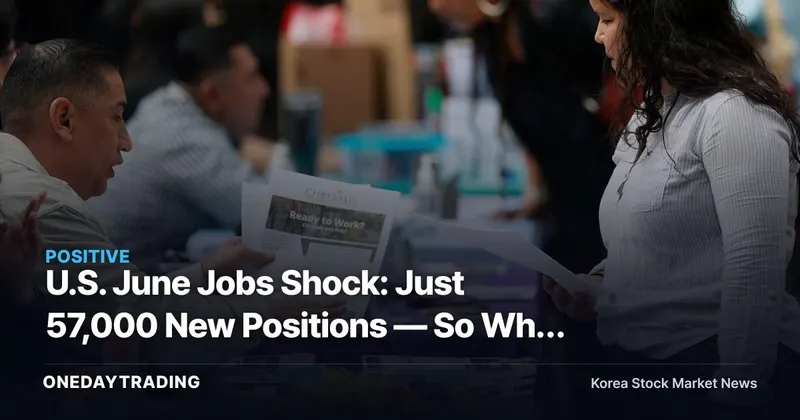
U.S. nonfarm payrolls increased by just 57,000 in June, less than half the market consensus of 115,000. Meanwhile, the unemployment rate eased to 4.2%, below the expected 4.3%. This split outcome — hiring cooling sharply even as the jobless rate fell — is being read as fresh fuel for a September Federal Open Market Committee rate cut.
What Happened
The first number to focus on in this release is that headline job growth came in at less than half the consensus estimate. With the market expecting 115,000, a print of 57,000 is a clear surprise. Normally, a miss of this magnitude would push the unemployment rate higher as well. Instead, the unemployment rate didn't just hold at 4.3% — it fell to 4.2%.
That combination is the real signal here. A falling unemployment rate would be good news if it reflected genuine improvement in the labor market. But when it comes alongside a sharp slowdown in new hiring, it points to a possible decline in the denominator — that is, the labor force participation rate. When more people give up job searching or exit the labor force altogether, they're no longer counted as unemployed, which lowers the unemployment rate — but this can reflect labor-market contraction rather than healthy improvement.
For now, the market has interpreted the data as supportive of rate cuts. A clear cooling in employment strengthens the case for the Fed to shift its focus from fighting inflation to defending the labor market. The catch is that this interpretation needs to be confirmed by the same directional signal in upcoming data releases.
Structural Background
Under the Fed's dual mandate framework, episodes where labor data crack before inflation data are a common pattern at monetary policy turning points. The longer rates stay elevated, the more the cumulative cost of consumer and corporate credit weighs on the real economy — and employment is often the first to feel it. Evidence is mounting that the U.S. labor market has entered a lagging phase marked by slower hiring, a rising share of temporary and part-time positions, and fewer job openings.
For Korean investors, this data flows through two distinct channels. The first is the rate channel: stronger Fed rate-cut expectations would pressure U.S. Treasury yields and the dollar lower, weigh on the KRW/USD exchange rate, and support KOSPI valuations — particularly multiples for growth stocks. The second is the demand channel: a slowdown in U.S. hiring could eventually translate into weaker U.S. consumption, which would erode final demand for Korean companies with heavy exposure to exports to the United States. These two channels point in opposite directions.
Impact on Stocks and Sectors
- Samsung Electronics (005930) / SK Hynix (000660): If rate-cut expectations solidify, lower discount rates could support further multiple expansion for growth stocks. However, a U.S. consumption slowdown could weigh on data center and consumer IT demand, potentially working against the earnings trajectory.
- KB Financial Group / Shinhan Financial Group: Rate cuts translate directly into narrower net interest margins. A faster pace of loan-deposit spread compression would be a near-term drag on profitability.
- Hyundai Motor / Kia: A further decline in the KRW/USD exchange rate would be a headwind, reducing the won-converted value of dollar-denominated revenue — though actual U.S. sales volumes would not be immediately affected.
- KOSPI high-dividend stocks / REITs: These sectors tend to gain relative appeal in a falling-rate environment, with the most rate-sensitive assets seeing the largest benefit.
Bullish vs. Bearish Scenarios
In the bullish scenario, the hiring slowdown leads to a soft landing without reigniting inflation, and the Fed begins preemptive rate cuts starting in September. In this case, dollar weakness, won strength, and KOSPI multiple expansion would likely occur together, lifting both rate-sensitive growth stocks and domestic consumption plays.
The bearish scenario starts from the premise that the 4.2% unemployment figure itself is an illusion. If the decline is driven by a falling labor force participation rate, the unemployment rate could jump back up in next month's data, creating the textbook recessionary combination of slowing employment and rising unemployment together. In that case, the Fed would likely lean toward waiting for more data rather than rushing to cut, and the market would unwind rate-cut expectations, driving volatility higher. If valuations have already priced in much of the anticipated easing, the resulting pullback could be substantial.
Investor Action Points
- Check whether the next U.S. CPI release shows inflation and employment both pointing in the same (cooling) direction. If inflation fails to ease while employment alone weakens, the narrative could flip toward stagflation concerns.
- Track the labor force participation rate separately. Whether the drop in unemployment stems from more people finding jobs or more people giving up their job search will completely change how the market interprets the data.
- Watch which direction the KRW/USD exchange rate moves from current levels. A break lower could be read as a favorable signal for foreign investor order flow.
- Keep a checklist of upcoming employment and inflation data releases ahead of the September FOMC meeting, and use shifts in rate-cut probability to time position adjustments in advance.
This article is auto-summarized and analyzed based on the original news source. Read the original article (CNBC)