
Summary
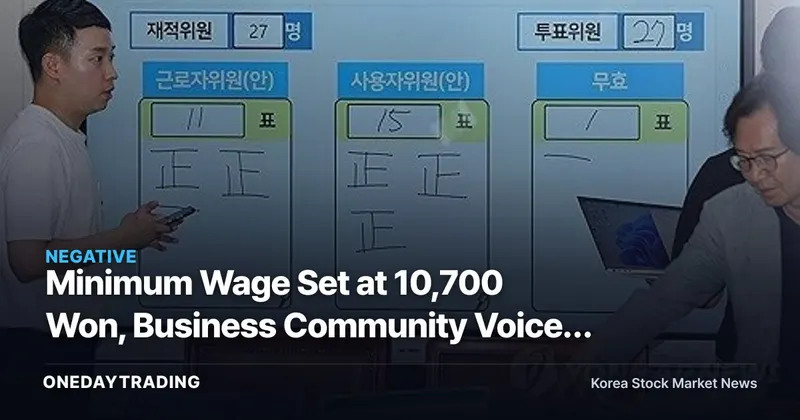
With next year's minimum wage finalized at 10,700 won per hour, the business community has officially voiced its concerns. On the surface, this looks like the familiar standoff between labor and management, but the market should be focused elsewhere. The cost structure of convenience store and restaurant franchises — where labor costs make up a large share of expenses — faces another round of pressure, while at the same time, demand for unmanned and automation equipment is set to expand as a countervailing force. Two distinct ripple effects are opening up simultaneously.
What Happened
The business community expressed concern that small merchants will face growing hardship following the decision to set next year's minimum wage at 10,700 won per hour. While this decision is the product of the annual labor-management-government negotiations that repeat every year, the market should not dismiss it as a routine annual event, because the share of labor costs in cost of goods sold (COGS) varies dramatically by industry sector. In sectors like convenience stores and restaurants, which rely heavily on part-time and hourly workers, the minimum wage increase is effectively passed straight through as higher fixed costs.
By contrast, large manufacturers or companies that have already adopted automation equipment face relatively limited impact. The business community's concerns are ultimately directed at franchisees and small business owners, and the cost pressure they face will, with a time lag, also show up in the franchise-management and revenue structure of the listed parent franchise companies.
Structural Background
The minimum wage hike is not a one-off news item but a cumulative, structural variable. Rising labor costs are ultimately absorbed through one of three channels: companies absorb the cost by cutting margins, pass it on through higher selling prices, or reduce headcount and replace it with automation. The market has already priced in the first channel — the familiar concern over margin pressure — but has not yet fully priced in the third channel: the fact that each successive labor-cost increase pulls forward the break-even point for automation investment.
Stock (Ticker) and Industry Sector Impact
- BGF Retail (CU) — Rising labor costs at franchise stores could translate into a greater support burden for the parent company or a slowdown in new store openings, making this a margin-pressure factor.
- GS Retail (GS25) — With a high concentration in the convenience store business, GS Retail faces the same labor-cost pass-through risk, and its supermarket and home-shopping segments will also see rising labor costs.
- Kyochon F&B — Given the labor-intensive nature of restaurant franchise store operations, declining franchisee profitability could, with a time lag, affect the parent company's revenue and royalty structure.
- Douzone Bizon — This is an indirect beneficiary, as rising demand for labor-cost management and payroll compliance is expected to boost demand for ERP and time-and-attendance solutions among small and mid-sized businesses.
- Robotis — Demand for unmanned robots for serving and food-prep assistance is a theme that resurfaces every time the minimum wage rises, though the key question is whether it translates into actual orders.
Bullish vs. Bearish Scenarios
The bearish scenario is clear: if the labor-cost burden erodes franchisee profitability, it will lead to higher closure rates and slower new store openings, which in turn will translate into slower revenue growth for the parent companies. This is precisely the pathway behind the business community's official concerns. The bullish scenario, on the other hand, centers on automation and unmanned-solution stocks (tickers). However, there is a catch to this narrative: the robotics/kiosk theme resurfaces every minimum-wage announcement season, but cases where it has actually translated into confirmed equipment orders and revenue have been limited. If the market reacts to the narrative first and earnings fail to follow, all that remains is valuation risk.
Investor Action Points
- In the next quarterly earnings of listed convenience store and restaurant franchise companies, check whether labor costs are being passed through relative to franchise store revenue, and monitor store-closure trends.
- For automation and robotics stocks (tickers), verify claims with concrete indicators such as actual order announcements and installation counts, rather than buying on theme alone.
- Check the next CPI release for signs of labor-cost pass-through into consumer prices (inflation), as this is also a variable that could affect the Bank of Korea's monetary policy path.
- Track follow-up policy announcements, including how this year's minimum wage increase rate compares with prior years and whether a schedule for small-business support measures is announced.
This article was automatically summarized and analyzed based on the original news report. View original (Yonhap News, Industry)