
At a Glance
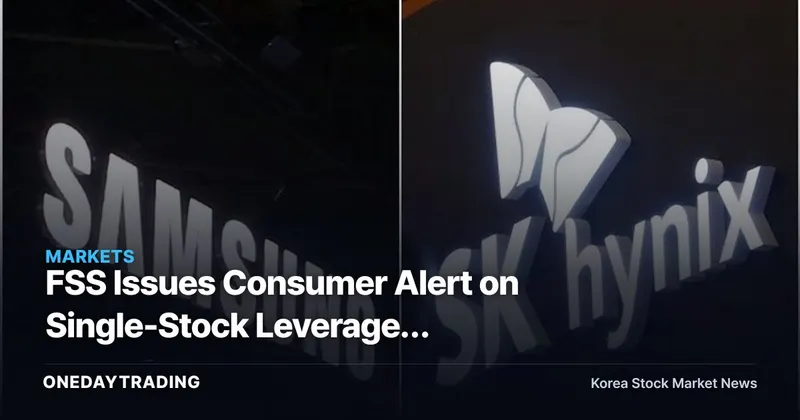
South Korea's Financial Supervisory Service (FSS) has issued a consumer alert on single-stock leveraged products built on Samsung Electronics and SK Hynix as underlying assets. At the core of the warning is the fact that concentrating roughly 2x directional bets on a single stock (ticker) can trigger losses of up to 60% in a single day, alongside a divergence between market price and intrinsic value, and a negative compounding effect that erodes principal in volatile markets.
This alert is not aimed directly at the fundamentals of large-cap semiconductor names, but rather at the structural risks of the derivative and exchange-traded products that use those share prices as leverage. For investors, the key question isn't whether the underlying asset will rise, but where, even if the direction is correct, the product's structure causes returns to leak away.
Why It Matters Now
Retail investors net-bought 8.2 trillion won worth of these products in just 12 trading sessions, during which the product group's market capitalization more than doubled, from 4.5 trillion won to 9.6 trillion won. Such a rapid, one-sided inflow of capital in a short period means a structure has formed in which a single sharp move in the opposite direction could trigger a chain reaction of losses.
The real trap in leveraged products isn't the intraday loss magnitude but the cumulative path. The FSS's cited average decline of 36.9% during sustained downtrends doesn't simply mean the underlying asset fell by that much — it illustrates how the daily rebalancing structure, which resets the multiple every day, produces a negative compounding effect that erodes principal in markets that move up and down repeatedly. Even when the underlying asset returns to its starting point, the leveraged product's price commonly ends up lower.
Compounding this is the divergence (or "kimchi premium"-style gap) issue. When demand piles onto one side, the market price can trade above the product's actual intrinsic value, and this premium tends to evaporate quickly once volatility settles. This is the backdrop for situations where investors correctly call the underlying asset's direction yet still lose money because they bought in at an inflated price.
FAQ
- Is a 60% loss in a single day really possible? - With 2x leverage, if the underlying asset plunges nearly 30% in a day, that loss is arithmetically achievable, and single-stock products carry higher individual volatility than indices, making this a realistic risk.
- What is the negative compounding effect? - Because the structure resets the multiple daily, repeated up-and-down swings can cause the product to accumulate losses even when the underlying asset ends up flat.
- Why is the price divergence dangerous? - When popularity overheats, the market price rises above intrinsic value, and as that premium shrinks, losses occur regardless of the underlying asset's direction.
- Is it safe to hold long-term? - These products are designed for short-term directional trading, so the longer the holding period, the greater the compounding losses and cost burden.
Related Stocks (Tickers) and Sector Impact
- Samsung Electronics - The underlying stock's own earnings and industry conditions are a separate matter, but overheating and unwinding of leveraged fund flows can amplify short-term supply-demand (order flow) volatility and widen the swings in share price movement.
- SK Hynix - As a stock (ticker) with high volatility driven by HBM demand momentum, it is the underlying asset showing the widest profit-and-loss swings in single-stock leverage products.
- Brokerages (ETN/ETP issuers) - While issuance fee income has increased, tighter regulation and heightened scrutiny of sales responsibility could constrain product lineups and marketing.
- Broader Semiconductor Sector - As derivative-driven supply-demand (order flow) feeds back into spot-market volatility, there is room for short-term noise unrelated to fundamentals to increase.
Investment Considerations
- Set a clear holding period - If you plan to hold for more than a few days, you should assume that the negative compounding effect will structurally reduce expected returns.
- Check the price divergence before buying - Entering when the market price is excessively above intrinsic value increases loss risk even if the direction is correct.
- Watch the underlying asset's intraday volatility - Since the large-cap semiconductor stock's short-term swings directly translate into the product's profit-and-loss swings, risk rises sharply during periods of expanding volatility.
- Monitor the schedule for further FSS and exchange measures - Regulatory changes such as tighter trading limits or entry requirements can directly affect liquidity and the price divergence.
Overall Outlook
As long as expectations for the semiconductor industry remain intact, demand for single-stock leveraged products is unlikely to cool quickly. It's also true that these can be efficient tools for investors who read direction accurately and trade with short holding periods.
Still, the message of this alert is clear: even when betting on the correct direction, there are zones where the product's structure causes returns to leak away, and the more one-sided the positioning, the sharper the decline during unwind phases. Separating the underlying asset's upside potential from the product structure's negative effects is the starting point for surviving in an overheated single-stock leverage market.
Samsung Electronics: Real-Time Data
Samsung Electronics (005930)'s most recent closing price was 362,500 won (up 4.62% from the previous day), and the signal combining foreign investors/institutional investors order flow with news and momentum reads 🟢 Buy-leaning. With foreign investors, institutional investors, news flow, and momentum all positive, this stock (ticker) warrants attention.
- ▲ Dual buying — foreign investors +872.7 billion won · institutional investors +689.0 billion won, bought in tandem
- ▲ Trend alignment — short- and medium-term uptrend alignment (same-day +4.6% · 1-week +21.2% · 1-month +29.0%)
- ▲ 52-week position — in the top 98% of its 52-week range — near record-high territory
- ▲ News flow — 26 positive catalysts vs. 7 negative catalysts — positive catalysts prevail
Recent related news has been favorable, with 26 positive catalysts versus 7 negative catalysts.
※ Price and foreign/institutional investor order-flow data are provided by Korea Investment & Securities (KIS) and are current as of the time of publication.
This article was automatically summarized and analyzed based on the original news report. View Original (Maeil Business Newspaper, Securities)