
In the corporate bond market, investors must distinguish between expectations of an issuance recovery and an actual recovery. Yonhap News Securities reported on 2026-10-25 that corporate bond issuance has been sluggish this year and is expected to resume in 2027. What has been confirmed is the net redemption calculated by Yuanta Securities; what remains uncertain is the volume of deferred issuance that will return and the breadth of the recovery across credit ratings.
Corporate Bond Slump and 2027 Outlook in Three Points
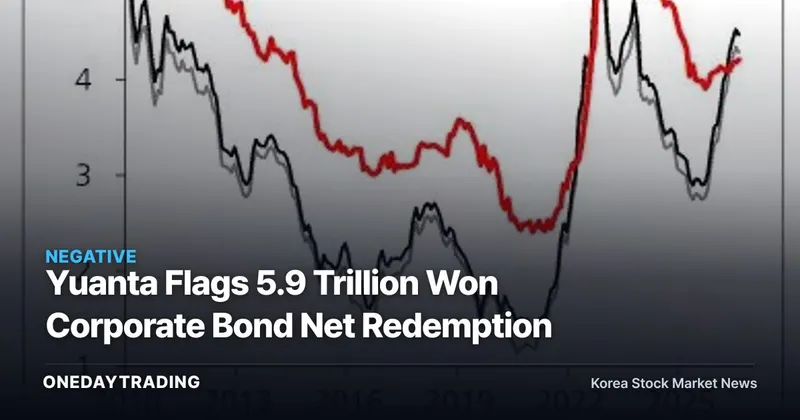
- According to Yuanta Securities, general unsecured corporate bonds recorded net redemption of 5.9 trillion won from January through September this year, marking the first shift to net redemption in four years.
- Compared with the same period last year, corporate bonds maturing from January through September increased by 8.7 trillion won, while issuance declined by 15.6 trillion won.
- Lee Hyun-soo and Han Si-hwa expect deferred issuance demand to return, while Oh Eun-seok forecasts that net issuance next year will remain below the long-term average of 8 trillion won.
Yuanta Securities Data Reveal an Issuance Gap
Corporate bond net issuance is calculated by subtracting redemptions from issuance, while net redemption means companies repaid more than they raised through new bonds. Yuanta Securities’ figure showing 5.9 trillion won in net redemption of general unsecured corporate bonds from January through September this year is a stronger signal than a simple slowdown in issuance because it reflects the combined effects of issuance and maturing debt.
During the same period, corporate bonds maturing increased by 8.7 trillion won from a year earlier, while issuance fell by 15.6 trillion won. From an investor’s perspective, the rise in maturities and the decline in new issuance should be assessed separately. Even if issuance increases in 2027, the available data cannot establish whether that reflects returning refinancing demand or an expansion in demand for new funding.
6.1-Times Bookbuilding Ratio Points to a Different Trend
Sluggish issuance does not necessarily indicate a broad-based weakening of investor demand for corporate bonds. Hanwha Investment & Securities analyst Han Si-hwa noted that this year’s corporate bond bookbuilding ratio was 6.1 times, in line with the 2023∼2025 average level. On that basis, Han expects issuance deferred this year to resume in 2027 and be concentrated in the first quarter.
What this figure actually shows is that issuance volume and bookbuilding participation did not move in the same direction. If issuers continue returning to the market, the first quarter will be the initial test of whether a recovery is underway. However, actual issuance and net issuance figures for 2027 remain unknown.
Interest-Rate Conditions Will Determine the Scale of the Return
Lee Hyun-soo said deferred refinancing and new-issuance demand could return to the corporate bond market in 2027. Shinyoung Securities analyst Lee Kyung-rok expects issuance to recover gradually once the Bank of Korea finishes raising its benchmark interest rate. Both forecasts leave open the possibility of renewed issuance but do not estimate the actual scale of the recovery.
Korea Investment & Securities analyst Oh Eun-seok takes a more conservative view. He expects net corporate bond issuance next year to remain below the long-term average of 8 trillion won. In other words, a recovery and a return to the long-term average are not the same conclusion. Companies’ funding choices could also change if the relationship between bank lending rates and corporate bond yields shifts, but the data do not include either rate for 2027.
iM Securities Highlights Uneven Recovery for A-Rated and Lower Bonds
Looking only at total issuance can obscure differences across credit ratings. iM Securities analyst Lee Seung-jae said the decline in issuance of A-rated and lower corporate bonds this year was more pronounced than usual. Therefore, even if overall issuance recovers, investors will need separate confirmation that the improvement has extended to A-rated and lower bonds.
There is also no basis for identifying a related stock (ticker) in advance. Neither the list of companies that will actually resume deferred corporate bond issuance nor 2027 issuance volumes by credit rating has been confirmed. Investors therefore have reason to wait for actual issuance disclosures identifying issuers and their credit ratings rather than assuming that particular companies will benefit or suffer.
What to Verify in the 2027 Corporate Bond Market
- First-quarter issuance: Watch whether the concentration of deferred issuance predicted by Han Si-hwa translates into actual bond offerings.
- Net issuance: Confirm whether increased issuance exceeds redemptions and results in positive net issuance.
- Funding rates: Monitor whether companies choose bank loans or corporate bonds based on their respective borrowing costs.
- Credit ratings: If the recovery extends to A-rated and lower corporate bonds, the normalization of issuance will be broader.
Time to Watch Actual Issuance, Not Recovery Expectations
Corporate bond issuance in 2027 could improve from this year as deferred demand returns, but forecasts that net issuance may remain below the long-term average of 8 trillion won and continued weakness among A-rated and lower bonds remain concerns. The key tests will be actual first-quarter issuance, whether the market shifts to net issuance, and whether the recovery spreads across credit ratings. Expectations are already in place; what the market now needs to see is volume.
This article was automatically summarized and analyzed from the original news report. View the Original Article (Yonhap News Securities)