
Key Takeaways
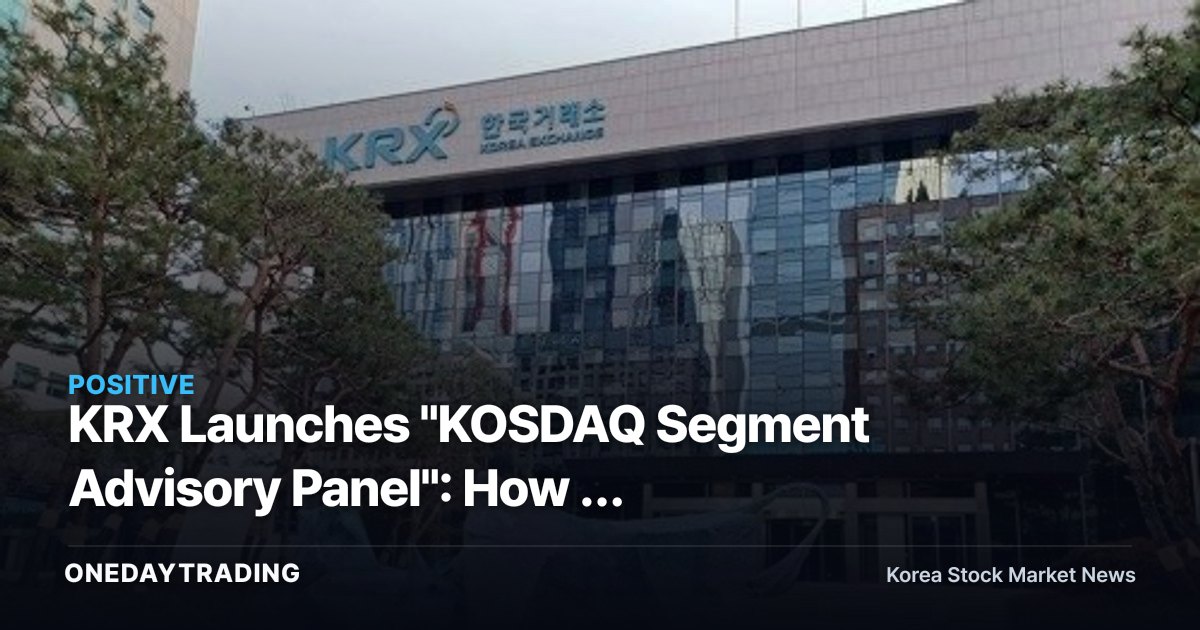
The Korea Exchange (KRX) KOSDAQ Market Division has formed a KOSDAQ Segment Advisory Panel and held its first meeting. This signals that discussions are getting underway in earnest on a promotion-relegation system that would divide the market by quality and move stocks up or down in tier. Rather than an immediate positive catalyst for any single stock, it is better read as the starting point of a structural overhaul that, over the medium to long term, could widen the gap in supply-demand (order flow) and valuation between high-quality KOSDAQ names and marginal companies.
What Happened
The Korea Exchange (KRX) announced on the 16th that it had formed a KOSDAQ Segment Advisory Panel and held its first meeting. At the core of the segment system is a promotion-relegation mechanism that classifies KOSDAQ-listed stocks (tickers) into multiple tiers according to set criteria such as financial soundness, governance, and liquidity, and moves them into higher or lower tiers depending on whether they meet those criteria.
For now, this is only the launch of the advisory panel and its first meeting; specific classification criteria and an implementation timeline have not yet been finalized. Still, the fact that the exchange has officially activated a consultative body to gather outside expert opinions suggests that the design of the system has entered the track of practical, working-level discussion.
Background and Context
Despite its useful role as a financing channel for growth companies, the KOSDAQ carries a discount problem: because stocks with weak earnings or fragile governance are lumped in together, the market as a whole is perceived as a risk asset. This is also part of why institutional and foreign investors find it difficult to significantly increase their weightings. The segment and promotion-relegation system is interpreted as an attempt to separate high-quality companies into a distinct tier, giving investors a clear signal, and—in tandem with the government's value-up policy drive—to elevate the qualitative standing of the KOSDAQ.
Impact on the Market and Individual Stocks
- Large-cap, high-quality KOSDAQ stocks: Top stocks by market capitalization, such as EcoPro BM and Alteogen, are likely candidates for inclusion in the upper segment. If the system takes hold, they could be relatively advantaged in attracting institutional and foreign investor capital as well as passive order flow.
- Marginal and troubled stocks: Stocks with persistent losses or weak governance could face shrinking trading and heavier financing burdens from the stigma effect if they are classified into a lower tier.
- Indices and ETF products: If new indices and ETFs are designed around the segment criteria, there is room for greater supply-demand (order flow) volatility among the constituents of existing benchmark indices such as the KOSDAQ 150.
- Securities and asset management industry: The launch of segment-linked products and changes in trading turnover could affect revenue tied to trading value, so the securities industry sector is also indirectly connected.
Investor Checkpoints
- Watch for the timing of the exchange's release, following the advisory panel's discussions, of a draft segment classification framework and an implementation roadmap.
- Examine in detail how the requirements for upper-tier inclusion and lower-tier relegation (financial, liquidity, and governance metrics) will be set.
- Check whether disclosures emerge on new indices or ETFs linked to the system, and the resulting changes in passive order flow.
- Gauge in advance, based on earnings and governance criteria, which tier your holdings are most likely to fall into.
Outlook
If the system becomes established, one can expect a positive path of high-quality-stock-led re-rating and an easing of the KOSDAQ discount. On the other hand, the current stage is no more than the formation of the advisory panel, so it will take considerable time to reach actual criteria and implementation, and variables remain—such as the reconciliation of competing interests over the classification criteria and pushback from lower-tier stocks. Rather than viewing this as a short-term share-price catalyst, the reasonable approach is to watch for tier-by-tier supply-demand (order flow) differentiation from the moment the draft framework is disclosed.
This article is content automatically summarized and analyzed based on an original news report. View original (Yonhap News, Securities)