
Summary
The crux of this development is that a figure nominated with rate cuts in mind has instead signaled a tightening stance. If the easing scenario the market had already priced in starts to wobble, overall risk appetite across Korean equities will be directly affected through the channels of a weaker won and foreign investor fund flow.
A prolonged high-rate environment is a double-edged event: it is favorable for rate-sensitive beneficiaries such as banks, but it weighs on highly valued growth stocks and tickers sensitive to the exchange rate.
What Happened
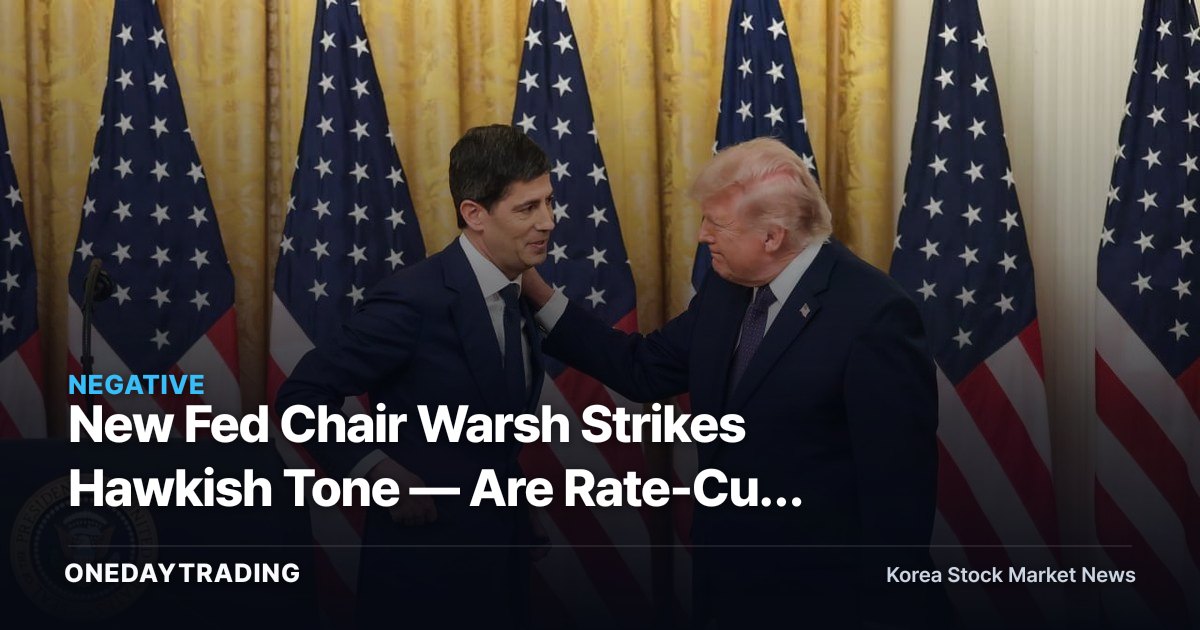
U.S. President Donald Trump is reported to have tapped Kevin Warsh as the new Federal Reserve (Fed) chair in anticipation of monetary easing — that is, a cut in the benchmark interest rate. Ahead of taking office, however, Warsh laid out a hawkish agenda that prioritized taming inflation and restoring confidence in the currency over cutting rates.
This shows that the expectations of those who appoint a policymaker can diverge from the actual direction of monetary policy. Because the Fed's independence and the chair's personal policy philosophy can steer the near-term rate path, there is now greater room for the market to recalibrate its outlook on the size and timing of cuts it had been pricing in.
What matters for Korea is the structure by which the U.S. benchmark interest rate transmits to the domestic market through the Korea–U.S. rate gap and the exchange rate. If the U.S. keeps rates high, upward pressure on the won-dollar exchange rate intensifies and foreign investors' incentive to hold Korean stocks and bonds weakens.
Structural Background
A hawkish pivot by the Fed chair draws attention because global capital moves with U.S. rates as its reference point. When U.S. real rates stay elevated, the relative appeal of emerging-market and Asian assets declines, and a stronger dollar feeds into import prices and corporate input costs.
Korea in particular is a market with a high export share and large foreign ownership, so KOSPI and KOSDAQ volatility tends to react sensitively to shifts in U.S. monetary policy. The very uncertainty around the rate path is itself a factor that raises the discount rate on risk assets.
Impact on Stocks and Sectors
- Banks and financials (KB Financial, Shinhan Financial Group, Hana Financial Group): A prolonged high-rate environment is favorable for maintaining net interest margins (NIM), which could highlight the resilience of their interest income. That said, concerns over loan defaults are a separate variable.
- Large-cap exporters (Samsung Electronics, Hyundai Motor): A weaker won is favorable for short-term translation gains, but the effect is offset if it coincides with slowing global demand.
- Growth and platform stocks (NAVER, Kakao): A rising discount rate translates directly into multiple pressure on high-valuation tickers whose value rests heavily on future earnings.
- Construction and real estate-related stocks: This is a rate-sensitive sector where investor sentiment contracts if rising funding costs and project-financing (PF) burdens persist.
Bullish vs. Bearish Scenarios
On the bullish side, the hawkish stance could translate into confidence in price stability, so that long-term rates actually stabilize, and if dollar volatility calms, foreign supply-demand (order flow) could normalize. Bank stocks have room to show relative strength in this phase.
On the bearish side, as rate-cut expectations retreat, valuations across risk assets get re-rated, and if won weakness steepens, foreign net selling and concerns over currency-translation losses could compound, intensifying downward pressure on the index. The longer the uncertainty over the policy path drags on, the greater the risk that volatility itself becomes a cost.
Action Points for Investors
- Watch Chair Warsh's official remarks and any changes to the dot plot and rate projections presented at the next FOMC.
- Gauge the direction of foreign supply-demand (order flow) through the level of the won-dollar exchange rate and the trend in the Korea–U.S. rate gap.
- For bank stocks, watch NIM and delinquency metrics; for growth stocks, watch earnings visibility when results are reported.
- Assuming a high-rate phase, reassess your exposure to rate-sensitive sectors and your allocation to cash-equivalent assets.
This article is content automatically summarized and analyzed based on the original news report. View original (MarketWatch)