
3-Line Briefing
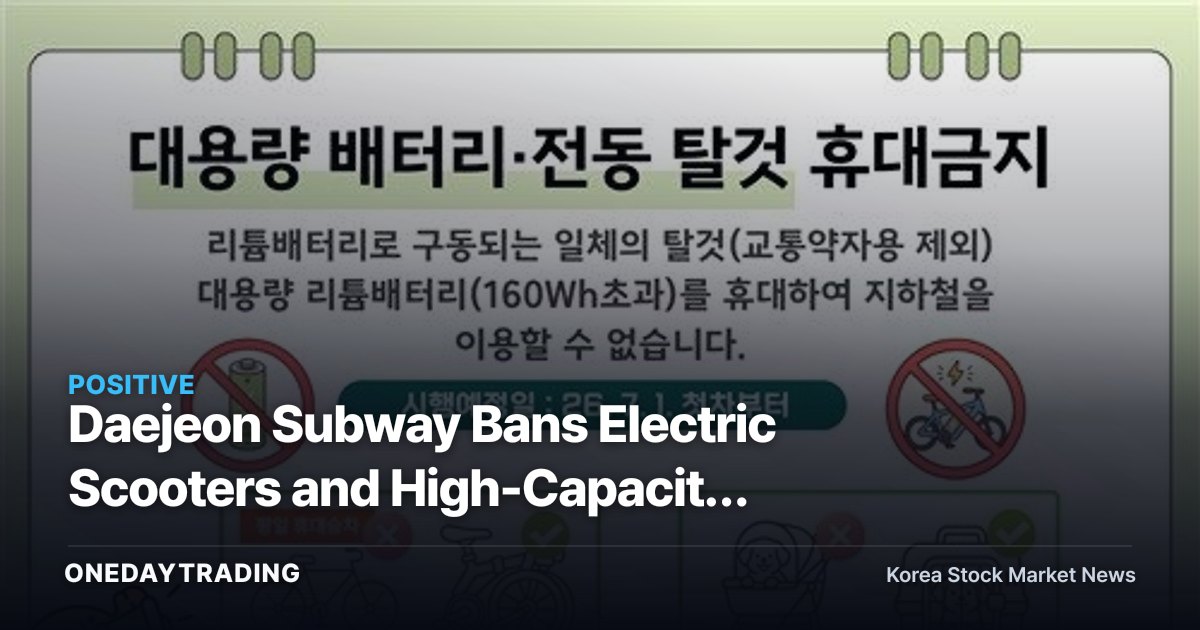
- Daejeon Transportation Corporation has revised its passenger transport terms to ban electric scooters and high-capacity lithium batteries on its urban rail system starting July 1.
- On the surface this is local safety administration, but it is one scene in a broader trend toward institutionalizing fire precautions against lithium batteries in public facilities.
- It could serve as a structural tailwind for demand in battery-safety solutions and fire-suppression equipment, while weighing on perceptions of the secondary battery and personal mobility (PM) industries.
What Is Changing
The crux of this measure is not the rule change in a single city itself, but the fact that lithium-based batteries are now being explicitly designated as a potential fire source in multi-use facilities and physically blocked. Once electric scooters and high-capacity batteries are firmly written into the terms as prohibited items, there is greater room for the rules to spread to other municipal transportation corporations and public facilities that have faced similar fire concerns.
From an investment standpoint, what matters is that such regulation cuts in two directions. One direction grows institutional demand for safety technologies that detect and suppress battery thermal runaway, along with fire-suppression equipment; the other stirs social wariness toward lithium batteries in general, placing a subtle burden on consumer sentiment toward secondary batteries and electric mobility. The same event simultaneously creates a positive catalyst and a negative catalyst across different sectors.
By the Numbers and Context
The only publicly disclosed detail is effectively the timing — implementation on July 1 — while specifics such as the capacity threshold for the import restriction and the level of penalties for violations must be confirmed in the detailed enforcement rules of the terms. Still, the reason this should not be viewed as a one-off administrative action is that lithium fire issues recurring over recent years in electric scooters, e-bikes, and ESS have accumulated, driving a shift in which safety regulation is perceived not as a cost but as essential infrastructure.
Beneficiary and Affected Stocks
- Fire-suppression and firefighting equipment: If demand rises to replace and expand battery fire-response equipment in multi-use facilities, downstream demand for automatic fire-suppression and detection equipment makers strengthens.
- Battery-safety and BMS solutions: The justification for adopting early thermal-runaway detection and shutoff technologies grows, favoring suppliers of safety modules and materials.
- Secondary battery cell manufacturers (LG Energy Solution, Samsung SDI, etc.): The direct earnings impact is limited, but the spreading wariness over lithium fires is a burden on the non-price variable of safety credibility.
- Personal mobility and shared mobility: As restrictions on carrying and storage increase, usage patterns may contract, raising growth friction for PM-related businesses.
Risk Check
- If it stops at a terms revision in Daejeon alone, the market impact is effectively negligible, and any theme expansion remains merely an assumption.
- Fire and safety stocks see high short-term volatility on policy expectations alone, and without actual order or contract disclosures, valuation concerns can quickly come to the fore.
- At this stage, the evidence is weak that worsening perceptions of lithium fires would actually damage the fundamentals of secondary batteries (orders, utilization rates).
- If the regulatory details are set in a lenient manner, the strength of the benefit could be lower than expected.
One-Line Conclusion
Although it looks like local administration, read within the larger thread of institutionalizing lithium battery safety regulation, it is a gradual favorable signal for demand related to firefighting and battery safety, and a perception-side variable for secondary batteries and mobility. It is worth examining the substance of the theme using whether the rules spread to other municipalities and safety-equipment order disclosures as confirmation indicators.
This article is content automatically summarized and analyzed based on the original news report. View Original (Yonhap News, Industry)