
Summary
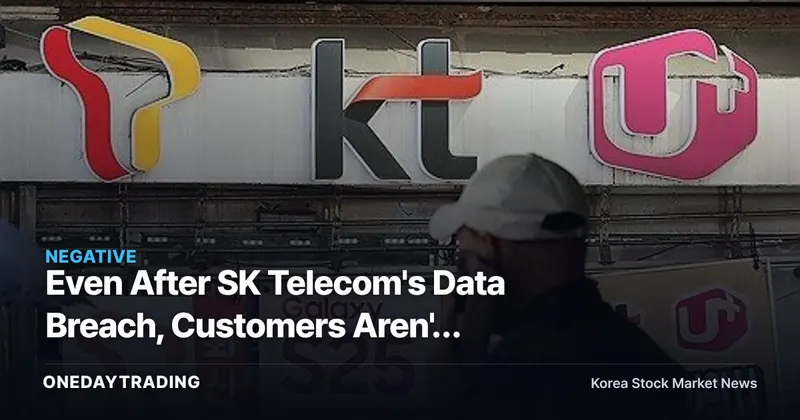
A study following last year's telecom carrier personal data breach found that users who were normally more concerned about online privacy violations were actually less likely to leave their carrier. This runs counter to the conventional wisdom that greater anger leads to greater churn. The key factor is bundled plans (product bundling). Subscribers who combine internet, IPTV, and mobile service stayed put despite eroded trust, deterred by early termination fees and the hassle of re-contracting.
The Full Story
A telecom carrier's personal data breach breaks the trust contract between users and the carrier. In theory, when trust collapses, subscribers should respond by switching numbers to another carrier. However, the study found that the gap between churn intention and actual churn behavior was larger among the group with higher privacy sensitivity. In other words, concern was high, but action didn't follow.
Bundled products were identified as the variable bridging this gap. Users on a standalone mobile plan can switch simply by using a number-portability app, but households bundled with internet and IPTV service must go through early termination fee settlement, set-top box returns, and coordinating a line reinstallation schedule when canceling. Switching costs effectively overwhelmed the anger.
Structural Background
Korea's three major telecom carriers have for years pursued a strategy of increasing the share of wireline-wireless bundled subscribers over wireless-only subscribers. In a saturated market where maintaining ARPU (average revenue per user) is difficult, bundle discounts have functioned as a lock-in device to lower churn rates. This study shows that the lock-in effect works as a buffer suppressing churn not only for everyday marketing purposes but also during a trust crisis such as a security incident. However, this reflects a structure where customers stay not because they trust the carrier, but because leaving is cumbersome.
Impact on Stocks (Tickers) and Industry Sector
- SK Telecom: Although it is the party responsible for the breach, its bundled-subscriber base may cushion the short-term impact of net subscriber losses. However, brand trust damage could manifest with a delay when it comes time to sell next-generation 5G/AI services.
- KT and LG Uplus: These competitors have an incentive to ramp up number-portability marketing amid a rival's incident, but given the low switching rate among bundled subscribers, the actual net-add effect may be limited.
- Cable and IPTV Platforms: As one leg of the bundled-product stack, demand for bundling will continue to be supported as long as the three carriers maintain their lock-in strategy.
Bullish vs. Bearish Scenarios
The bullish scenario holds that the switching costs created by bundled products reinforce the defensive nature of telecom stocks overall. If churn rates don't spike sharply even after a negative catalyst like a data breach, the earnings volatility of telecom stocks should stay lower than the market fears. The bearish scenario is the opposite: because today's retention reflects forced retention from contract structure rather than restored trust, deferred churn could erupt all at once in quarters when contract expirations cluster. On top of this, the severity of sanctions and the scale of fines from the Personal Information Protection Commission remain an additional cost variable.
Investor Action Points
- At quarterly earnings releases, compare the trend in bundled-subscriber share and churn rate across the three telecom carriers.
- Monitor the schedule for the Personal Information Protection Commission's sanctions and fine decisions related to SK Telecom.
- Identify the quarters where bundled-plan contracts signed around the time of the breach are set to expire, and separately track number-portability statistics for those periods.
- Distinguish whether competitors' (KT, LG Uplus) disclosed net additions from number portability are actually meaningful in scale, or merely modest due to the existing bundled-product structure.
SK Telecom (005930) in Real-Time Data
SK Telecom's most recent closing price is 100,500 won (+10.32% versus the prior session), and the signal combining foreign investor/institutional investor supply-demand (order flow) with news and momentum reads 🟡 neutral / wait-and-see. With positive and negative signals mixed, this is a segment to watch.
- ▲ Trend Alignment — Short- and medium-term uptrend alignment (intraday +10.3% · 1-week +13.9% · 1-month +18.2%)
※ Price and foreign/institutional investor order-flow data are provided by Korea Investment & Securities (KIS) and are current as of publication.
This article was automatically summarized and analyzed based on the original news report. View Original (Yonhap News Industry)