
At a Glance
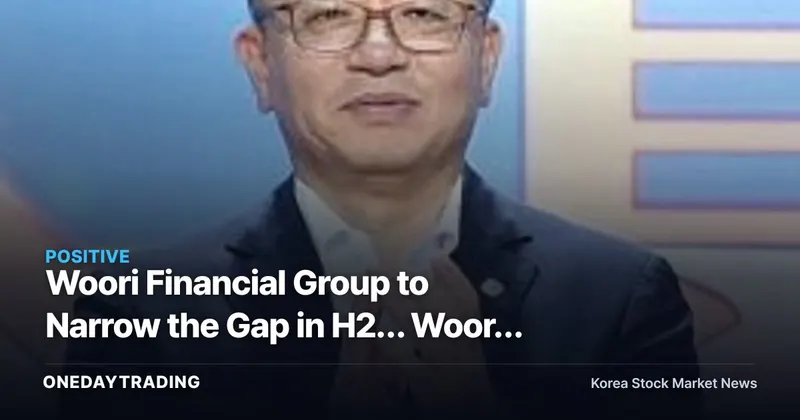
The key to reading Woori Financial Group is not the CEO's slogan, but how quickly its earnings resilience narrows the gap with competitor banks in the second half. Jung Jin-wan, CEO of Woori Bank, delivered a message at the H2 strategy meeting held in Hoehyeon-dong, Seoul on July 24, calling for the bank to keep pursuing its own competitive approach, deliver results, and close the gap with rival banks.
What makes this remark meaningful for investors is not that it's simply a sales pep talk. Once the rate cycle passes its peak, bank stocks become hard to re-rate on the loan-deposit margin alone — cost discipline, asset quality, and the quality of non-interest income are what drive the multiple.
Why It Matters Now
In banking, interest rates speak and valuation answers. The stronger the market's expectations for a benchmark interest rate cut, the sooner it prices in a potential decline in net interest margin. Against that backdrop, the H2 performance Woori Bank is promising can't be explained by loan growth alone. Even if lending expands, unless the pace of falling funding costs, the delinquency migration rate, and the provisioning burden all move in tandem, any earnings improvement will remain just numbers on paper.
Woori Financial Group's challenge is clear. Among the major financial holding companies, a structure heavily reliant on the banking arm can act as a valuation discount factor when rates are falling. For the narrowing gap with rival banks to be reflected in the share price, Woori Bank's sales push needs to translate into corporate finance, high-quality household lending, and fee-based income. A strategy that simply grows loan balances risks boomeranging back as credit costs once an H2 economic slowdown is confirmed.
What the market has already priced in is the undervaluation of bank stocks and expectations for shareholder returns. What it has not yet fully priced in is the difference in execution capability across banks. Even under the same rate environment, a bank with stable funding and well-managed bad-debt costs sees its price-to-book discount narrow. CEO Jung's message reads as a signal that Woori Bank intends to re-enter that execution competition.
Frequently Asked Questions
- Will this news directly move Woori Financial Group's stock price? As a short-term catalyst, the impact is limited. Comments from a strategy meeting signal direction, not numbers. That said, if the cost ratio and credit costs improve in H2 earnings, the stock's relative appeal within the banking sector could increase.
- Why is a Woori Bank statement relevant to Woori Financial Group? Woori Bank is Woori Financial Group's core earnings source. The bank's sales performance and asset quality directly feed into the holding company's earnings, dividend capacity, and capital ratio assessment.
- What should investors watch to gauge the gap with rival banks? Rather than loan growth rates, focus on net interest margin, the delinquency ratio, provisioning expenses, and the recurring quality of non-interest income. Only when all four move together can the actual gap be considered narrowed.
- Is this a positive catalyst for bank stocks broadly? It's more a matter of Woori Financial Group's individual execution than an industry sector-wide catalyst. If the pace of rate cuts accelerates, the sector's valuation multiple will remain under pressure.
Related Stocks & Sector Impact
- Woori Financial Group. The pressure on Woori Bank's H2 performance will shape the holding company's earnings and shareholder-return expectations. The key question is whether it can defend margin and asset quality simultaneously, not just growth.
- KB Financial Group. This is the benchmark Woori Bank is targeting to close the gap with. Its industry-leading capital strength and non-bank portfolio provide resilience.
- Shinhan Financial Group. Its strength lies in a balanced revenue mix across banking, card, and securities businesses. The more Woori Financial Group tries to grow non-interest income, the more it will be compared against Shinhan.
- Hana Financial Group. It is grouped alongside Woori as a financial stock highly sensitive to the exchange rate and corporate finance. H2 won movements and credit-cost burden could determine relative share-price performance.
- Banking Sector. As expectations for rate cuts build, supply-demand (order flow) is more likely to favor stocks (tickers) that demonstrate disciplined cost management and clear capital policy rather than those relying purely on the loan-deposit margin.
Investment Considerations
- Earnings improvement should not be assumed based on strategy-meeting comments alone. Net interest margin and provisioning both need to be confirmed in the next quarter's earnings.
- If rate cuts happen quickly, estimates for bank stocks' interest income could be revised down. The key question is how much dividend expectations offset that.
- If delinquency rates among households and SMEs rise, a growth-focused strategy becomes a discount factor instead. Asset quality should be checked before loan growth.
- Narrowing the gap with rival banks is not a short-term event. It requires tracking quarterly trends in the cost ratio, non-interest income, and the common equity capital ratio.
Overall Outlook
The bull case for Woori Financial Group is clear. If Woori Bank shifts its H2 sales strategy toward profitability and manages credit costs steadily, the market could price in a narrower valuation discount within the banking sector. In that scenario, the share-price driver would be a recovery in its multiple relative to rival banks, not simple growth rates.
The trigger for the bear case is rates and asset quality. If expectations for rate cuts accelerate and delinquencies among vulnerable borrowers increase, the CEO's execution resolve will be hard to translate into numbers. The next checkpoints are Woori Financial Group's H2 earnings release, the direction of net interest margin, and the scale of provisioning. Whether earnings power holds up even as rates fall is the single line that will decide the stock's next level.
Woori Financial Group at a Glance: Real-Time Data
Woori Financial Group's most recent closing price was KRW 30,850 (-0.16% vs. the previous day), and the composite signal combining foreign/institutional supply-demand (order flow) with news and momentum shows 🟢 Buy-leaning. With foreign investor flows and news sentiment both positive, this stock (ticker) is worth watching.
- ▲ Supply-Demand Continuity — Foreign investors have been net buyers for 3 consecutive days (+KRW 3.1 billion)
Recent related news skews favorable, with 2 positive catalysts and 0 negative catalysts.
※ Price and foreign/institutional supply-demand (order flow) data are provided by Korea Investment & Securities (KIS) and reflect the time of publication.
This article is automatically summarized and analyzed based on the original news report. View Original (Maeil Business Newspaper Economy)