
Key Takeaways
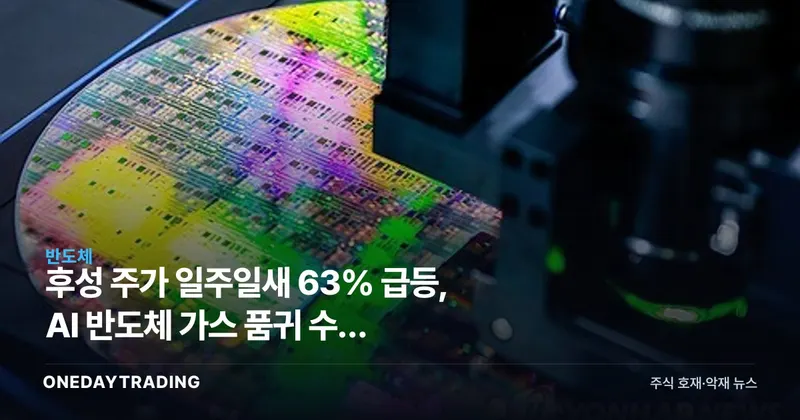
Shares of Hucet — a producer of specialty gases for semiconductor manufacturing and secondary-battery materials — have surged roughly 63% in a single week. Analysts attribute the buying pressure to rapidly rising demand for process gases as expanding artificial intelligence (AI) investment drives greater memory chip capacity, combined with expectations of earnings improvement from price hikes.
What Happened
According to the Korea Exchange (KRX), Hucet's stock jumped more than 60% over the past week, drawing intense market attention. The direct catalyst is the build-out of high-bandwidth memory (HBM) and DRAM capacity for AI servers and data centers. Semiconductor fine-process manufacturing requires a variety of specialty gases at each etching and deposition step, and Hucet is counted among the few companies to have localized and supplied some of these products domestically.
On top of this, tightening global supply of certain process gases has brought the possibility of shortages and price hikes into focus. Given the nature of gas products, where demand is rising but capacity cannot be expanded quickly, expectations that higher unit prices will translate directly into margin improvement are seen as being priced into the stock.
Background and Context
Beyond specialty gases for semiconductors, Hucet also operates a business in LiPF6, a key raw material for secondary-battery electrolytes. The stock has long been classified as one with high earnings volatility tied to downstream industry conditions, but the structural demand of AI infrastructure investment has emerged as fresh momentum. Investors should note, however, that this surge reflects expectations priced in ahead of time rather than confirmed earnings results.
Impact on the Market and Stocks
- Hucet: If process-gas price hikes coincide with higher utilization rates, the company stands to be a direct beneficiary of quarterly earnings improvement.
- Semiconductor materials, parts, and equipment stocks: Expectations of benefiting from AI-driven memory capacity expansion could spread beyond gases to etching and deposition materials more broadly.
- Samsung Electronics and SK hynix: The intensity of downstream memory capacity expansion is the key variable determining upstream demand for gases and materials.
- Secondary-battery materials stocks: Given the nature of Hucet's LiPF6 business, a recovery in electrolyte market conditions could provide additional momentum.
- Specialty gas competitors: If the shortage phase continues, there is room for domestic localized suppliers across the board to strengthen their bargaining power.
Investor Checkpoints
- It is necessary to confirm whether price hikes are actually reflected in real contracts and quarterly earnings, and whether market expectations have not already been priced in.
- A 60% surge in one week may be a sign of short-term overheating, so investors should be mindful of increased volatility and profit-taking.
- The market conditions and utilization rates of the secondary-battery electrolyte business, and their impact on overall earnings, should also be examined.
- Investors should remember that the sustainability of the memory capacity expansion cycle and customers' investment plans are the foundation of demand.
Outlook
On the optimistic side, if AI infrastructure investment continues and the process-gas shortages and price hikes are confirmed in actual earnings, Hucet could be re-rated as a beneficiary of structural demand. On the other hand, if expectations are not backed up by earnings following the surge, or if the pace of memory capacity expansion slows, there is a risk of a steep correction. Rather than focusing on short-term price movements, a sound approach is to separate the winners from the losers by confirming actual price and volume data along with quarterly earnings.
This article is content automatically summarized and analyzed based on an original news report. View original (Maeil Business Newspaper, Securities)