
At a Glance
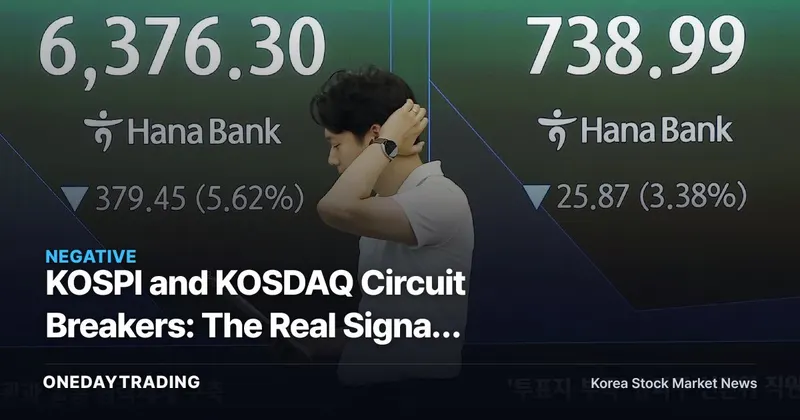
The KOSPI tumbled more than 8% intraday on July 28, triggering a circuit breaker at 10:13:43 a.m. What this really signals isn't just that the index fell — it's how heavily Korean equities had come to rely on a single semiconductor multiple.
The fact that KOSDAQ trading was also halted shows this wasn't a simple large-cap correction. It was a moment when the risk-asset discount rate jumped across the board, hitting growth stocks and small/mid caps alike.
Why It Matters Now
The trigger for this sell-off was a correction in U.S. AI chip stocks combined with concerns over China's drive for semiconductor self-sufficiency. In the Korean market, these two variables never move independently. When the U.S. AI value chain wobbles, expectations for HBM and memory at SK Hynix and Samsung Electronics (005930) get marked down; when concerns over Chinese self-sufficiency intensify, a discount gets applied to medium- and long-term demand and pricing power.
The KOSPI circuit breaker is a powerful stabilization mechanism triggered when the index falls more than 8% from the previous close for at least one minute. A sell-side sidecar on the KOSPI kicked in early in the session, and as losses widened toward the 6,200 level, trading was halted. The market wasn't just pricing in a single negative catalyst — it was simultaneously compressing both elevated earnings expectations and multiples.
Viewed through the lens of interest rates, this becomes clearer. Growth-stock prices represent distant future earnings pulled forward into today's price. When volatility rises and the risk premium climbs, the appropriate multiple falls even with the same earnings outlook unchanged. That's why semiconductors were hit first, followed by KOSDAQ sectors such as biotech, AI, and robotics — sectors where expectations have run ahead of actual earnings.
Frequently Asked Questions
- Is a circuit breaker a sell signal? The mechanism itself carries no directional signal. However, it does mean that liquidation pressure has overwhelmed price discovery — so what matters more than any post-halt rebound is whether foreign net selling in futures and cash markets continues.
- Does this reflect structural damage to semiconductor stocks? No confirmed earnings slowdown has been established yet. The issue isn't earnings — it's price. The key question is how much the market will pare back the premium it had assigned to AI chip growth rates.
- Why is KOSDAQ riskier? KOSDAQ has a high concentration of loss-making growth stocks and high-P/E names. In a rising-discount-rate environment, cash flow and funding conditions get scrutinized before revenue growth does.
- When can investors judge it's time to buy the dip? Trading value, a decline in margin loan balances, an easing of foreign selling, and a stable exchange rate matter more than the size of a single day's drop. Lower prices alone aren't sufficient justification.
Related Stocks and Sector Impact
- SK Hynix. A bellwether stock whose valuation multiple has been lifted by AI memory expectations. If the U.S. AI chip correction spreads into a discounting of HBM demand forecasts, short-term volatility will increase.
- Samsung Electronics (005930). The core of KOSPI market capitalization. Since both a memory recovery and foundry expectations are being priced in simultaneously, it is directly exposed to foreign passive selling during a sharp index decline.
- Hanmi Semiconductor. A stock whose price already reflects expectations around HBM equipment orders. If actual equipment orders hold up, there's a case for resilience — but if concerns emerge over customers slowing capacity expansion, multiple compression could hit quickly.
- KOSDAQ growth stocks. Sectors like biotech, AI, and robotics, where future earnings make up a large share of valuation, are more sensitive to shifts in the risk premium than to interest rates themselves. The circuit breaker exposed that sensitivity all at once.
- Brokerage stocks. A surge in trading value provides some benefit to brokerage revenue, but forced liquidations from margin financing and heightened market volatility can weigh on investor sentiment and trading P&L.
Investment Considerations
- First, watch supply-demand (order flow), not the rebound rate. An intraday technical bounce is natural. What matters longer-term is whether foreign net selling in cash and futures positions is actually easing.
- Second, margin loan balances are the inflection point to watch. If forced liquidations follow the plunge, selling pressure emerges that has nothing to do with a company's fundamental value. In this phase, even good stocks (tickers) see their prices break down first.
- Third, it's too early to assume multiples will recover before earnings are confirmed. The "oversold" thesis only gains traction if next-quarter chip shipments, HBM pricing, and customer orders hold steady.
- Fourth, the exchange rate is half the picture if ignored. A deepening won depreciation intensifies foreign selling pressure. A stable won-dollar exchange rate is a precondition for confirming an index bottom.
Overall Outlook
The optimistic scenario is straightforward. If the U.S. AI chip correction proves to be short-term profit-taking, and domestic semiconductor makers' shipment and pricing indicators hold up, today's circuit breaker could turn out to have marked an oversold zone. In that case, the market would first re-rate the earnings visibility of Samsung Electronics (005930) and SK Hynix, with KOSDAQ growth stocks following afterward.
The bearish scenario hinges on three triggers: a continued decline in U.S. tech shares, China's self-sufficiency push translating into actual order cuts, and a won-dollar exchange rate that deepens foreign investors' currency losses. In that case, today's 8% plunge (sharp drop) may not be the end but the beginning of a broader multiple normalization. The next indicators to watch are the scale of foreign net selling once trading resumes, whether large-cap semiconductor stocks recover their losses, and the exchange rate level.
This article was automatically summarized and analyzed based on the original news report. View Original (Maeil Business Newspaper, Securities)