
Three Key Facts From Lee Jae-young’s Report
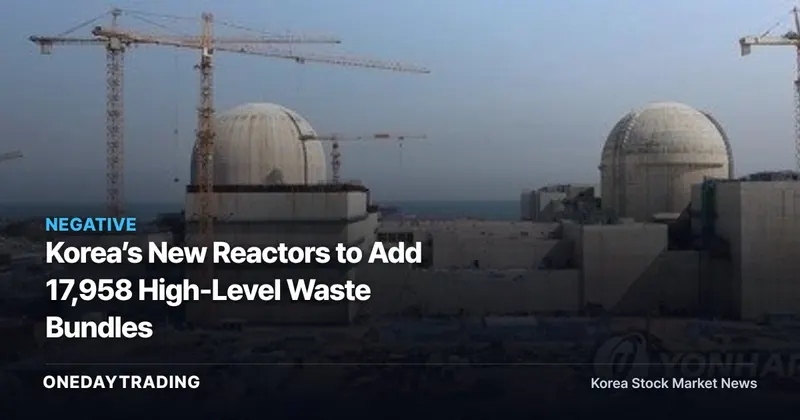
- Yonhap News financial reporter Lee Jae-young reported that two new large nuclear power plants and one small modular reactor (SMR) are expected to generate an additional 17,958 bundles of high-level radioactive waste.
- Yonhap News reported that, through the third quarter of this year, commercial nuclear plants had generated 552,478 bundles and the HANARO research reactor 584 bundles.
- The Third Basic Plan for High-Level Radioactive Waste Management targets the operation of an interim storage facility before 2050 and a disposal facility by 2060.
Management Challenge Looms Larger Than New Reactor Capacity
For nuclear investors, the first figure to focus on in this announcement is not the generation capacity of the new reactors but the 17,958 bundles of high-level radioactive waste. This means plans to expand nuclear power can no longer be assessed separately from spent nuclear fuel management. Investors need to consider additional generation facilities, storage capacity, disposal schedules, and investment in waste-management projects as a single policy package.
High-level radioactive waste is defined as waste containing alpha-emitting radionuclides with half-lives of at least 20 years, radioactivity concentrations of at least 4,000 becquerels (Bq)/g, and heat-generation rates of at least 2kW/㎥. Spent nuclear fuel is the primary example. Because it requires both long-term management and storage facilities, plans for new reactors are closely tied to radioactive-waste disposal schedules.
Two Components of the 17,958-Bundle Estimate
The 35 reactors included in the 11th Basic Plan for Electricity Supply and Demand are expected to generate an additional 210,000 bundles of high-level radioactive waste. Of these, the two large reactors with confirmed sites are projected to produce 10,482 bundles, while one SMR is expected to produce 7,476 bundles. Although both reactor types are part of the same nuclear expansion plan, their projected waste volumes have been disclosed separately and should be assessed accordingly.
These figures do not directly translate into revenue or orders for any particular company. The specific sites, names, and commissioning dates of the new large reactors and SMR have not been disclosed, and no site has been selected for the radioactive-waste management facility. For now, the available data cover projected waste volumes and policy investment, with no basis yet for linking them to individual companies’ profits or losses.
Wet Storage Capacity Sets the Timeline
At the time of the report, wet storage facilities at nuclear plants were 93.4% full at Kori, 86.0% at Hanbit, 84.3% at Wolsong, 76.1% at Hanul, 41.3% at Shin-Wolsong, and 17.5% at Saeul. Current utilization rates do not correspond directly to the projected order in which capacity will be exhausted. Hanbit is expected to reach capacity in 2030, followed by Hanul in 2031, Kori in 2032, Wolsong in 2037, Shin-Wolsong in 2041, and Saeul in 2066.
The nearest milestone is Hanbit’s projected capacity limit in 2030. Because the interim storage facility is not targeted to begin operations until before 2050, the management plan covering the gap between those dates will be crucial to policy credibility. If wet storage facilities reach capacity earlier than expected or the interim storage target is delayed, storage pressures surrounding the nuclear expansion plan will intensify.
The Gap Between the 72.85 Trillion Won Project and Corporate Earnings
The total cost of the high-level radioactive-waste management project was estimated at 72.85 trillion won as of 2024. The assessment also indicated that implementing the Third Basic Plan would require investment of at least 2.4953 trillion won over the next five years. Although the figures are substantial, the contracting authorities, allocations by project, and participating companies have not been identified, so it is too early to treat the spending as orders for any specific listed company.
Host communities are expected to receive special support of at least 300 billion won, equivalent to the support offered for low- and intermediate-level radioactive-waste disposal facilities. The plan calls for the support amount to be finalized before a local referendum and paid within 30 days after the relevant local government is notified. The High-Level Radioactive Waste Management Commission said it would “develop the host community into a safe, livable, and thriving city,” but the final support amount and facility site remain undecided.
Key Distinctions for the Nuclear Sector
- New reactor plan: With projected waste volumes now specified for two large reactors and one SMR, construction plans and management responsibilities must be assessed together.
- Radioactive-waste management project: The total project cost and five-year investment amount have been disclosed, but no related listed companies or individual contracts have been identified.
- Support for host communities: A minimum threshold of 300 billion won has been announced, but it cannot be linked to corporate beneficiaries until the final amount and recipient region are determined.
Policy Milestones to Watch After the Public Review
- The draft Third Basic Plan will be available for public review from 2026-11-04 through 2026-11-23.
- Briefings on the basic plan will be held at the Daegu Gyeongbuk Design Center in Dong-gu, Daegu, on 2026-11-16; Kyowon Challenge Hall Busan in Dong-gu, Busan, on 2026-11-17; and the Kimdaejung Convention Center in Seo-gu, Gwangju, on 2026-11-18.
- Following the public review and briefings, investors should watch whether facility sites and investment execution details are clarified during deliberation and approval by the Atomic Energy Promotion Commission and reporting to the relevant National Assembly standing committee.
- If the targets of an interim storage facility before 2050 and a disposal facility by 2060 remain unchanged, the next decision points will be the actual site selection and finalization of the basic plan.
Bottom Line
Nuclear expansion is continuing, but with 17,958 bundles of high-level radioactive waste and storage-capacity timelines now disclosed, any revaluation of the nuclear sector should follow confirmation of management-facility sites and investment execution rather than rely solely on the construction narrative.
This article was automatically summarized and analyzed based on the original news report. View the original article (Yonhap News)