
Summary
It wasn't that ETFs collapsed on their own — in July, a broad-based pullback from risk assets came first. The fact that 891 domestically listed ETFs, or 78.3% of the total, declined tells us less about the failure of any single theme and more about a market-wide multiple compression across portfolios.
What's notable is that reversal expectations emerged alongside the intensity of the weakness. If single-stock leveraged ETF trading has slowed, the market may be shedding speculative excess and shifting back into a phase where interest rates and earnings drive prices again.
What Happened
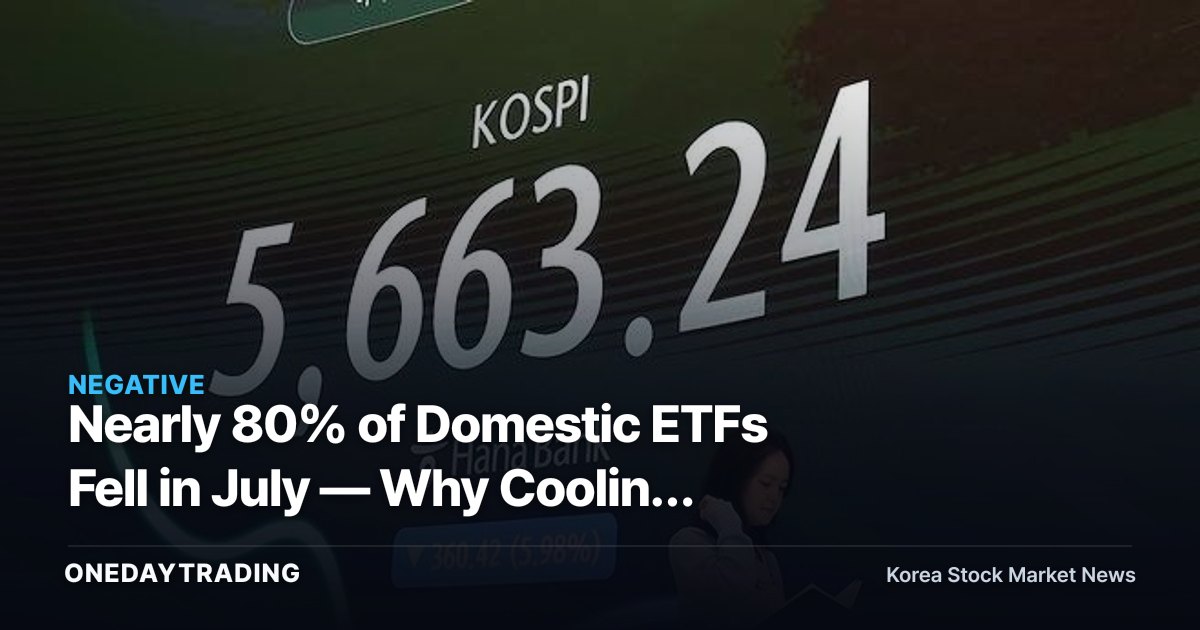
In July's domestic ETF market, 891 stocks (tickers) closed lower — 78.3% of the total. An ETF isn't a single stock; it's a product that bundles an index, industry sector, commodity, bond, or overseas asset into a single tradable instrument. A decline of this breadth points less to an earnings shock at any one company and more to a broader shift toward conservative asset allocation.
The comparison point is also a heavy one. This decline ratio was described as comparable to March, when risk aversion spiked following the outbreak of the Middle East war. Markets don't only wobble when there's a visible shock like war headlines. When the rate-cut path gets pushed back, exchange rate pressure lingers, and discount rates rise for richly valued growth stocks, the entire ETF basket tends to fall together.
Still, it's hard to read July's weakness as a simple collapse. The drop in single-stock leveraged ETF trading signals that investors' expected returns have fallen, but it also means the hottest trading has cooled off. Once overheated trading flows out, price sensitivity to the same negative catalyst can become duller.
Structural Background
The decline in the ETF market starts with interest rates and flows down into valuations. When rates are elevated, the present value of future earnings falls. That pressure hits thematic ETFs first — those like tech stocks, secondary batteries, and biotech that are priced on earnings far out in the future. Investors then trim their ETF holdings to limit losses, and less liquid products get hit even harder.
What the market has already priced in is July's losses. What's not yet fully priced in is whether shrinking trading volume will also erode the fee-generating capacity of asset managers and brokerages. Even if ETF balances hold steady, a drop in turnover dulls brokerage revenue. Conversely, once outflows stop in the themes that fell the most, prices can rebound ahead of earnings.
Impact on Stocks and Sectors
- Brokerage stocks: A decline in single-stock leveraged ETF trading weighs on brokerage commissions and derivative-linked trading value. Earnings momentum may stay limited until trading value recovers.
- Asset management industry sector: With 78.3% of ETFs down, redemption pressure from existing investors outweighs new inflows. Since management fees are tied to balances, net asset flow is the key variable.
- Growth-theme ETFs: As long as rate pressure lingers, multiple compression tends to hit products tied to long-term growth expectations — such as AI, secondary batteries, and biotech — first.
- Bond ETFs: As risk aversion intensifies, these could become a parking spot for money leaving equity funds. That said, volatility remains if long-duration bond exposure is increased without confirmation of falling rates.
- Commodity/energy ETFs: If Middle East-related risk resurfaces, these could move in the opposite direction from equity ETFs, and may be reappraised as a portfolio hedge.
Bullish vs. Bearish Scenarios
The bullish scenario views the drop in trading as a release of overheated speculation. If turnover in single-stock leveraged ETFs slows, deleveraging pressure eases as well. Add expectations of rate cuts or a stabilizing exchange rate, and a rebound could begin with sectors that still have solid earnings among the ETFs that fell together in July.
The bearish scenario is different. A decline across 891 ETFs could mean diversification itself has lost its defensive power. If investors cut not only leveraged products but also plain-vanilla equity ETFs, liquidity gets even thinner. In that case, a rebound would need confirmation that redemptions have calmed down before price appeal alone can drive a recovery.
Investor Action Points
- Watch whether August ETF fund flow turns to a net inflow. An end to outflows matters more than a price rebound at this stage.
- Watch whether single-stock leveraged ETF trading value spikes again. A spike could signal a rebound, but it could also mean speculative excess is building back up.
- Check the direction of market interest rates after the Bank of Korea's Monetary Policy Board meeting and U.S. inflation data. Rates need to fall for the multiple pressure on growth-theme ETFs to ease.
- If the won-dollar exchange rate grows unstable again, supply-demand (order flow) could diverge between overseas-asset ETFs and domestic equity ETFs. Currency-hedging status is worth checking as well.
Mirae Asset Securities in Real-Time Data
Mirae Asset Securities's most recent closing price was 34,550 won (-1.85% from the previous session), and the signal combining foreign/institutional investor flows with news and momentum reads 🟡 Neutral / Watch. With positive and negative signals mixed, this is a stock (ticker) to watch.
- ▲ Supply-demand (order flow) continuity — Foreign investors have been net buyers for 9 straight days (+6.2 billion won)
Recent related news is mixed, with 1 positive catalyst and 1 negative catalyst.
※ Price and foreign/institutional investor supply-demand (order flow) data are provided by Korea Investment & Securities (KIS), as of the time of publication.
This content is automatically summarized and analyzed based on the original news article. View original (Maeil Business Newspaper, Securities)