
Summary
The crux of this incident is not the government program itself, but the fact that an outside partner firm participating in the program was breached. In other words, the security of a partner entrusted with handling data proved to be the weak link rather than the systems operated directly by the public agency — an issue that could drive demand for security reviews across outsourcing and partner networks as a whole. From an investment standpoint, it is worth viewing this through both the short-term surge of interest in the information-security sector that tends to appear each time a personal-data breach recurs, and the longer-term trend toward tighter regulation.
How It Unfolded
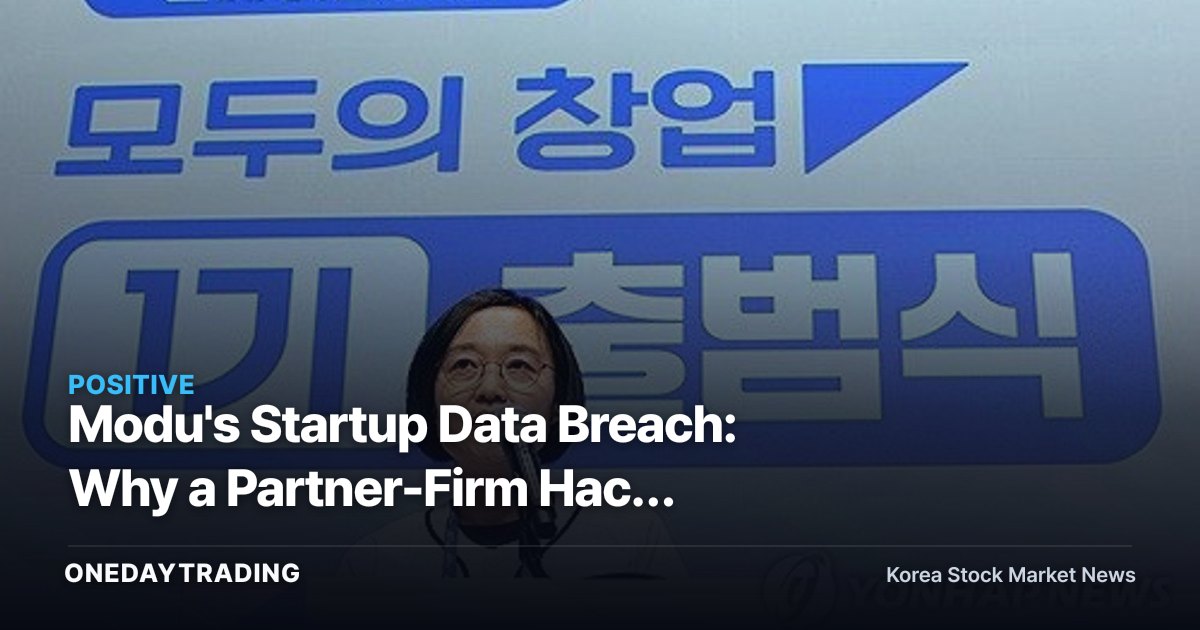
In the "Modu's Startup" program run by the Ministry of SMEs and Startups, the personal data of thousands of accepted applicants — along with the startup ideas they had submitted — leaked to the outside. An investigation into the cause found that this was not a direct breach of government systems, but a leak resulting from an external attack on a company participating in the project.
What stands out is the nature of the leaked data. Because it included not only ordinary personal information such as names and contact details but also pre-commercialization startup ideas, the damage could extend beyond simple identity theft to the exposure of business secrets and intellectual property. It is also an issue directly tied to the credibility of public support programs.
In a structure where the government does not store and process all data directly but entrusts it to operating agencies or participating firms, this incident reaffirmed the structural vulnerability whereby even if the core system is secure, a breach at a single partner can expose all the data.
Structural Background
In Korea, personal-data breaches have recurred across telecom, retail, finance, and the public sector alike, and each time has been followed by debate over expanding security investment and strengthening penalties and compensation. Indirect breaches through subcontractors and partners, in particular, fall in an area that the primary contractor finds hard to control directly, so policy pressure to strengthen supply-chain security and accountability for managing subcontractors is on the rise.
The public sector is characterized by large procurement orders and the tendency for a standard, once set, to spread to the private sector. If items such as encryption of entrusted data, access-rights controls, and breach monitoring are strengthened into mandatory program requirements, there is room for the very scale of orders for related solutions and managed security services to grow.
Impact on Stocks and Sectors
- AhnLab: With both antivirus/endpoint security and managed security services in its portfolio, it is a direct beneficiary candidate for the public and private security demand that rises after a breach. That said, a single incident is reflected with a time lag along the procurement cycle rather than translating immediately into earnings.
- WINS: With network intrusion prevention (IPS) and other external-attack blocking equipment as its mainstay, its business area aligns closely with the nature of this incident, which was attributed to an external hack.
- Raonsecure: It has a business structure connected to the trend toward stronger personal-data protection in the authentication and identity-verification fields.
- SGA Solutions and PIOLINK: This is a group of stocks that could pursue contract opportunities if demand for reviews of outsourcing and partner networks rises, in the public security solutions and data-center security areas.
- Platform and retail firms that outsource a lot of personal-data processing: These fall on the cost/regulation downside rather than the beneficiary side — if accountability for managing partners is strengthened, the burden of security investment could grow.
Bull vs. Bear Scenarios
The bull case is clear. The logic is that if recurring large-scale breaches lead to stricter public procurement requirements and bigger private security budgets, the order base for intrusion-blocking, managed-security, and authentication-solution firms widens. The emergence of a relatively new demand axis in supply-chain security is also favorable.
Conversely, the bear-case variables are just as evident. Security stocks have repeatedly followed a pattern of surging in the short term on expectations right after an incident, then pulling back when those expectations fail to translate into actual orders and earnings. Because the profit base of many security firms is not large, valuation strain can build quickly even on small contracts, and if responsibility for the incident is confined to the partner firm, there is also a risk that the intensity of policy tightening proves weaker than expected.
Investor Action Points
- Watch for the investigation findings and follow-up measures from the Ministry of SMEs and Startups and the Personal Information Protection Commission. Whether institutional changes such as stronger security obligations for subcontractors are explicitly spelled out will be the dividing line for whether demand persists.
- Monitor public security-related procurement and tender notices, along with new-contract disclosures from security firms, to track whether expectations convert into actual revenue.
- Check the prior quarter's operating profit and order backlog of the security stocks you are watching, to distinguish whether they are in a short-term thematic surge phase or one backed by earnings.
- Use whether additional similar breaches occur, and whether a regulatory-legislation timeline is set, as indicators of how sustainable the sector's momentum is.
AhnLab Through Real-Time Data
AhnLab's latest closing price is 55,600 won (-3.14% from the previous day), and its traffic-light signal — combining foreign investor and institutional investor order flow with news and momentum — is 🔴 Caution. With foreign investors, institutional investors, and momentum all negative, caution is warranted right now.
- ▼ Dual selling — foreign investors −900 million won and institutional investors −100 million won selling in tandem
- ▼ Trend alignment — aligned to the downside over the short and medium term (today -3.1% · 1 week -3.0% · 1 month -7.9%)
- ▼ 52-week position — 2% above the 52-week low
- ▲ News flow — positive catalysts 3 vs. negative catalysts 0 — positive-catalyst edge
Recent related news is favorable, with 3 positive catalysts and 0 negative catalysts.
※ Price and foreign/institutional order-flow data are provided by Korea Investment & Securities (KIS) and are as of the time of publication.
This article is content automatically summarized and analyzed based on the original news. View original (Yonhap News, Industry)