
At a Glance
When a value-investing legend accumulates low-PBR large caps, it reads not as a simple stock pick but as a style-rotation bet that "the era of growth-stock dominance is drawing to a close." Large caps trading cheap relative to their assets — like Samsung Electronics — along with the financial and automotive sectors facing mounting pressure to strengthen shareholder returns, move into direct focus.
The key is not a recommendation of individual stocks, but the question of whether the market's leading style can shift from growth to value — an outcome that hinges heavily on the value-up policy and the interest-rate environment.
Why It Matters Now
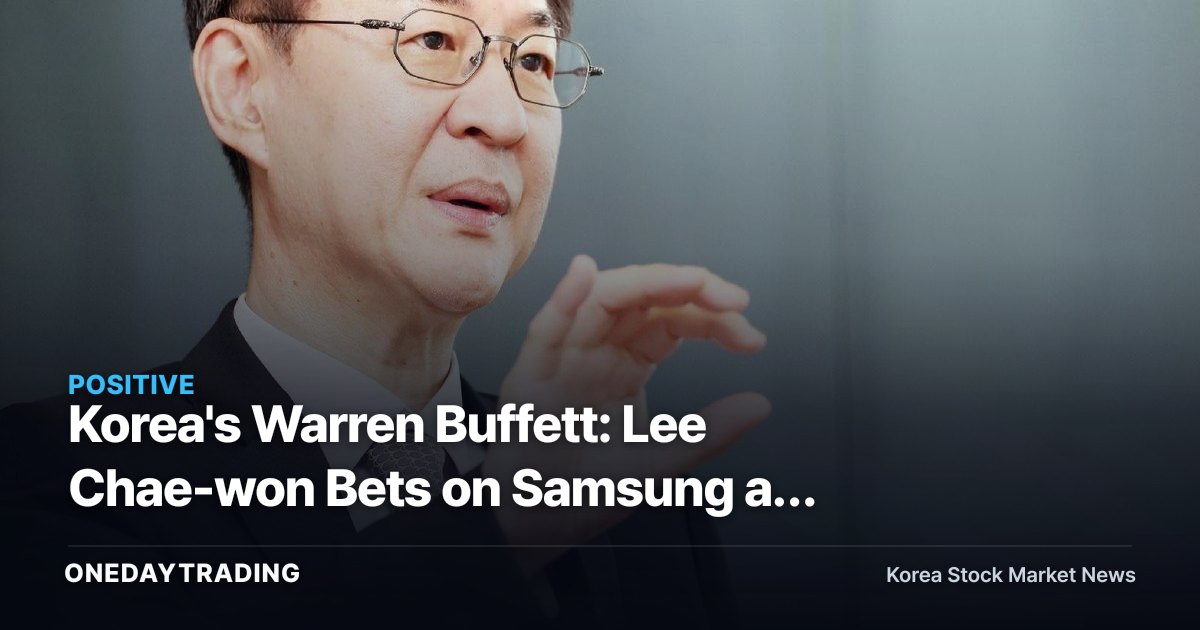
Lee Chae-won, chairman of Life Asset Management, is known as Korea's Warren Buffett and the godfather of value investing, and the fact that he is buying Samsung Electronics in the 60,000-won range while viewing the coming decade as a period when value investing shines again is drawing market attention. For the past several years, domestic and global equity markets have been led by growth stocks such as semiconductors, AI, and platforms, while traditional large caps trading cheap relative to asset value have been left behind. In this environment, a heavyweight from the value-investing camp increasing his large-cap holdings suggests that the style cycle may be approaching an inflection point.
Digging one level deeper into the mechanism, there are two conditions for value stocks to be re-rated. The first is a phase in which interest rates no longer rise quickly or turn lower, increasing the discount-rate burden on growth stocks that pull forward distant future earnings. The second is a shift in capital policy, in which companies return accumulated cash and assets to shareholders through dividends and share buyback-and-cancellation. Because Korea's chronic low-PBR (price-to-book ratio below 1x) discount is only resolved when the latter is at work, the effectiveness of the government's corporate value-up program becomes a precondition for this scenario.
Conditions for a Style Rotation
That said, a revival of value stocks is not automatically realized simply because they are "cheap." Undervaluation does not in itself guarantee gains, and for companies with low capital efficiency (ROE), there is often a valid reason their PBR is low. Accordingly, a re-rating continues only when not just asset value but also an earnings recovery and a commitment to shareholder returns are confirmed together.
Frequently Asked Questions
- Why Samsung Electronics in particular? Beyond expectations for a recovery in the semiconductor cycle, it rests on an asset-value view that the share price sits in a historically undervalued zone relative to the company's cash and assets.
- What is the crux of the 10-year value-investing revival thesis? It is a style-cycle logic: because the tilt toward growth stocks has been excessive, capital could rotate back into undervalued large caps once the interest-rate and policy environment changes.
- Can retail investors simply follow and buy the same? A master's buying timing, average cost, and holding period differ from those of retail investors, and even with the same stock, entry price and patience separate the outcomes.
- How does this relate to the value-up policy? Since the key to resolving the low-PBR discount is strengthening shareholder returns, the crux is whether the policy actually leads to expanded dividends and share buyback-and-cancellation.
Impact on Related Stocks and Sectors
- Samsung Electronics The core stock cited directly as an accumulation target in the article, a case where both the semiconductor cycle and an asset-value re-rating are at stake simultaneously.
- Banks and financial holding companies (KB Financial, Hana Financial Group, etc.) A representative low-PBR sector; the stronger their dividend payouts and buyback policies, the more directly they benefit from the value-up theme.
- Automakers (Hyundai Motor, etc.) Large caps that have remained undervalued relative to their earnings strength, candidates for a value re-rating if shareholder returns expand.
- The semiconductor sector broadly The logic behind accumulating Samsung Electronics, coupled with expectations of a cyclical recovery, could affect investor sentiment toward peer large caps.
- Low-PBR and high-dividend style ETFs Should a style rotation into value stocks materialize, these become a channel for capital inflows.
Points to Watch When Investing
- Undervaluation is not a sufficient condition for gains. Without an accompanying ROE and earnings recovery, the discount can persist for a long time.
- The value-revival thesis is sensitive to the direction of interest rates. If high rates persist, there is a risk the style rotation is delayed.
- It is necessary to verify whether the value-up policy actually translates into dividends and share buyback-and-cancellation, or merely stops at declarations.
- The mere fact that a famous investor is buying does not guarantee the near-term share price, and differences in entry timing and holding period drive the outcomes.
Overall Outlook
In the optimistic scenario, rate stabilization combines with an effective value-up policy to move capital into low-PBR large caps, and asset-value stocks including Samsung Electronics are gradually re-rated. Conversely, if the growth-led trend persists longer or the strengthening of shareholder returns remains mere rhetoric, the neglect of value stocks could be prolonged. Investors would be wise to treat next quarter's earnings, dividend and share buyback-and-cancellation disclosures, the benchmark interest rate decision schedule, and the number of companies participating in value-up disclosures as checkpoints, confirming step by step whether the style rotation is actually underway.
Samsung Electronics in Real-Time Data
Samsung Electronics' most recent closing price is 343,000 won (+1.78% from the previous day), and the signal light combining foreign and institutional supply-demand (order flow) with news and momentum is 🟡 Neutral — Wait and See. With positive and negative signals mixed, it is a zone to watch.
- ▲ Trend alignment — Short- and mid-term upward alignment (today +1.8% · 1 week +6.5% · 1 month +15.9%)
- ▲ 52-week position — Near the 52-week high at 91% — new-high territory
- ▲ News flow — 29 positive vs 9 negative — positive catalysts in the lead
Recent related news is favorable, with 29 positive and 9 negative items.
※ Price and foreign/institutional supply-demand (order flow) data are provided by Korea Investment & Securities (KIS), as of the time of publication.
This article is auto-summarized and analyzed content based on the original news. View original (Maeil Business Newspaper, Securities)