
Summary
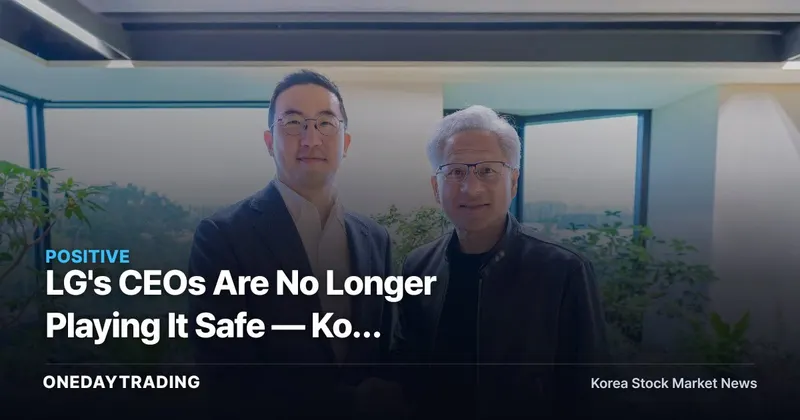
LG Group Chairman Koo Kwang-mo has told subsidiary CEOs to stop hiding behind the chairman and to communicate their management performance and business direction directly. This push for "star executives" in place of low-profile CEOs should not be read merely as a change in leadership style — it should be read as a signal that LG Group itself recognizes the holding company discount and the broader problem of undervaluation.
What Happened
According to a Maeil Business Newspaper report, Chairman Koo Kwang-mo recently asked subsidiary CEOs to take on a role that traditionally belonged to the chairman rather than the CEO — actively communicating management performance and business direction to the market and the public. Until now, LG subsidiary CEOs have largely kept a low media profile, focusing instead on hands-on management. This directive directly reverses that practice.
The key change is in sequencing. Previously, the chairman set group-level direction while CEOs quietly executed behind the scenes; now CEOs are expected to step forward themselves and explain earnings and strategy directly. This should be understood as a directive requiring real changes to IR and communication practices at each subsidiary under holding company (Ju) LG — including LG Electronics, LG Chem, LG Energy Solution, LG Uplus, and LG Innotek.
Structural Background
Korean holding company stocks chronically trade below the sum of their subsidiaries' equity value — the so-called holding company discount. When this is compounded by information asymmetry, where a company's actual competitiveness and business direction are not adequately communicated to the market, the discount widens further. Having CEOs speak directly is one of the cheapest ways to reduce this information asymmetry. The more specifically a CEO explains numbers and strategy in earnings releases, conference calls, and media interviews, the better the quality of information feeding into analysts' and institutional investors' valuation models.
Impact on Stocks (Tickers) and Industry Sectors
- (Ju) LG - The stock (ticker) most directly affected by expectations of a narrower holding company discount. If stronger CEO communication improves how well subsidiary value is reflected in the market, it could translate into a smaller discount to the holding company's net asset value.
- LG Electronics - As the CEO more frequently explains changes in the earnings structure of the home appliance and automotive electronics businesses, the market may more quickly absorb the re-rating narrative of a company evolving from a simple appliance maker into an automotive electronics and B2B solutions provider.
- LG Energy Solution - In periods of high battery-industry volatility, CEO commentary on order intake and utilization rates helps reduce share-price volatility. Explanation, rather than silence, favors valuation defense.
- LG Chem - In the petrochemical downcycle, the CEO directly explaining the direction of business restructuring could lower the market's uncertainty premium around the restructuring process.
- LG Uplus - Among the three telecom carriers, there is a strong incentive to offset relatively low market attention through greater CEO visibility.
Bullish vs. Bearish Scenarios
In the bullish scenario, stronger CEO messaging translates into actual increases in IR activity — more conference calls, more overseas investor meetings, greater media exposure — which in turn improves supply-demand (order flow) from foreign investors and institutional investors and narrows the holding company discount. Precedents from the Korea Value-up Program, where companies that improved governance, shareholder returns, and communication were re-rated, support this scenario.
In the bearish scenario, the enhanced communication amounts to form without substance. If CEO visibility increases but earnings and business fundamentals fail to follow, the market may view it as over-promotion and lose trust instead. In a weak battery and chemicals environment, an increase in talk is not the same thing as an improvement in earnings quality. Investors need to distinguish whether this directive comes alongside genuine fundamental improvement at the subsidiaries, or whether communication is simply running ahead of it.
Investor Action Points
- Check whether CEOs of major LG subsidiaries personally appear on next quarter's earnings conference calls and provide concrete figures.
- Track (Ju) LG's market capitalization discount to net asset value on a quarterly basis to see whether the discount is actually narrowing.
- Cross-check trading data to confirm whether foreign investor and institutional investor supply-demand (order flow) actually improves following the expanded CEO communication.
- Track each subsidiary's earnings release schedule alongside the frequency of CEO interviews and media appearances to judge whether there is a gap between communication and fundamentals.
LG in Real-Time Data
LG's most recent closing price was 97,900 won (-3.64% versus the previous day), and the signal combining foreign/institutional supply-demand (order flow) with news and momentum reads 🟡 neutral / wait-and-see. With positive and negative signals mixed, this is a stock (ticker) to watch closely.
- ▲ Supply-Demand Continuity — Foreign investors have been net buyers for 5 consecutive days (+3.7 billion won)
- ▼ Trend Alignment — Short- and medium-term downward alignment (-3.6% today · -0.9% over 1 week · -1.3% over 1 month)
※ Price and foreign/institutional supply-demand (order flow) data are provided by Korea Investment & Securities (KIS) and are as of the time of publication.
This article was automatically summarized and analyzed based on the original news report. View original (Maeil Business Newspaper, Corporate)