
Key Takeaways
The fact that U.S.-imported eggs sold out the same day at the high 5,000-won range per tray as soon as they hit large discount stores is not merely a consumer-price story — it is a signal that cracks have appeared in Korea's domestic laying-hen supply chain. The sharp gain (surge) in prices can serve as a near-term catalyst that lifts margins for poultry and livestock processing companies, but when the government's expansion of imports and tariff-quota measures kick in at the same time, the effect on domestic producers cuts both ways.
What Happened
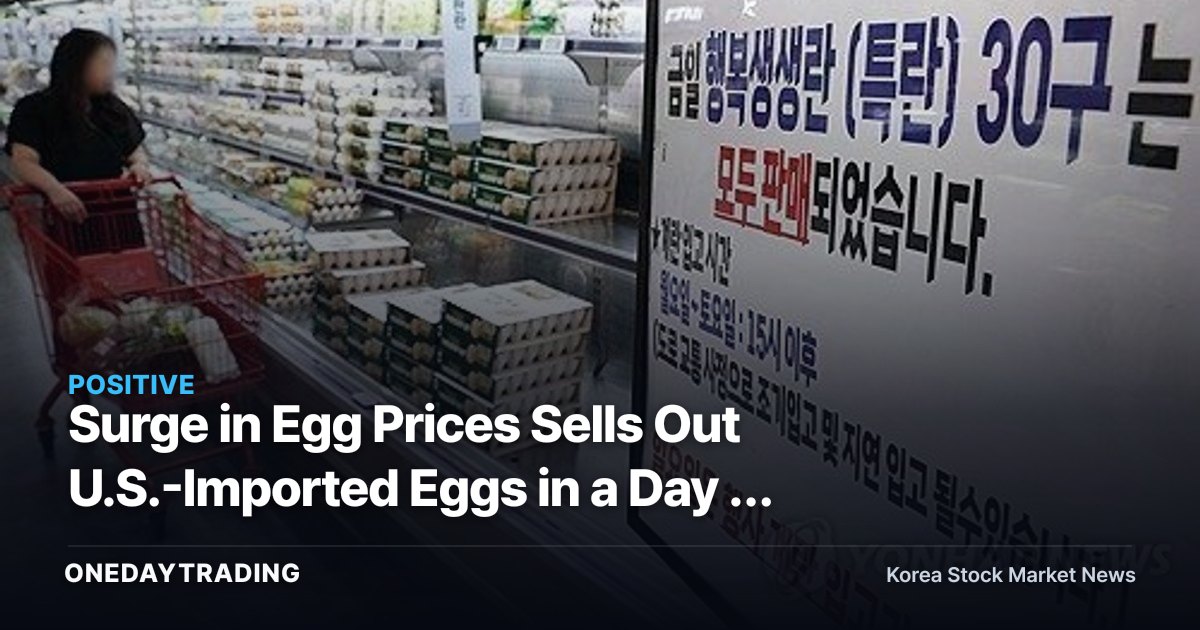
As the retail price of eggs climbed steeply, the government and the distribution industry urgently rolled out U.S.-imported eggs, and the volume sold at major discount stores for the high 5,000-won range per tray (30 eggs) was cleared out on the very day it was put on display. With domestic egg prices running well above normal-year levels, the price appeal of the imports stood out and demand poured in.
Bringing in imported eggs is a card that typically appears when domestic supply is structurally short. When the number of laying hens raised declines, or when culling takes place amid the spread of avian influenza (AI), the egg-production base contracts and wholesale prices are the first to jump. This sell-out laid bare for the market the difficulty of meeting demand with domestic volume alone.
Background and Context
Eggs are an essential good with low price elasticity, so even a small drop in supply causes prices to swing sharply. When wintertime AI outbreaks, rising feed costs, and an increasing share of aging laying hens overlap, it can take several months for supply to recover. If the government temporarily lowers tariffs on imported eggs or subsidizes air-freight costs, imports can spike in the short term — but this structurally feeds back as downward pressure on domestic prices.
In other words, the key point is that in the early stages of a price surge, farms holding laying hens and egg distribution and processing companies enjoy improved margins, but once import volumes ramp up in earnest and the domestic number of birds raised recovers, prices can normalize quickly.
Impact on the Market and Stocks
- Harim / Harim Holdings: As Korea's largest broiler-based operator with a high share of chicken meat and processed foods, it finds it relatively easy to pass through prices during a broad rise in protein prices.
- Easy Holdings: With a vertically integrated structure spanning feed–breeding stock–processing, the path to upstream margin improvement is clear when egg and broiler prices rise.
- Maniker / Cherrybro: Centered on chicken-meat processing, but their earnings leverage is large when poultry protein demand and prices strengthen together.
- Sajo Industries and other diversified livestock and food stocks: They benefit from rising protein prices while also bearing feed-cost burdens, so the direction of profit and loss can diverge.
- Feed and grain-related stocks: An indirect path works through rising demand for compound feed as laying-hen rearing recovers.
Investor Checkpoints
- Track on a monthly basis the wholesale and retail egg-price trends released by the Korea Institute for Animal Products Quality Evaluation and Statistics Korea, as well as the pace of recovery in the number of laying hens raised.
- The number of AI outbreaks and the scale of culling from winter through spring — a leading indicator for gauging the size of the supply shock.
- The schedule of government tariff-quota and import-expansion announcements — a variable that caps the upside on domestic prices.
- Prices of feed raw materials such as corn and soybean meal, along with the exchange rate — these determine the cost structure of poultry companies.
Outlook
If the supply shortage drags on, the near-term earnings momentum of poultry and livestock processing companies can continue. That said, surging egg prices are a sensitive item that invites policy intervention, so import expansion and price-stabilization measures tend to follow quickly. Therefore, rather than chasing the move on rising prices alone, a balanced approach is needed — one that also watches for the point at which recovering bird numbers and import-volume trends reverse prices. Whether a short-term supply-demand (order flow) event translates into structural earnings improvement must be confirmed in next quarter's earnings and cost trends.
Harim Through Real-Time Data
Harim's latest closing price is 2,745 won (-1.44% vs. the previous day), and the signal light — combining foreign and institutional investor order flow with news and momentum — is 🟡 Neutral · Wait-and-See. With positive and negative signals mixed, this is a zone to watch.
- ▼ Trend Alignment — short- and mid-term downward alignment (today -1.4% · 1 week -3.7% · 1 month -10.1%)
- ▼ 52-Week Position — 52-week bottom zone, 1%
- ▲ News Flow — 3 positive catalysts vs. 0 negative catalysts — positive catalysts dominate
Recent related news is favorable, with 3 positive catalysts · 0 negative catalysts.
※ Price and foreign/institutional investor order-flow data are provided by Korea Investment & Securities (KIS) and are as of the time of publication.
This article is content automatically summarized and analyzed based on an original news report. View Original (Yonhap News, Industry)