
Key Takeaways
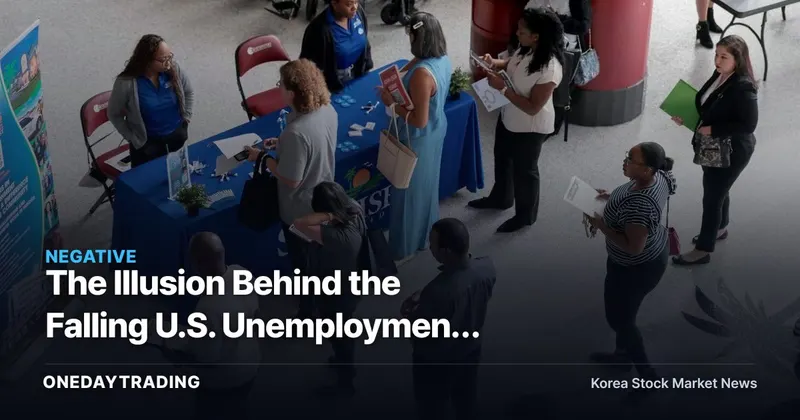
In its latest jobs report, the U.S. Department of Labor showed a decline in the unemployment rate — but this wasn't the result of stronger hiring. It was the result of more people giving up their job search altogether. The labor force participation rate fell to its lowest level in 50 years, excluding the COVID-19 pandemic period. That signals a widening gap between the headline number and the actual strength of the labor market, with ripple effects reaching the Federal Reserve's rate-setting calculus, the won-dollar exchange rate, and domestic equity market supply-demand (order flow).
What Happened
The unemployment rate isn't just a standalone figure — it's a fraction. The numerator is the number of unemployed people; the denominator is the labor force (employed workers plus those actively seeking work). Anyone who gives up job hunting and exits the labor market entirely is no longer counted as unemployed — and drops out of the denominator too. That's exactly what drove the unemployment rate lower in this report. With the broader jobs data disappointing, even the one number that improved — the unemployment rate — is hard to read as a pure positive catalyst.
The more troubling signal is the labor force participation rate. Excluding the period when COVID-19 froze the labor market, it has fallen to its lowest level in 50 years. The reasons vary — retirement, childcare, health issues, or simply having given up on the job search — but they share one thing in common: these people are not applying for open positions. While the market takes comfort in the falling unemployment rate, a more structural trend — a shrinking labor supply itself — is underway.
Background and Context
The Fed doesn't set monetary policy by looking at the unemployment rate alone. An improvement in the unemployment rate driven by falling participation is close to a statistical illusion, and the Fed is well aware of this. The key question is whether this drop in participation is viewed as a temporary adjustment or a structural contraction in labor supply. If it's judged to be the latter, that implies potential growth itself has declined — which would affect both the justification for and the pace of rate cuts.
Impact on Markets and Stocks (Tickers)
- U.S. government bonds: With labor market cooling confirmed, expectations for rate cuts could regain momentum, particularly at the short end of the curve. However, if falling participation comes with inflationary pressure (from rising wages), long-term yields may not decline as easily.
- Won-dollar exchange rate: If a weakening U.S. labor market reinforces a more dovish tilt at the Fed, that would be a factor for dollar weakness and won strength. That said, this remains a hypothesis until foreign investor inflows into the domestic stock market are actually confirmed.
- KOSPI growth stocks and semiconductors: Expectations of lower discount rates (interest rates) tend to support multiple expansion, which could favor valuations for growth stocks and semiconductors. However, this only holds if the U.S. economy achieves a soft landing rather than a recession.
- Gold and safe-haven assets: If cracks in the labor market are read as a sign of economic slowdown, demand for safe-haven assets like gold could pick up again.
- Domestic financial stocks: If U.S. rate-cut expectations spill over into domestic market rates, expectations for bank net interest margins could be revised down — a headwind for financial stocks.
Investor Checkpoints
- Watch the next U.S. Consumer Price Index (CPI) release to see whether wage-driven inflation pressure actually materializes.
- Monitor whether Federal Open Market Committee (FOMC) members characterize the drop in participation as a temporary factor or define it as structural.
- Track whether the won-dollar exchange rate moves above or below the 1,300 won level, a key inflection point for the direction of foreign investor flows.
- Watch next month's jobs report to see whether participation rebounds or falls further, which will help determine whether this decline is a trend or just noise.
Outlook
The optimistic scenario is that this drop in participation proves to be temporary noise, and the falling unemployment rate ultimately strengthens the Fed's case for rate cuts, easing valuation pressure across the broader stock market. In that case, KOSPI growth stocks and large-cap semiconductor names would likely react first. Conversely, if the decline in participation hardens into a structural contraction in labor supply, it could produce a combination of low growth and high inflation — leaving the Fed stuck in a dilemma where cutting rates becomes difficult. At this point, the market appears to be pricing in the more optimistic interpretation. The risk of the latter scenario has yet to be priced in.
This article was automatically summarized and analyzed based on the original news source. Read original (CNBC)