
Summary
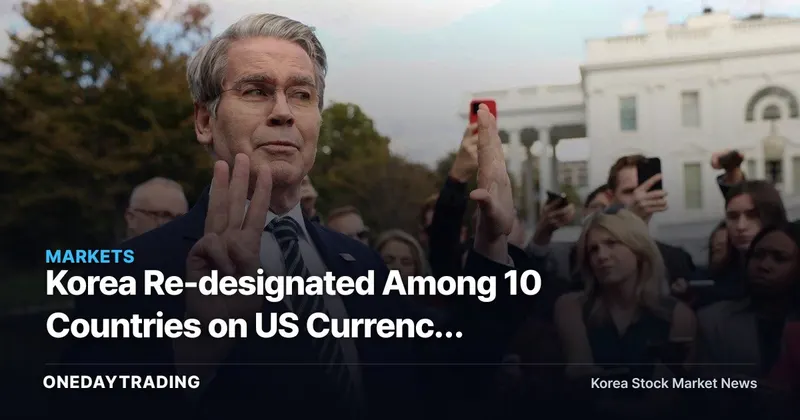
In its semiannual currency report, the US Treasury once again placed Korea on its list of currency monitoring countries, along with nine others. The designation itself is not a sanction — it simply reflects trade-account metrics such as the bilateral trade surplus with the US and the current account surplus. Yet dollar demand driven by Seohak-gaemi (Korean retail investors' overseas stock purchases) net buying of foreign equities — which arguably has a bigger impact on won supply-demand (order flow) — appears nowhere on this scorecard.
What Happened
Under the 1988 Omnibus Trade Act and the 2015 Trade Facilitation Act, the US Treasury reviews and publishes the currency policies of major trading partners twice a year. The assessment rests on three main criteria: a goods trade surplus with the US of at least $15 billion, a current account surplus exceeding 3% of GDP, and persistent one-directional foreign exchange intervention — sustained for at least six of the past 12 months — exceeding 2% of GDP. Meeting two or more of these criteria results in classification as a monitored country, and a country must clear the bar for at least two consecutive reports before being removed from the list.
Korea was once again listed alongside countries with structural trade and current account surpluses vis-à-vis the US, including China, Japan, Taiwan, Vietnam, Singapore, Germany, and Switzerland. The muted market reaction is straightforward to explain: the monitoring-list designation has recurred for years now, so it's already fully priced into consensus. What actually warrants attention isn't the designation itself, but the capital-account pressure this assessment fails to capture.
Structural Background
All three Treasury criteria target trade and current account dynamics — that is, surpluses arising from goods and services transactions and authorities' FX market intervention. By contrast, the capital outflow generated by domestic investors buying overseas stocks — dollar demand from Seohak-gaemi — is a factor this scorecard simply doesn't capture. A current account surplus tends to support won strength, whereas Seohak-gaemi net buying works in the opposite direction, exerting downward pressure on the won as a capital outflow item. Because these two forces move in opposite directions, judging the won's trajectory solely by the monitoring-list designation risks missing the actual direction entirely.
Impact on Stocks (Tickers) and Industry Sectors
- Mirae Asset Securities, Kiwoom Securities, NH Investment & Securities — As Seohak-gaemi's overseas stock trading value rises, brokerage commissions and FX-conversion-related revenue rise in tandem, so whether the net-buying trend continues has a direct bearing on earnings.
- Hyundai Motor, Kia, Samsung Electronics (005930) — A monitoring-list designation signals that authorities will find it harder to artificially suppress the won to protect export competitiveness. If the won strengthens faster than expected, it would weigh on profitability.
- Bank holding companies such as KB Financial Group, Shinhan Financial Group — Greater won volatility could widen quarter-to-quarter swings in foreign currency translation gains/losses and derivatives-related gains/losses.
- Industries with heavy raw-material import exposure, such as refining and chemicals — A shift toward won strength could provide a tailwind by easing input-cost burdens.
Bullish vs. Bearish Scenarios
In the bullish scenario, the monitoring-list designation does not escalate into actual sanctions, and Seohak-gaemi capital continues to recycle gains from the US stock market back into the domestic market in a virtuous cycle. This would support brokerage commission income and improve related consumer spending capacity. In the bearish scenario, cumulative capital outflows from Seohak-gaemi entrench structural won-weakness pressure, while the US tightens its criteria in the next report or warns of an upgrade to "currency manipulator" (in-depth analysis) status. In that case, the FX authorities' policy room would narrow sharply, and expectations for FX-related gains among exporter stocks would also be shaken.
Investor Action Points
- Track the timing of the next US Treasury currency report. It's typically released semiannually, and the key variable to watch is whether Korea is upgraded from "monitoring" to "in-depth analysis" status.
- Watch for tonal shifts regarding FX market intervention in Bank of Korea Monetary Policy Board commentary.
- Monitor the Korea Securities Depository's monthly data on Seohak-gaemi net overseas stock purchases to gauge the direction and pace of capital outflows.
- Watch whether the KRW/USD exchange rate breaks through key levels, and how earnings sensitivity diverges between exporter stocks and raw-material-import-dependent sectors as a result.
This article is auto-summarized and analyzed based on the original news report. View Original (Yonhap News Securities)