
Key Takeaways
These regulations are a variable that simultaneously shakes the profit structure and credibility of the electronic payment gateway (PG) industry. Forcing settlement funds to be held separately in external custody reduces the room PG firms have had to effectively deploy the unsettled balances they have long managed, while the deregistration clause for repeat violations heightens the survival risk for small and mid-sized operators. In the short term this is a cost burden for listed PG firms, but over the medium-to-long term it carries a dual aspect — expanded transactions through restored trust.
What Happened
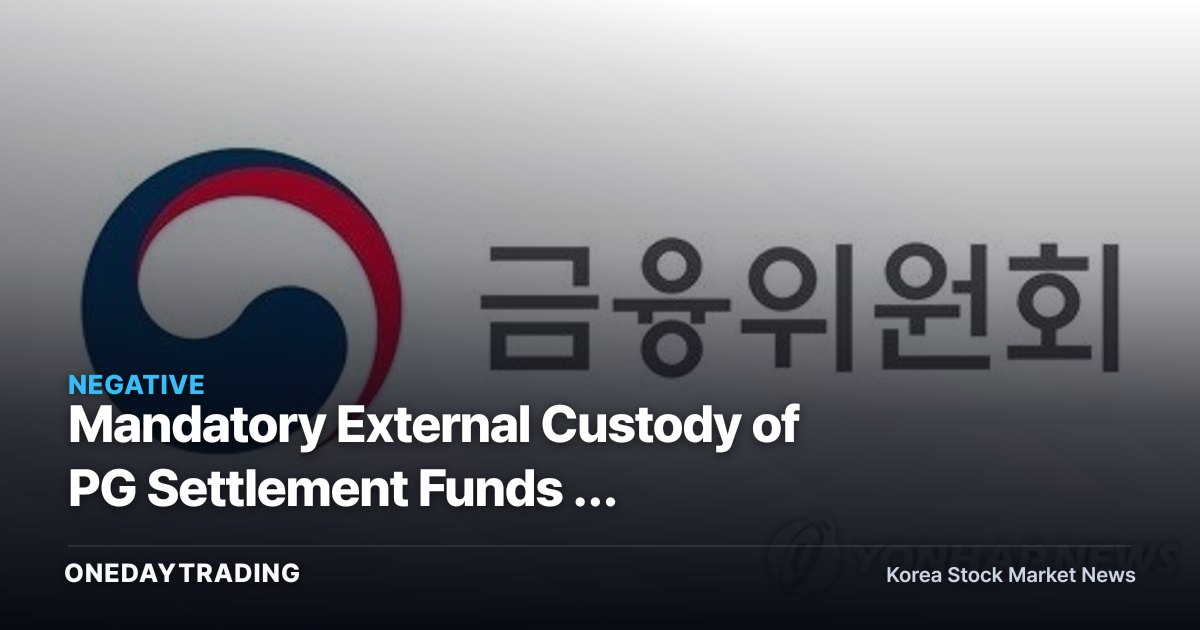
To prevent a second TMON-WeMakePrice (TMON·WeMakePrice) large-scale non-settlement crisis, financial authorities are pushing a plan to require PG operators to hold their settlement funds separately at an external institution. The core is a structure in which settlement proceeds owed to sellers are segregated from the PG firm's own assets, so that sellers' funds are protected even if the company becomes insolvent.
Added to this is a strengthened sanctions clause that allows registration itself to be revoked if business suspensions are repeated. The intent is to institutionally block a repeat of the TMON-WeMakePrice case, in which delayed and unpaid settlements reached the hundreds of billions of won and triggered cascading damage to onboarded sellers and consumers.
Background and Context
Until now, PG firms have held settlement funds during the period between receiving proceeds from card companies and others and paying them out to sellers, earning investment income from these balances or using them as working capital. Mandatory external custody restricts precisely this — making it not a mere administrative regulation but a change that directly touches profitability.
Impact on the Market and Stocks
- KG Inicis: As a large domestic PG firm with a high transaction-volume share, the reduced capacity to deploy funds under external custody of settlement money and the cost burden of building new systems could weigh relatively heavily.
- NHN KCP: As a specialized electronic-payment operator, compliance costs from the changed settlement structure could be reflected in its margins.
- NICE Information & Telecommunication, Danal, Hecto Financial: As mid-tier payment firms, the deregistration clause for repeat sanctions is directly tied to survival risk, especially for operators with weaker financial soundness.
- Kakao Pay: As it runs both simple payment and PG businesses, a broader scope of regulatory application could expand its fund-management constraints.
- Major e-commerce platforms: Greater settlement stability eases concerns over seller attrition, which is positive for restoring trust in the transaction ecosystem.
Investor Checkpoints
- The timetable for amending the Electronic Financial Transactions Act and its enforcement decree, which will set the specific start date for external custody of settlement funds and the transaction-volume thresholds for application
- The extent of each PG firm's decline in investment income from introducing external custody, and how system-building costs affect operating profit margins in quarterly earnings
- The detailed criteria for business-suspension and deregistration requirements, and the potential for mergers and acquisitions or market realignment among small and mid-sized payment firms
- Whether improvements in transaction convenience — such as shorter seller settlement cycles — following tighter regulation translate into higher payment volumes
Outlook
Optimistically, a stronger settlement safety net could restore trust across the PG industry, increasing payment usage by onboarded merchants and consumers and feeding into transaction-volume growth for large operators. Conversely, constraints on deploying settlement funds and the added costs weigh on short-term profitability; in particular, small and mid-sized payment firms with weaker capital could face eroding competitiveness or pressure to exit the market in the course of complying with the regulations. The degree of impact across individual stocks will diverge widely depending on the strength of the enforcement decree and its timing.
KG Inicis Through Real-Time Data
KG Inicis' latest closing price is 9,570 won (-3.82% versus the prior day), and the signal light combining foreign and institutional supply-demand (order flow) with news and momentum is 🟡 Neutral — Wait and See. With positive and negative signals mixed, it is a zone to watch.
- ▼ Trend alignment — short- and medium-term downward alignment (same day -3.8% · 1 week -5.5% · 1 month -7.3%)
- ▼ 52-week position — near the 52-week low at 13%
※ Price and foreign/institutional supply-demand (order flow) data are provided by Korea Investment & Securities (KIS), as of the time of publication.
This article is content automatically summarized and analyzed based on the original news report. View original (Yonhap News Securities)