
At a Glance
The 10th anniversary of Korea Growth Investment Corp is not a mere commemoration but a turning point for examining the fund flow and exit structure of Korea's venture-capital ecosystem. As long as policy capital plays a priming role, it is directly tied to the investment and management environment of listed venture-capital firms, and the debate over reforming the exit market will affect the visibility of realized gains for this group of stocks (tickers) going forward.
The crux lies in the exit, not the supply of capital. Even a well-run fund faces a structural limit: unless portfolio companies are exited at fair value, those returns cannot be converted into firm profits — a point underscored once again at this event.
Why It Matters Now
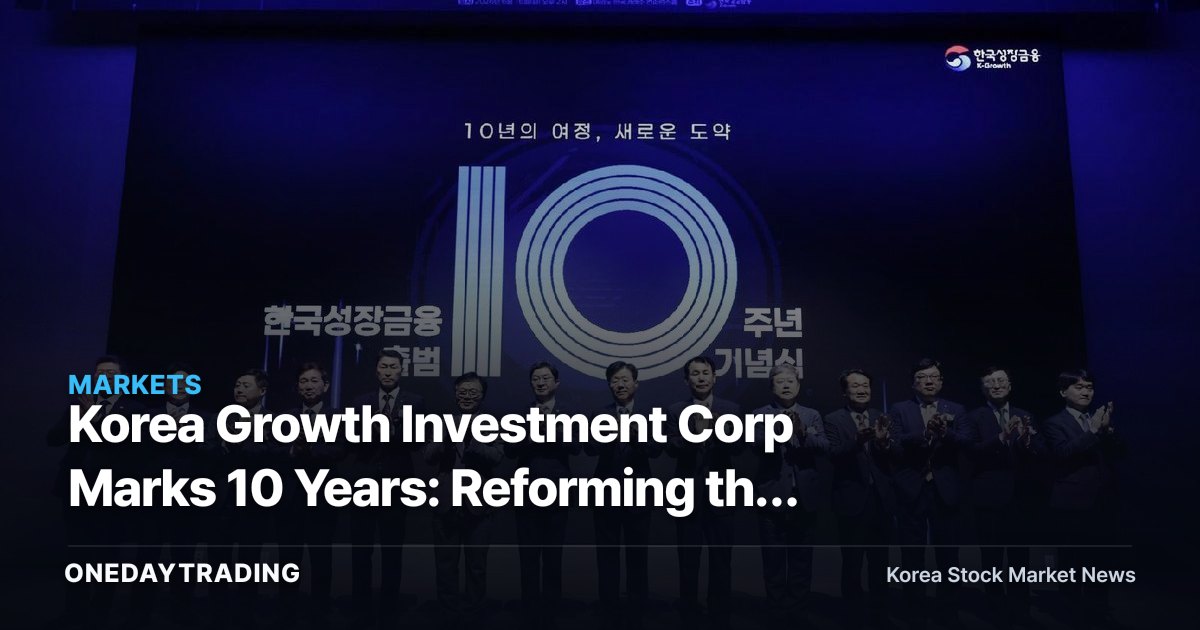
On the 16th, Korea Growth Investment Corp held a ceremony marking its 10th anniversary and announced that it had formed 603 sub-funds supporting some 4,600 companies over that period. The roughly 14% return recorded on funds that have completed liquidation is regarded as a solid result for the operation of a policy-oriented mother fund.
Within this structure, Korea Growth Investment Corp acts as a fund of funds that invests in private fund managers rather than investing directly. The scale and direction of policy commitments therefore determine the assets under management (AUM) growth and management-fee base of the listed venture-capital firms that run the sub-funds. Expanded commitments lay the groundwork for top-line growth at these firms, whereas shrinking commitments lead to delays in fund formation.
This is also why the industry has singled out improving the exit market as an urgent task. Venture-investment exits in Korea rely heavily on initial public offerings (IPOs), while the markets for mergers and acquisitions (M&A) and secondary (existing-share) transactions remain thin. When exit routes are concentrated in IPOs alone, fund liquidations and the recognition of performance fees are delayed during equity-market downturns, which amplifies the volatility of managers' earnings.
Frequently Asked Questions
- Is Korea Growth Investment Corp a listed company? No. It is an unlisted policy-oriented investment institution that influences the market through the private fund managers running its sub-funds rather than being a direct investment target itself.
- Why is the exit market so central? Because the exit is the stage at which invested capital is converted into profit. M&A and secondary transactions, beyond IPOs, must become more active for managers to realize returns steadily regardless of market conditions.
- What does the 14% return on liquidated funds signify? By the standards of a policy mother fund, it is read as a signal that strong results were achieved without losses while supplying venture capital to the capital markets.
- What does this have to do with ordinary investors? The connection is indirect, channeled through the fund-formation and exit environment of venture-capital firms listed on the KOSDAQ.
Impact on Related Stocks and Sectors
- Listed venture-capital firms When policy mother-fund commitments expand, the base for sub-fund formation and management fees broadens. Improving the exit market is a direct path to greater visibility on the realization of performance fees.
- The venture-investment sector overall If exit channels beyond IPOs become more diverse, funds turn over faster and new fund formation is encouraged, improving fund flow across the industry sector as a whole.
- The KOSDAQ market As the key exit gateway, whether the IPO market recovers is directly tied to managers' earnings.
- Portfolio growth companies Continued supply of venture capital is favorable for the funding environment of early- and mid-stage companies, but a prolonged exit slump feeds back as a contraction in capacity for new investment.
Points to Watch When Investing
- The earnings of listed venture-capital firms carry very high quarterly volatility depending on when performance fees are recognized. It is hard to infer a trend from a single quarter's figures.
- Overhauling the exit market is a medium-to-long-term task that requires accompanying institutional and market changes, so there is a significant lag before it can be viewed as a short-term share-price catalyst.
- During slowdowns in the equity and IPO markets, valuation losses on the existing portfolio and exit delays can emerge at the same time.
- The scale and direction of policy commitments can shift with budget and policy priorities, making it difficult to assume continuity.
Overall Outlook
The optimistic scenario is one in which policy commitments are maintained while M&A and secondary transactions expand, freeing managers' exit routes from their heavy concentration in IPOs. In that case, fund turnover and the realization of performance fees would accelerate, potentially improving the earnings visibility of listed venture-capital firms. Conversely, if an equity-market slump and shrinking IPOs drag on, exit delays and valuation-loss burdens would accumulate, leaving earnings stagnant even under the same policy environment. Ultimately, it is the breadth of the exit — more than the scale of commitments — that will determine the direction of this group of stocks.
Mirae Asset Venture Investment in Real-Time Data
Mirae Asset Venture Investment's latest closing price is 28,500 won (-4.36% from the previous day), and the signal light combining foreign and institutional supply-demand (order flow) with news and momentum is 🟡 Neutral · Wait-and-See. With positive and negative signals mixed, it is a zone to watch.
- ▼ Trend alignment — short- and medium-term downward alignment (intraday -4.4% · 1-week -25.3% · 1-month -50.5%)
Recent related news is favorable, with 1 positive catalyst and 0 negative catalysts.
※ Price and foreign/institutional supply-demand (order flow) data are provided by Korea Investment & Securities (KIS), as of the time of publication.
This article is content automatically summarized and analyzed based on the original news. View the original (Maeil Business Newspaper, Securities)