
Key Takeaways
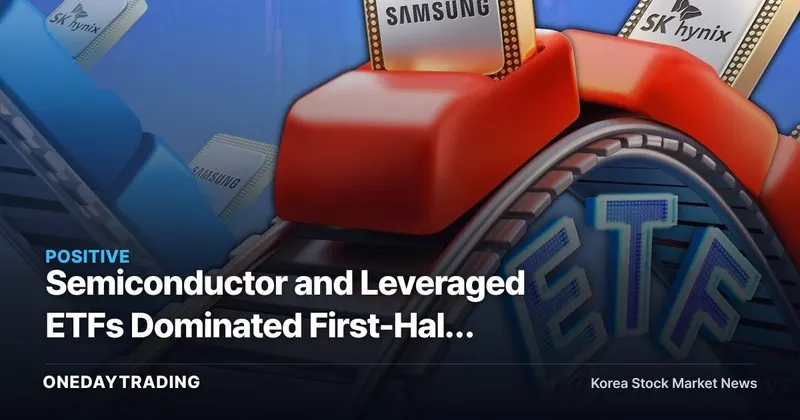
The keywords that dominated the top of Korea's ETF market in the first half of 2026 were semiconductors and leverage. As the AI data center investment cycle hit the HBM supply chain head-on, semiconductor ETFs surged across the board, and the 2x daily-tracking leverage structure combined with this to maximize the return-amplification effect. Now that much of the first-half performance has already been priced in, the second half will need a different catalyst.
What Happened
Leveraged ETFs are structured to track twice the daily return of an underlying index. In periods when the index maintains a one-directional uptrend, the compounding effect works positively, generating gains that exceed a simple 2x multiple. The key engine behind the semiconductor index's sustained uptrend in the first half was the surge in HBM3e demand driven by expanding shipments of Nvidia's Blackwell GPUs. Demand cascaded stepwise from supply-chain materials to equipment and foundries, and that amplitude translated directly into ETF returns.
SK Hynix, a core holding in domestic semiconductor ETFs, led the sector rebound by maintaining a dominant share of HBM3e supply. Samsung Electronics (005930) was relatively sidelined due to delays in customer qualification for its HBM3e 12-layer stack, but a recovery in the commodity DRAM market supported a floor under its share price. The back-end and materials supply chain — including Hanmi Semiconductor's TC bonders and HPSP's high-pressure oxidation equipment — also fell squarely within the direct beneficiaries of rising HBM demand.
Background and Context
This round of strength in semiconductor ETFs stemmed not from the traditional DRAM price-cycle logic but from a structural shift created by AI accelerator demand. HBM commands a unit price several times that of commodity DRAM, and the volume loaded per GPU keeps rising with each generation, fundamentally reshaping SK Hynix's revenue mix. The very fact that leveraged ETFs climbed to the top of the return rankings signals that the market has come to view the improvement in the semiconductor cycle as a trend rather than a one-off event. In an uptrend with limited volatility, leverage's path dependency translated directly into maximized returns.
Market and Stock Impact
- SK Hynix — Its position as the near-exclusive supplier of HBM3e was the core engine behind semiconductor ETF returns. As its exposure to Nvidia grows, this structure brings both rising ASPs and improving margins.
- Samsung Electronics (005930) — The timing of completing HBM3e 12-layer qualification is the fork in the road for its contribution within ETFs. If qualification delays persist, the relative benefit within semiconductor ETFs will remain concentrated in SK Hynix.
- Hanmi Semiconductor — Its monopoly position in TC bonders gives it a direct beneficiary role in rising HBM back-end demand. Its order backlog offers the clearest earnings visibility among the stocks (tickers) held in the ETFs.
- HPSP — Its monopoly in high-pressure oxidation equipment ties it directly to the advanced-process expansion cycle. As HBM capacity-expansion capex rises, order intake follows suit.
- Leveraged ETFs broadly — While they stay at the top of the return rankings as long as the index maintains its direction, investors need to recognize the structural asymmetry: once the trend turns, losses accelerate at twice the pace.
Investor Checkpoints
- HBM3e 12-layer yield trends — The timing of Samsung Electronics (005930)'s completion of customer qualification is the first fork in the road for semiconductor ETF returns in the second half. If yields stabilize, margins improve; if they stall, only expansion costs accumulate.
- SK Hynix and Samsung Electronics (005930) Q2 earnings releases (expected in July) — The key is to confirm HBM capex guidance and the HBM4 transition schedule. An upward guidance revision would pass benefits through to equipment and materials suppliers.
- Nvidia's Blackwell Ultra shipment schedule — Once the HBM loading specification is finalized, it will further open up order visibility for SK Hynix. Quarterly GPU shipment volumes serve as a leading indicator for HBM demand forecasts.
- Leveraged ETF holders — Watch for a reignition of the debate over peak HBM demand and news of a slowdown in U.S. data center investment as signals of a shift toward a sideways or downward move. Once the trend reverses, the negative compounding effect accumulates quickly.
Outlook
The optimistic scenario is one in which the AI data center investment cycle extends and the generational transition from HBM3e to HBM4 accelerates. As the number of stacked layers increases and packaging complexity rises, the benefit to back-end equipment and materials suppliers intensifies, leaving room for additional momentum across the full roster of stocks (tickers) held in semiconductor ETFs.
Risk comes from three directions. The first is valuation, much of which has already been priced in during the first half — the margin of safety for new buyers is narrower than for those who entered in the first half. Second, if HBM yields stall at the 12-layer stage, expansion capex will eat into margins — volume may return, but profit will follow only slowly. Third, tail risks that could shake the HBM market include Nvidia's own attempts at in-house memory development and a slowdown in Chinese AI demand. Ultimately, the direction of semiconductor ETFs in the second half will be decided by two numbers: yield and capex.
SK Hynix Through Real-Time Data
SK Hynix's most recent closing price is 2,650,000 won (0.00% vs. the previous day), and the composite signal combining foreign-investor/institutional-investor supply-demand (order flow) with news and momentum reads 🟡 Neutral — Watch. With positive and negative signals mixed, this is a stock (ticker) to keep an eye on.
- ▼ Supply-demand (order flow) continuity — Foreign investors have been net sellers for 8 consecutive days (−1.58 trillion won)
- ▲ 52-week position — 88% toward the 52-week high — near record-high territory
- ▲ News flow — 6 positive catalysts vs. 1 negative catalyst — positive catalysts prevail
Recent related news skews favorable, with 6 positive catalysts versus 1 negative catalyst.
※ Price and foreign-investor/institutional-investor supply-demand (order flow) data are provided by Korea Investment & Securities (KIS) and reflect the time of publication.
This article is automatically summarized and analyzed content based on the original news report. View original (Yonhap News Agency, Securities)