
Three-Line Briefing
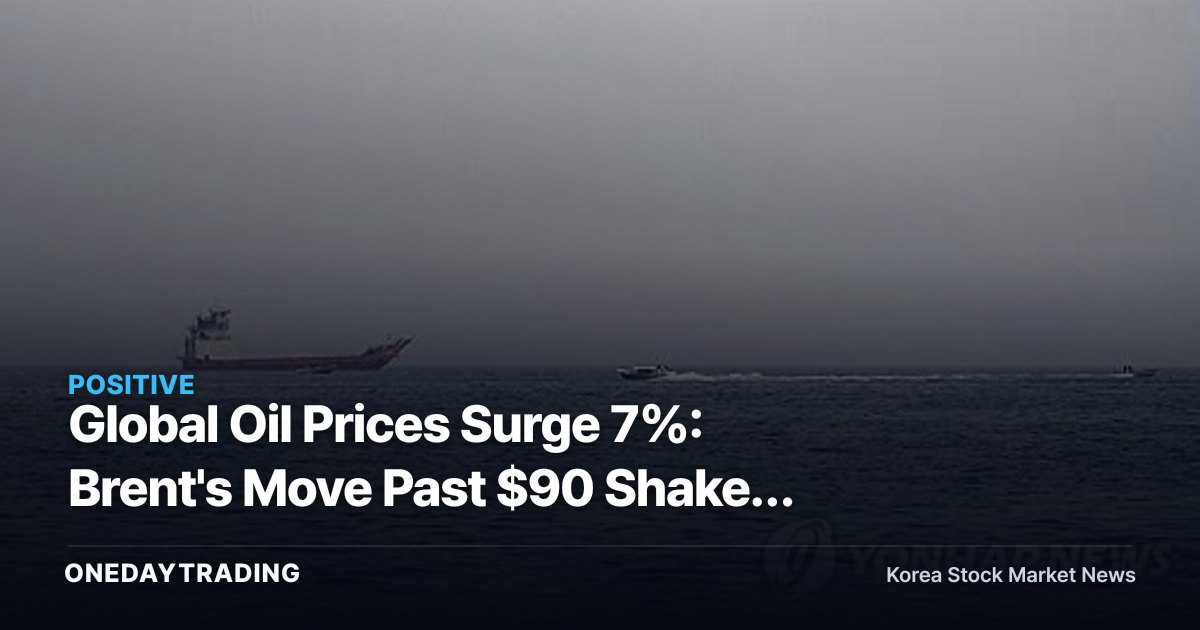
- Global oil prices posted a sharp gain of as much as 7% intraday after renewed military conflict in the Middle East, with Brent crude climbing past $90 a barrel.
- What this number really signals isn't confirmed supply disruption but a repricing of the risk premium. The market is pricing in shipping routes, insurance costs, and inventory expenses before it prices crude itself.
- For Korean investors, this is a two-track signal: a short-term positive catalyst for refiners, but a cost burden for chemical, airline, and shipping stocks. If oil prices stay elevated for long, however, weakening demand could eventually erode refining margins as well.
What's Changing
Kang Si-hyun's energy macro analysis. Brent crude in the $90s isn't just a commodity price tag. It injects inflation anxiety into interest rates, discount-rate pressure into valuations, and a divergence in cost pass-through power among sector leaders. When oil prices rise, refiners book inventory valuation gains first, while chemical makers and airlines see their input costs rise first. The same energy headline lands on a different line of the income statement depending on the industry sector.
The fact that the U.S. and Iran have resumed military clashes after a brief pause changes probabilities more than actual supply volumes. Oil markets price in Middle East risk even before actual production disruptions are confirmed. Insurance premiums, shipping freight rates, discussions of strategic reserve releases, and the possibility of increased output from oil-producing nations all move at once. This week's sharp gain of roughly 7% is the result of that probability being repriced within a single day.
In the Korean market, refiners are likely to react first. Companies holding crude inventories can recognize inventory valuation gains during a price upswing, and if refining margins hold up, the improvement in earnings can be substantial. Chemical makers that rely on naphtha, by contrast, see their spreads squeezed if they cannot pass rising input costs on to product prices. For airlines, fuel costs are a core component of operating expenses, so higher oil prices translate directly into margin pressure.
Reading the Numbers in Context
What the market has already priced in is the immediate premium from Middle East risk. The intraday gain of roughly 7% and Brent's move past $90 have, by themselves, absorbed much of the short-term shock. Two things remain only partially priced in: one is the possibility that the conflict spreads to crude shipping routes, and the other is the channel through which higher oil prices could once again unsettle U.S. inflation and interest rate expectations.
The stronger the market's conviction that rates will fall, the more uncomfortable a spike in oil prices becomes. If energy prices reignite consumer inflation, central banks will likely slow the pace of easing. That would compress multiples for growth stocks while boosting the relative appeal of energy and financial names with visible near-term cash flow. For the KOSPI as a whole, exchange-rate effects on exporters and cost-push inflation are working simultaneously.
Winners and Losers
- S-Oil: During periods of rising global oil prices, the value of its crude inventories increases, and if refining margins hold up, earnings leverage shows up most directly. However, if only crude prices rise while product demand stays weak, the effect will be short-lived.
- SK Innovation: Its refining segment can benefit from higher oil prices, but cost and demand variables in its battery and chemical segments must also be considered. The read on this stock is more complex than for a pure-play refiner.
- GS: Earnings expectations for its refining subsidiary could be reflected in the share price. Given its holding-company structure, the stock's reaction tends to reflect a combination of refining margin trends and dividend expectations.
- Korean Air: Higher oil prices mean a heavier jet fuel cost burden. The impact is cushioned if fare increases can be passed through, but defending margins becomes difficult in a phase of weakening passenger and cargo demand.
- LG Chem: Rising naphtha prices squeeze petrochemical spreads. If cost increases are reflected faster than product price hikes, it weighs on near-term earnings.
Risk Check
- If the Middle East conflict does not translate into actual supply disruption, the oil price premium could unwind quickly.
- If Brent stays in the $90s for an extended period, concerns over slowing global demand could outweigh the benefit to refiners.
- If rising oil prices stoke inflation expectations, rate-cut expectations could retreat, weighing on equity valuations broadly.
- For refiners, refining margins matter more than crude prices themselves. If crude price gains outpace product price gains, the strength of this positive catalyst will fade.
Bottom Line
This surge in oil prices offers refiners a short-term catalyst, but the moment Brent in the $90s starts to unsettle the path of inflation and interest rates, market focus will shift from hunting for beneficiaries to sorting out which companies can withstand the cost pressure.
S-Oil: A Real-Time Data Snapshot
S-Oil's most recent closing price was 126,400 won (-2.39% versus the prior session), and the signal combining foreign and institutional investor supply-demand (order flow) with news and momentum reads 🟢 Buy-leaning. Foreign investors, institutional investors, and news flow are all positive, making this a stock (ticker) worth watching.
- ▲ Sustained supply-demand (order flow) — Foreign investors have been net buyers for 3 straight days (+3.9 billion won)
- ▲ Dual buying — Foreign investors (+3.9 billion won) and institutional investors (+2.7 billion won) buying together
Recent related news skews favorable, with 1 positive catalyst and 0 negative catalysts.
※ Price and foreign/institutional investor supply-demand (order flow) data are provided by Korea Investment & Securities (KIS) and reflect figures as of publication time.
This article is automatically summarized and analyzed content based on the original news report. View original (Yonhap News Agency, Securities)