
What the KOSPI’s Strength Signals
The KOSPI traded higher intraday on November 12, 2026, but the key signal for investors is not the index gain itself—it is how strongly semiconductor stocks and supply-demand (order flow) can sustain the advance. Samsung Electronics rose despite mounting management uncertainty surrounding Nvidia, suggesting that Korean chip stocks are absorbing the immediate impact.
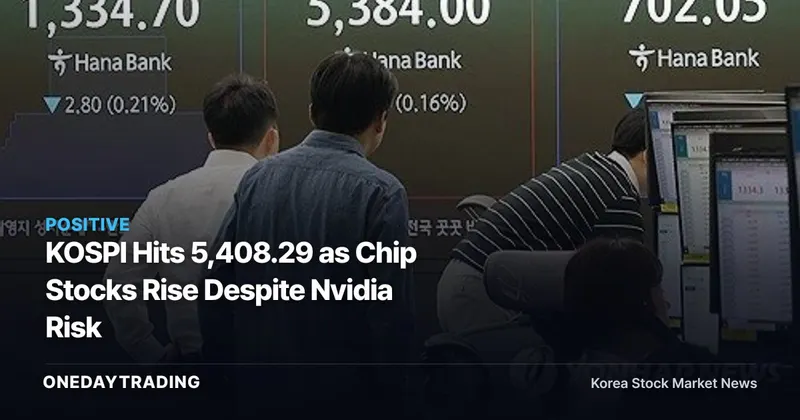
According to Yonhap News’ securities coverage, the KOSPI stood at 5,408.29 as of 10:59 a.m. on November 12, up 32.93 points, or 0.61%, from the previous session. An intraday price is formed by buying and selling before trading ends, meaning its direction has not yet been finalized, unlike the closing price.
KOSPI Rebound Masks Diverging Order Flow
The KOSPI gained 4.39% on November 10 and advanced another 2.60% in the previous session. However, a continuing rally should not be conflated with solid underlying momentum. In the main KOSPI market, foreign investors and retail investors were net buyers of 168.9 billion won and 175.3 billion won, respectively, while institutional investors were net sellers of 522.6 billion won.
This supply-demand (order flow) reveals competing expectations within the index. Purchases by foreign investors and retail investors supported the advance, but because institutional selling was larger, fresh buying may be needed for further gains. Prices currently reflect expectations for a semiconductor-led rebound; what remains unconfirmed is whether those expectations will hold through the market close.
Nvidia and Jensen Huang Uncertainty Exposes a Fault Line
Major U.S. stock indexes rose overnight, with AI and semiconductor shares also gaining. CoreWeave climbed 24.71% in the previous session, while Nvidia advanced 2.87% overnight. This provided a favorable backdrop for AI investment optimism to bolster market sentiment toward Korean semiconductor stocks.
However, The Wall Street Journal reported that Nvidia’s board had begun preparations to remove CEO Jensen Huang. Nvidia subsequently fell more than 8% in after-hours trading. With the regular-session rebound followed by an after-hours sharp drop (plunge), the market has begun pricing in not only the profitability of the AI business but also management continuity.
Executive Director Seo said, “Uncertainty over CEO Huang’s future has raised concerns that Nvidia’s aggressive AI investment strategy, product development, and partnerships with major customers could face disruption.” Neither whether Huang will actually be removed nor the timing or details of any official board decision have been confirmed. It is therefore too early to treat the report as a finalized management change or draw firm conclusions about its impact on Korean semiconductor stocks.
Different Confirmation Points for Samsung Electronics and SK Hynix
- Samsung Electronics: The stock was up 2.43% and subsequently extended its gains. Continued buying despite Nvidia-related uncertainty shows that Korea’s major semiconductor stocks did not immediately move in the same direction.
- SK Hynix: The stock fluctuated intraday before moving higher. Because no specific percentage gain was provided, there is no basis for numerically comparing its strength with Samsung Electronics or determining whether the Nvidia situation will benefit or hurt the company.
- Nvidia: The stock reversed direction in after-hours trading following a regular-session gain. Whether Jensen Huang’s future affects management strategy and customer partnerships will be pivotal for market sentiment.
KOSDAQ Weakness Highlights the Rally’s Limited Breadth
The KOSDAQ was down 0.20 points, or 0.03%, at 704.90. The divergence between the KOSPI and KOSDAQ indicates that the intraday strength was not evenly distributed across the broader market. This is why gains in major semiconductor stocks alone cannot be interpreted as a broad recovery in risk appetite.
If the KOSPI continues to rise, strength led by large-cap stocks could persist. Conversely, if net institutional selling increases or Nvidia’s after-hours weakness carries into the next session, semiconductor market sentiment and the index’s gains could both come under pressure.
Three Things Investors Should Monitor Next
- Closing indexes: The KOSPI at 5,408.29 and KOSDAQ at 704.90 are intraday readings. Their closing prices must be confirmed to determine whether the divergence between the two markets persists.
- Supply-demand (order flow) reversal: The index’s staying power will depend on whether foreign investors and retail investors remain net buyers and whether institutional investors’ net selling of 522.6 billion won decreases or increases.
- Nvidia’s official decision: Until the board issues an official announcement, Jensen Huang’s actual status and any changes to business strategy remain unconfirmed.
- Reaction of Korean semiconductor stocks: Investors should watch whether Samsung Electronics and SK Hynix maintain their gains despite Nvidia’s management uncertainty to assess the independent strength of buying in the Korean market.
Between Rebound Hopes and Management Risk
The optimistic scenario is that foreign investors and retail investors remain net buyers while Samsung Electronics and SK Hynix continue to rise. In that case, the KOSPI could price Nvidia’s management uncertainty separately from the performance of Korean semiconductor stocks.
Downside risks would emerge if an Nvidia board decision heightens concerns about potential disruption to product development or cooperation with major customers while institutional selling also increases. The decisive factors are not speculation but closing supply-demand (order flow) and Nvidia’s official decision. Until then, the KOSPI’s strength is more accurately viewed as a conditional rebound than a confirmed trend.
KOSPI Index MetricsAs of 2026-11-12
| Performance by Period | 1 Week -4.59% 1 Month -10.15% |
|---|
Index, commodity, and exchange rate figures are based on global markets and reflect values at the time of publication.
Samsung Electronics Key MetricsAs of 2026-11-12
| Returns by Period | 1 Week +5.46% 1 Month -8.41% |
|---|---|
| Trading Value · Trading Volume | 219.7 billion won · 14,090,289 shares |
| Supply-Demand (Order Flow) | Foreign Investors Net buying of 346.7 billion won (3 consecutive days) Institutional Investors Net selling of 15.7 billion won |
| Recent News Tone | 2 positive catalysts · 0 negative catalysts |
Price and supply-demand (order flow) data are real-time figures from Korea Investment & Securities (KIS); supply-demand (order flow) and news-tone tallies are calculated independently by OneDayTrading.
Upcoming Events to Monitor
- 11.12Index Options ExpirationLowKOSPI200 options expiration
- 11.26Bank of Korea Monetary Policy BoardHighBenchmark interest rate decision meeting
- 12.09FOMC Policy Rate DecisionHighU.S. Federal Reserve monetary policy announcement — interest-rate and dollar direction
- 12.10Futures and Options ExpirationMediumQuadruple witching — watch for volatility and supply-demand (order flow) disruptions
This article was automatically summarized and analyzed from the original news report. View the original article (Yonhap News)