
Three-Line Briefing
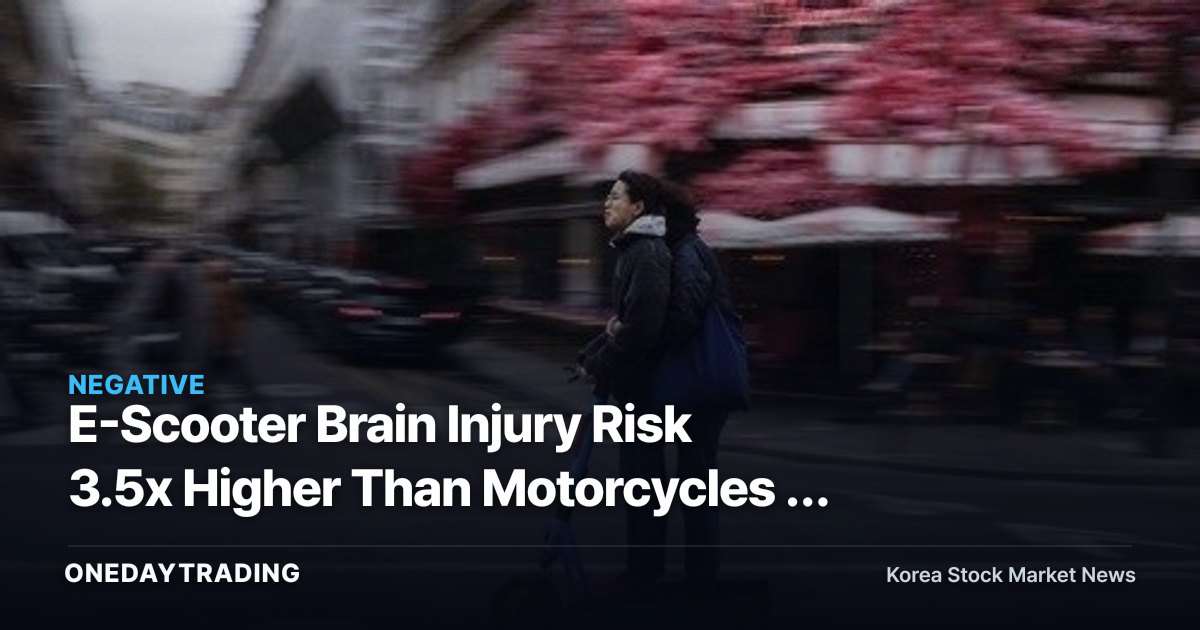
- A study analyzing more than 15,000 two-wheeled vehicle accidents in England and Wales between 2020 and 2022 found that e-scooter riders face a traumatic brain injury risk 3.5 times higher than motorcycle riders.
- The key point isn't the growth potential of eco-friendly mobility — it's the cost structure per accident. Helmet-wearing rates, speed limits, and insurance premiums are forcing platforms to recalculate their margins.
- For domestic investors, this issue spans shared personal mobility, non-life insurance, protective gear, and emergency medical demand all at once. Winners and losers don't move in the same direction.
What's Changing
Stock prices usually look at user numbers first. But what this data speaks to isn't traffic — it's the cost per accident. The intuition that e-scooters are slower than motorcycles didn't guarantee safety. When small wheels, a high center of gravity, and low rates of protective gear use combine, it's the manner of falling — not collision speed — that shakes the P&L. Put plainly: the eco-friendly short-distance mobility story told in press releases and the severe trauma shown in the data lead to entirely different valuations of the same business.
From a platform's perspective, revenue grows with usage volume, but so do accident probability and liability exposure. In particular, the finding that traumatic brain injury risk is 3.5 times higher than for motorcycles in moderate-to-severe trauma cases makes it harder for insurers to price e-scooters as a simple everyday mobility product. As mandatory helmet rules, nighttime operating restrictions, speed limits, and parking-zone enforcement tighten, convenience falls while operating costs rise. This is exactly where growth-stock multiples get cut.
Conversely, a small but clear demand emerges on the healthcare and safety-equipment side. Brain injury is a condition that extends from emergency CT scans and neurosurgical treatment through rehabilitation. Still, this single news item alone cannot be said to have directly boosted the earnings of medical device makers or helmet companies. What needs to be confirmed is whether regulation becomes mandatory and whether actual purchases follow. The data revealed the risk — it will take policy to generate the revenue.
Looking at the Numbers in Context
The study's sample covers more than 15,000 two-wheeled vehicle accidents in England and Wales between 2020 and 2022. E-scooter riders showed a traumatic brain injury risk 3.5 times higher than motorcycle riders and about 70% higher than cyclists. Motorcycles and bicycles may still account for a larger total number of accidents. But what matters for investment purposes isn't frequency — it's the cost per accident.
Helmet-wearing rates also help explain the cost structure. According to reports, only about 1 in 17 e-scooter riders wore a helmet. Even with the same impact, an unprotected head can turn what would have been a minor scrape into hospitalization, surgery, and long-term rehabilitation. Insurance premium rates directly reflect this tail risk. If platforms are required to bundle insurance and local governments mandate protective gear, the user base built on convenience runs into resistance from pricing and procedural friction.
Stocks to Watch: Winners and Losers
- Kakao: Has exposure to mobility platforms through Kakao Mobility. The impact is weaker than for direct e-scooter operators, but tighter PM regulation will raise the bar for partnership, insurance, and operating standards across mobility apps.
- Samsung Fire & Marine Insurance: Demand for personal mobility device insurance may grow, but loss-ratio calculation is the key issue. The more clearly brain injury risk is confirmed, the harder it becomes to compete on low premiums.
- DB Insurance: Product opportunities arise in the liability and accident insurance markets. However, if the severity of individual accidents is high, underwriting discipline — not growth — becomes the key stock-price variable.
- Hyundai Marine & Fire Insurance: A candidate for expanded coverage of everyday mobility devices. Even as platform-affiliated insurance products increase, actual profitability depends on accident rates and reinsurance terms.
- Protective gear and helmet distributors: Sales volume could rise if regulation becomes mandatory. However, few listed domestic companies have significant pure-play exposure, so investors should be wary of thematic overheating.
Risk Check
- Overseas research results cannot be directly applied to domestic accident rates. Road conditions, enforcement intensity, rider age, and the share of drunk riding all differ.
- If regulation tightens, it creates opportunity for insurance and protective gear, but PM platforms may see a decline in usage first.
- Direct exposure among listed companies is low. Trading related stocks may carry a weaker link to actual earnings than their sensitivity to news would suggest.
- If helmet mandates aren't actually enforced, demand for safety gear will also fall short of expectations. Enforcement matters more than the law itself.
Bottom Line
E-scooters' 3.5-times brain injury risk is data that attaches insurance premiums and regulatory costs to the mobility growth narrative. The next indicators to watch are domestic PM safety measures, the debate over mandatory helmet use, and insurers' loss ratios on related products.
Kakao: Real-Time Data Snapshot
Kakao's most recent closing price was 38,300 won (+0.39% versus the previous day), and the signal combining foreign and institutional order-flow (supply-demand) with news and momentum reads 🟢 Buy-leaning. Foreign investors, institutional investors, news, and momentum are all positive, making this a stock worth watching.
- ▲ Order-flow continuity — Foreign investors have been net buyers for 9 straight days (+1.4 billion won)
- ▲ Dual buying — Foreign investors +1.4 billion won · institutional investors +0 won, buying in tandem
- ▲ Trend alignment — Short- and medium-term trends aligned upward (same-day +0.4% · 1-week +8.5% · 1-month +7.6%)
- ▲ News flow — 3 positive catalysts vs. 0 negative catalysts — positive catalysts lead
Recent related news comprises 3 positive catalysts and 0 negative catalysts, a favorable mix.
※ Price and foreign/institutional order-flow data are provided by Korea Investment & Securities (KIS), as of the time of publication.
This article is automatically summarized and analyzed content based on the original news report. View original (Yonhap News Industry)