
At a Glance
The key issue for Illumina investors now is not its S&P500 inclusion itself, but whether actual usage can keep pace with the stock's 66% gain this year. Its high market share and $200-per-genome sequencing cost demonstrate formidable barriers to entry, but turning that technological strength into profit depends on reagent consumption and software usage after instruments are installed.
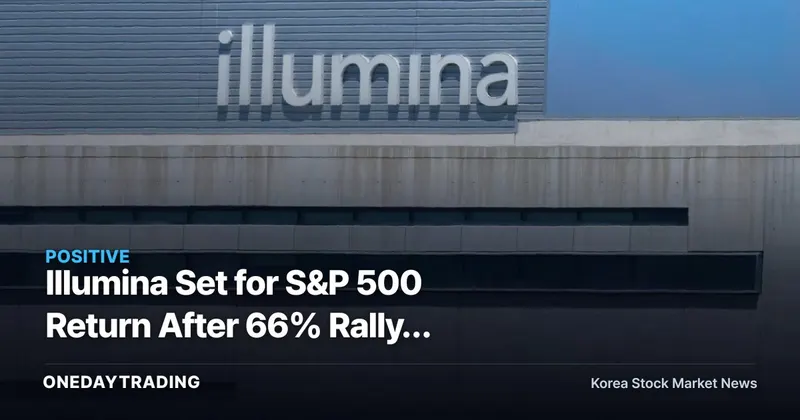
According to Maeil Business Newspaper Securities, Illumina is scheduled to rejoin the S&P500 on September 21 local time. The stock, which traded around $107 when it was removed from the index in 2024, has recently climbed to about $218, giving the company a market capitalization of $33 billion. Index inclusion is a scheduled catalyst; after that, core-business figures will drive the assessment.
Why It Matters Now
NGS stands for next-generation sequencing, a technology that reads DNA fragments in parallel to rapidly analyze vast amounts of genetic information. According to the U.S. National Human Genome Research Institute, sequencing one human genome cost $100 million in 2001. Illumina's latest flagship system, NovaSeq X, offers a cost of $200.
For investors, this gap says more about throughput economics than the testing price itself. As the cost per analysis declines, the same research budget can cover more samples. If hospitals, diagnostic laboratories, research institutions, and pharmaceutical companies increase the number of analyses they conduct, instrument placements can generate recurring demand for reagents and software.
The confirmed advantage today is Illumina's market position. Maeil Business Newspaper Securities reported that the company holds about 80% of the global NGS instrument market and roughly 90% of the South Korean market. The available information does not include growth in analysis volumes, reagent revenue, or operating margin. The $200 technical cost alone is not enough to calculate future profit.
Key Issues
- Index inclusion: Illumina was named to the list of new S&P500 constituents alongside Bloom Energy and Everpure. The effective inclusion date is September 21, and it should accurately be described as scheduled until the addition is completed.
- Precision-medicine demand: Illumina equipment was used to identify patients' genetic information during Moderna's cancer-vaccine development process. Illumina supplies equipment to Personalis, Moderna's diagnostic-testing partner.
- Customer ecosystem: JPMorgan surveyed 62 life-sciences laboratory and clinical professionals this year, and respondents expected to remain within the Illumina product ecosystem and anticipated future market-share gains. The 62-person survey indicates customer preferences but is not shipment data proving actual orders.
- Competition in China: China is pursuing domestic production of NGS equipment, led by MGI Tech. Although its ban on Illumina equipment imports has been lifted, U.S.-China relations and the spread of domestic alternatives remain separate risks.
Impact on Related Stocks and Sectors
- Illumina: Its high market share raises the cost for customers of switching from existing analytical methods and equipment ecosystems. The earnings impact of this development depends not only on new instrument sales but also on reagent consumption and software usage across the installed base. If utilization recovers in the next earnings report, the valuation case after index inclusion will strengthen.
- Moderna: Clinical results for its cancer vaccine demonstrate how patient-specific genetic analysis can be used in drug development. Illumina shares rose 9% on the 19th of last month, when Moderna announced Phase 3 trial results. This reflects the market's reaction but does not establish the scale of vaccine commercialization or the number of future tests.
- Genomic-analysis equipment: Thermo Fisher Scientific and Roche are challenging Illumina in its market. If competing products improve their pricing, performance, and compatibility with existing research environments, Illumina could face pressure on sales terms and profitability even if it retains its roughly 80% share.
Investment Considerations
- Investors should assess the stock's 66% gain this year separately from its scheduled September 21 index inclusion. Higher trading volume around the inclusion date may reflect index-tracking trades rather than business demand.
- NovaSeq X's $200-per-genome figure is a cost metric for the sequencing technology. It is neither the final testing fee paid by consumers nor Illumina's profit per test.
- Extrapolating a single Moderna cancer-vaccine case to overall precision-medicine demand could produce significant errors. Progress toward commercialization, real-world testing procedures, and rising analysis volumes would provide stronger evidence for expansion of the equipment ecosystem.
- If China tightens import restrictions again or expands the shift to domestic equipment, both sales and growth of Illumina's installed base could be disrupted. Investors should review management's comments on the China business and changes in competitors' market shares in the next earnings release.
Overall Outlook
In the bullish scenario, the number of genomic analyses rises in cancer testing and personalized drug development, while existing customers remain within the Illumina ecosystem. If instrument utilization drives reagent consumption, the company's roughly 80% market share will underpin more recurring revenue. S&P500 inclusion is a short-term catalyst that adds investor demand to this process.
The downside stems from elevated expectations and unproven utilization. The stock has recently traded at more than twice its level when Illumina was removed from the index in 2024, but the article provides no figures for instrument shipments or reagent-revenue growth. After September 21, the next earnings report's instrument shipments, utilization levels, reagent demand, and China-business trends will determine the outlook.
Frequently Asked Questions
What does Illumina do?
Illumina supplies equipment, reagents, and software used to read DNA sequences. Its customers include hospitals, diagnostic laboratories, life-sciences research institutions, and pharmaceutical companies. Rather than developing drugs directly, the company provides infrastructure for research and diagnostics.
When will Illumina rejoin the S&P500?
According to S&P Global's announcement, Illumina is scheduled to join the index on September 21 local time. A constituent from 2015 through 2024, Illumina will return to the list roughly two years after its removal.
What does the $200 DNA-sequencing cost mean?
It refers to the technical cost of reading the sequence information of one genome using NovaSeq X. It does not mean that an individual pays a final testing price of $200 or that the company earns $200 in profit per test. Investors should watch whether lower costs lead to higher actual analysis volumes and reagent usage.
Illumina Key MetricsAs of 2026-09-08
| Period Return | 1 Week +1.22% 1 Month +12.65% |
|---|---|
| Trading Value · Trading Volume | 1,748,198 shares |
Price and supply-demand (order flow) data are real-time figures from Korea Investment & Securities (KIS), while supply-demand (order flow) and news-tone metrics are calculated independently by OneDayTrading.
Supply-Demand (Order Flow) and Momentum Assessment🟡 Neutral · Wait and See
Positive and negative signals are mixed, suggesting a wait-and-see stance.
- ▲52-Week Position91% of 52-week range — near record-high territory
This article was automatically summarized and analyzed based on the original news report. View original article (Maeil Business Newspaper Securities)